

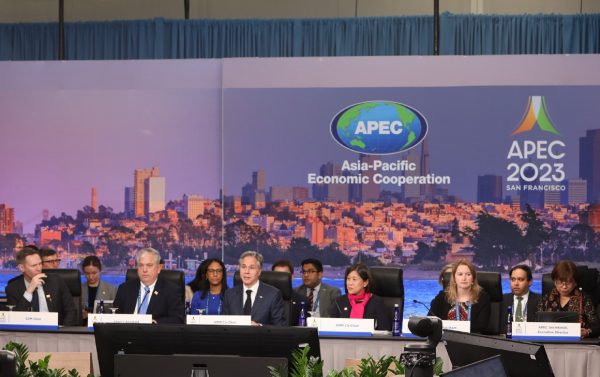
For the United States, the November meeting of APEC was widely seen as an opportunity to demonstrate its leadership and long-term commitment to the organization and the Asia-Pacific region. It was expected that a key part of this would be the announcement of substantial agreement and progress on the Indo-Pacific Economic Partnership for Prosperity (IPEF).
IPEF had been triumphantly announced at the May 23, 2022, Tokyo meeting of the Quadrilateral Security Dialogue (Quad). It was billed by the United States as the first of a new form of trade platform aimed at non-tariff barriers, benefiting workers, supply chains, and competition with China.
The grouping comprises four pillars: trade; supply chains; clean energy, decarbonization, and infrastructure; and tax and anti-corruption. Each of these areas would be the focus of negotiations on separate agreements, which any IPEF member could opt into (or out of). While it all sounded highly aspirational — albeit lacking in detail — 13 regional countries signed up for the initial launch: Australia, Brunei, Fiji, India, Indonesia, Japan, South Korea, Malaysia, New Zealand, the Philippines, Singapore, Thailand, and Vietnam. Eleven of those 13 are members of APEC (with Fiji and India as the only exceptions).
The November 2023 APEC summit was supposed to be a celebration of IPEF’s achievements. However, APEC was overshadowed by the intense focus on the summit between Chinese President XI Jinping and U.S. President Joe Biden, as well as the very clear lack of agreement of members with the U.S. position on the Russia-Ukraine and Israel-Palestine conflicts – reflected in the remarkably carefully worded concluding APEC statement.
In some ways this diversion was perhaps welcome, because it shifted attention away from the serious weakening of the IPEF announcement arising out of failure by the Biden administration to obtain the necessary Democratic and congressional support for the agreement on the trade pillar.
While it was possible to announce substantial progress on the other three pillars, much in these agreements is nonbinding and generally non-controversial among signatories, particularly given how the proposals relate to the progress of existing regional agreements and the limited level of initial commitment that signing involves.
The failure of the IPEF trade pillar sends a clear message to signatories and APEC as a whole. This has to be seen in terms of how both the United States and regional Asian governments perceive the merits of its trade provisions.
First, there was less than enthusiastic support at the outset for the entire agreement in the Asia-Pacific. It is certainly no replacement for the Comprehensive and Progressive Agreement for Trans-Pacific Partnership (CPTPP), which the United States has refused to consider joining since withdrawing from its predecessor agreement. Many IPEF members are likely to have signed up because they had no wish to antagonize the United States, rather than out of the expectations of concrete benefits.
Even so, the various Southeast Asian members, especially Indonesia and Vietnam, were disappointed by the standstill in access to the U.S. market, despite being required to accept binding commitments on higher domestic standards for labor and the environment along with former being enforced by a dispute settlement mechanism similar to the U.S.-Canada-Mexico free trade accord.
Without a quid pro quo, it would be difficult for Southeast Asian governments to justify joining the trade deal. Typically, binding commitments on higher non-trade standards come with tariff concessions and removal of non-tariff barriers, which may be re-imposed should partner countries fail to enforce new standards. Southeast Asian government might have been willing to accept meaningful non-market access incentives – such as incentives for technology transfer and investment – but these were not on offer, either.
For Jakarta, another unresolved area of contention involves the large “green” subsidies available under the U.S. Inflation Reduction Act to American businesses, a policy that threatens to undermine competitors from less financially powerful economies.
Southeast Asian governments’ skepticism was likely reinforced by high expectations derived from their constructive experiences in other, more open regional trade agreements not involving the United States – including the Regional Comprehensive Economic Partnership (RCEP). Additionally, four of the IPEF Southeast Asian economies also participate in the even deeper market-opening CPTPP.
In line with these developments, Southeast Asian economies are increasingly prioritizing deals with their fastest growing and principal trade partner: China. In bolstering these expectations, at a dinner in San Francisco shortly following the APEC summit, Chinese President Xi Jinping announced plans to join the CPTPP by aligning with its standards, in addition to expanding a worldwide network of high-standard free trade regions.
Beyond all these IPEF-specific concerns is a bigger issue. Regardless of the assertions of the Biden administration, the fact that domestic politics stymied IPEF reflects a failure to prioritize and casts doubt on U.S. support and commitment to the region (and APEC). The current limited levels of support for Asia-Pacific trade engagement might well fade with the next administration – as it did under former President Donald Trump.
More widely, behind all this lurks the suspicion that the United States has lost interest in APEC as a regional body. Many governments both inside and outside of the region view the organization as lacking any capacity to initiate significant regional development and change.
While some member governments may see APEC as fulfilling certain important coordinating roles, as with the Conference of the Parties (COP), and in lobbying for World Trade Organization (WTO) reform, its value is perceived increasingly in terms of sideline meetings, floating of ideas, networking for business connections, and general regional interaction of members – not least with China, Taiwan, and the United States as high-profile members.
The world has changed since 1989, when APEC was founded. The very significant roles that it played in establishing regional trade and technology arrangements have been overtaken by a wide range of bodies that have gained prominence since the end of the Cold War, including ASEAN, ASEAN+3, RCEP, and CPTPP, and rising new geoeconomic and geopolitical forces.
There is also concern that the United States has no vision for the Asia-Pacific or its broader and more recent strategic conceptualization in the form of the Indo-Pacific, only seeing each through the lens of its China policy. In this regard, the region has become the central arena for the playing out of intensifying China-U.S. rivalry, largely involving member countries as vehicles for Washington’s policies of containing Chinese economic and political advancement. This involves pushing back on China’s regional and global roles and putting pressure on countries to choose sides while maintaining or reasserting U.S. regional leadership,
It is clear that as a result of the IPEF trade pillar failure at APEC, the United States will need to re-double its efforts in making progress over the next year, if it still hopes to elevate IPEF as a key institution for the advancement of trade among its signatories and the broader APEC membership.
It is also clear that Southeast Asian countries are willing to continue negotiations of the IPEF trade pillar, and they will be crucial to its future prospects. These largely developing nations have strategically crafted their capabilities in pooling sovereignty to forge new multilateral institutions and agreements over the recent decade. Now they are increasingly taking center-stage in breathing new life into sometimes failing or stalled international agreements, just as was the case with both RCEP and the CPTPP at one stage. Equally, in terms of IPEF’s defunct trade pillar, its Southeast Asian member states are likely to be at the helm of driving forward an inclusivist, broader regional trade agenda.