

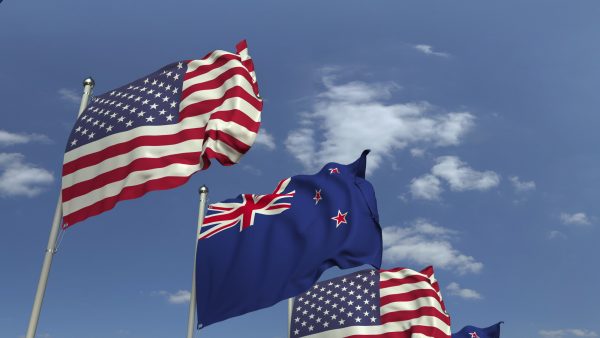
In the academic field of international relations, New Zealand occupies a role of some distinction as a “trading state,” alongside such economic powerhouses as Germany, Singapore, and South Korea. The trading state concept was first articulated by Richard Rosecrance in his 1986 book “The Rise of the Trading State.” Rosecrance made the argument that trading states recognize that “they can do better through internal economic development sustained by a worldwide market for their goods and services than by trying to conquer and assimilate large tracts of land.”
Former New Zealand Prime Minister Robert Muldoon (1975-84) would have agreed with Rosecrance. In 1980, Muldoon made the observation that “our foreign policy is trade. We are not interested in the normal foreign policy matters to any great extent, we are interested in trade.” But Muldoon was a shrewd, if controversial, politician who was fully aware that trade occurs in a geopolitical context. And the geopolitical context of 2023 differs markedly from the heyday of globalization between 1991 and 2016, when the idea of an international rules-based order enjoyed pride of place in the liberal democratic world.
This reality was underlined by then-Prime Minister Jacinda Ardern at Sydney’s Lowy Institute in July of last year, when she summed up the reality of present-day world politics with the statement that “it’s grim out there.”
The international rules-based order has always been more an aspiration than a reality. China, the antithesis of a liberal democratic state, joined the premier rules-based institution, the World Trade Organization (WTO), in 2001. The U.S. Trade Representative Office’s various annual reports on China’s record in the WTO, stretching from the George W. Bush to Joe Biden administrations, show in copious detail how Beijing shrewdly circumvented the spirit and the letter of the WTO’s rules. Let’s be clear, however: China is not an aberration. Many illiberal states have done quite well in the supposedly rules-based era. Some are even informal U.S. allies: Saudi Arabia, Egypt, and the United Arab Emirates.
In short, the aspiration for an international rules-based order clashed against the rocky shoals of world politics well before Donald Trump was able to advance his “America First” policies as U.S. president, which included withdrawing the United States from the Trans-Pacific Partnership economic agreement.
Where does the New Zealand trading state stand as the country enters its 2023 general election season? New Zealanders recognize that as a small state in the international system, the country needs to trade to survive and thrive. This explains why Beijing’s Marxist-Leninist political system has not been a barrier to China becoming New Zealand’s top trade partner since 2017. And according to a major 2022 study commissioned by the New Zealand China Council, New Zealand’s China-related trade actually increased during the COVID-19 years. Notably, in 2021, China and New Zealand signed an upgrade to their 2008 free trade agreement.
That said, a clear gap exists in New Zealand’s trade portfolio. Wellington has free trade agreements with Australia (since 1983), China (since 2008), the U.K. (since February 2022), and has one pending with the European Union (negotiations concluded in June 2022). And New Zealand is a signatory to several multilateral free trade agreements, most notably the Comprehensive and Progressive Trans-Pacific Partnership and the Regional Cooperation Economic Framework.
Conspicuously, there is no New Zealand-U.S. free trade agreement. This is not for lack of effort. In October 2002, then-U.S. Trade Representative Ambassador Robert Zoellick announced Washington’s backing for a free trade agreement with both New Zealand and Australia. While the U.S.-Australian Free Trade Agreement was signed on January 1, 2005, the New Zealand FTA was a casualty of differences over the U.S. intervention in Iraq. In May 2003, the U.S. embassy in Wellington stated that the Bush administration was not prepared to enter negotiations “at this time,” even as it left open the prospect for future negotiations.
That future has arrived. Indeed, if not now, then when? A New Zealand-U.S. free trade agreement makes sense for both countries, and the reasons are as much political as they are economic.
Consider New Zealand’s current strategic circumstances. Wellington needs to balance the imperative to increase trade even while taking actions to bolster its sovereignty to obviate pressure or even outright coercion. This is not an abstract concern. There is a clear track record in China’s foreign policy that makes trade diversification a national security issue for New Zealand. And the way to address the vulnerabilities created by trade is by reducing the country’s relative as opposed to absolute levels of trade exposure with China, where there is still room for growth.
Some might ask, is this mission impossible? Fortunately not. The Japanese, Singaporean, and Vietnamese relationships with China are instructive examples of states having long-standing robust trade with Beijing while simultaneously maintaining an independent foreign policy.
There is a compelling reason for New Zealand to study these states’ diplomacy with China. It is hardly a secret that a feature of Xi Jinping’s leadership tenure (2012-present) has been China’s increased proclivity to selectively wield economic, diplomatic, and military sanctions when its values and interests have been challenged. China has practiced what strategists call “coercive diplomacy” against New Zealand’s sole treaty ally (Australia), its regional partners (Japan, South Korea, and various ASEAN states), a European liberal democracy (Norway), and even a fellow Marxist-Leninist state that is an alliance partner (North Korea).
Australia drew Beijing’s ire after the Scott Morrison government called for an independent inquiry over the origins of COVID-19. Tariffs were enacted and remain in place today, even after Anthony Albanese’s election in May 2022.
Some of Wellington’s key regional partners have felt the sharp end of Chinese power. South Korea came under pressure from Beijing in 2017, after Seoul allowed its U.S. alliance partner to station missiles on South Korean territory to defend itself against North Korea. Then, there are China’s well-chronicled sovereignty disputes with Japan in the East China Sea, as well as a number of Southeast Asian states in the South China Sea.
And from 2010-16, Norwegian exports were sanctioned by China after the independent Nobel Committee’s decision to award to Chinese human rights and democracy advocate Liu Xiaobo the Nobel Peace Prize in 2010. Finally, China has signed on to successive rounds of United Nations Security Council sanctions against its alliance partner North Korea over its pursuit of nuclear weapons.
For New Zealand, then, the imperative to increase trade with other partners is clear. What’s in it for the United States?
Increasing China-U.S. rivalry has heightened the imperative for Washington to double down on engagement with states in the Indo-Pacific region that are not formal allies. A window of opportunity presents itself for the United States to further improve its relationship with partners such as New Zealand, to advance both states’ fundamental national interest in incentivizing China to focus on cooperating to stabilize the Indo-Pacific region.
In reaching out to Wellington, Washington would be pushing against an open door. China’s post-2020 coercive diplomacy against New Zealand’s treaty ally Australia has driven home to Wellington the reality of regional concerns about trends in Chinese foreign policy in ways that no amount of high-quality U.S. diplomacy ever could. And these concerns have been compounded by China’s projection of power into the Pacific Islands region, and in particular, Beijing’s high-profile overtures to Solomon Islands in 2022.
The timing is right for a push for a New Zealand-U.S. free trade agreement. U.S. relations with New Zealand have quietly experienced a renaissance in recent years. On the economic front, the United States is currently New Zealand’s third largest trading partner and its largest market for services. This builds on the longstanding security cooperation exemplified in discreet intelligence cooperation that occurs through the Five Eyes grouping.
The relationship is also expanding into new fields. Cooperation on space-related issues has occurred through the Artemis Accords. Leveraging New Zealand’s favorable geography for satellite launches, New Zealand’s Rocket Lab has cooperated with various U.S. government units, including the National Reconnaissance Office and the National Aeronautics and Space Administration, which helped launch rockets from the Mahia Peninsula on New Zealand’s North Island.
U.S. President Calvin Coolidge (1923-29) is known for his comment that the “business of America is business.” That sounds a lot like a U.S. version of Robert Muldoon. Why not take the next step and work out a New Zealand-U.S. free trade agreement? Now is the time for action.