

After public school teacher Gary Keblish was diagnosed with melanoma in 2019, a surgeon cut out the tumor. But he wasn’t out of the woods. In some patients, melanoma aggressively recurs after surgery, so his doctors referred him to a new trial: For Merck and Moderna’s personalized mRNA cancer vaccine.
Speaking by video at the STAT Summit on Thursday, Keblish compared the journey — in all its physical and emotional turbulence — to a trip on Ms. Frizzle’s Magic School Bus. “Seatbelts, everyone!,” he said, quoting the iconic line.
He’s glad he went. Today, he is still teaching, and Merck and Moderna are preparing to file the vaccine for approval, after announcing in August that it significantly delayed both cancer recurrence and the development of metastatic disease in melanoma patients like Keblish, in a large Phase 3 trial.
It’s a landmark moment for a cancer vaccine field that has long struggled to live up to its hype. But the two companies’ work is far from complete. They are now looking to prove the vaccine isn’t just a powerful tool for certain melanoma patients but that it can also transform a sea of other tumors, as an early generation of immunotherapies did.
It is careful and costly work.
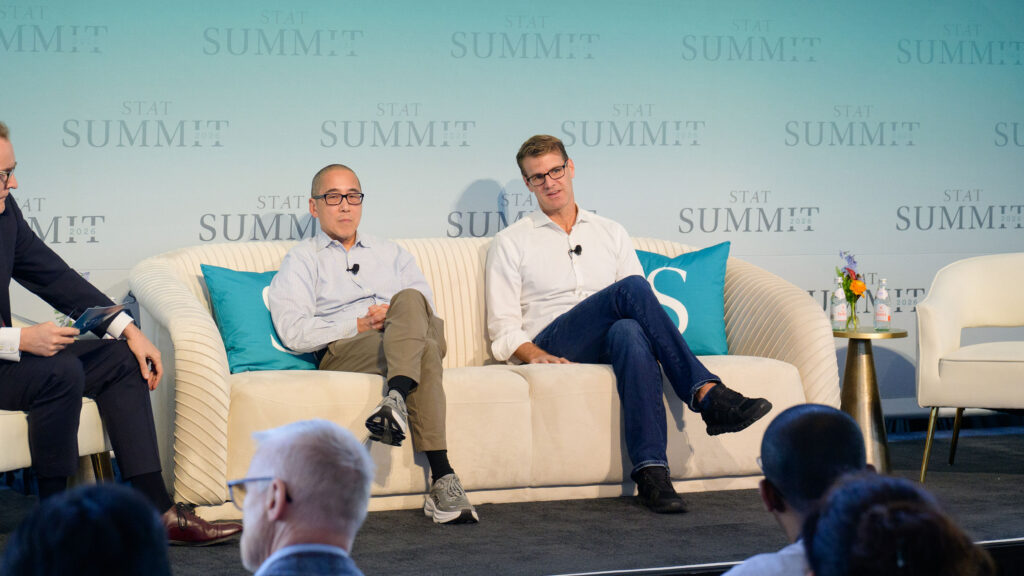
“We have a lot of exploring to do and need to prioritize where we explore,” Moderna President Stephen Hoge said on stage at the summit.
Beside Hoge, Merck R&D chief Dean Li outlined an exploration strategy. The vaccine, known chemically as intismeran autogene, works in combination with Merck’s blockbuster immunotherapy Keytruda, which has been tested in thousands of trials over the last 15 years. Keytruda works better in some tumors — so-called hot tumors, which often have lots of mutations — than other, so-called cold tumors.
“We know exactly where I-O [immuno-oncology] works, where a checkpoint inhibitor works, where it doesn’t, where it almost worked and didn’t make it,” said Li.
The pair have largely focused to-date on settings where Keytruda has worked best, such as an adjuvant — add-on — therapy for melanoma patients whose visible tumors have already been removed by a surgeon. They are already running trials in adjuvant lung, kidney and bladder cancer.
Li and Hoge suggested other settings they may explore or where trials are just beginning, including in tumors where Keytruda failed but another kind of immunotherapy worked, or as a standalone therapy in very early stage tumors. “There’s an incredible opportunity to think about how we bring immunotherapy into earlier interventions and really intercept cancer so that we don’t present with stage three, stage four disease later,” said Hoge.
Li contrasted their approach with “other people” who “may not have the advantage” of their expertise and have chosen to go after cold or metastatic tumors — an apparent nod at Moderna’s mRNA rival BioNTech, which has some early promising early data but also notable failures.
“We have chosen not to do this,” Li said. “But I can tell you: Anyone has positive data and it’s out there, you will never see Moderna and Merck pivot [so] fast.”
Small tests in adjuvant pancreatic and gastric cancer are underway, to test the possibility. Li also floated the possibility of using the vaccine in patients whose metastatic tumors have already been shrunk by other treatments.
In the meantime, they continue to try to improve the technology. The vaccine is made by looking at individual tumors and using an algorithm to select up to 34 mutant proteins, in hope that you can then flash those as a “wanted sign” to the immune system.
The algorithm is imperfect. But by closely analyzing the immune systems of patients in their trials, Moderna and Merck could in theory build even better software.
“It’s a real privilege to have all that information across the now several thousand people in our phase three program,” Hoge said. “I’m looking forward to digging into it.”