

A new axis is emerging in the global race for resources, and the Indian Ocean serves as a bridge. It is emerging as a critical corridor linking Africa’s mineral wealth to Asia’s industrial ambitions. Africa sits at one end of a strategic corridor, and its minerals are becoming the new terrain of strategic competition.
The continent is home to critical minerals essential for the global energy transition, including 55 percent of the world’s cobalt, 47.65 percent of its manganese, 21.6 percent of its graphite, 5.9 percent of its copper, and 0.6 percent of its iron ore. Africa is already emerging as a priority in ongoing India-Japan discussions on economic security and supply chains and, as the India-Japan leaders’ recent summit and the subsequent India-Japan Joint Declaration on Economic Security Cooperation confirmed, it now sits squarely within the partnership’s formal architecture. Backed by the India-Japan Joint Economic Forum, a new JETRO strategic report, and renewed focus on the Asia-Africa Growth Corridor (AAGC), India and Japan are positioning themselves to deepen cooperation in critical minerals, digital infrastructure, healthcare, green energy, and resilient supply chains across the Global South, seeing it as an opportunity for the next phase of investment. At the heart of this push is Africa, where the race for critical minerals is reshaping economic partnerships into long-term strategic leverage.
Forging a Trilateral Partnership for Africa’s Critical Mineral Future
India and Japan recognize the world’s growing dependency on China for critical minerals. China controls roughly 90 percent of global rare-earth refining and has also achieved a monopolistic advantage in development aid programs in Africa. This realization comes at a time when the new Trump administration, through an executive order in January 2025, titled “Reevaluating and Realigning United States Foreign Aid” has suspended all U.S. foreign development aid, putting several welfare projects for African nations at risk. Given this situation, African nations are eager to diversify their partnerships.
In this context, India and Japan can step up to support Africa’s development in a sustainable manner. Institutional cooperation on Africa predates both the Free and Open Indo-Pacific (FOIP) and the AAGC. In October 2010, India and Japan held their first Dialogue on Africa in Tokyo, launched after the Japanese foreign minister’s visit to India earlier that year. The dialogue sought to coordinate the two countries’ approaches to Africa amid China’s expanding presence, highlighting Japan’s financial resources and India’s capacity-building model.
However, a significant triangular relationship is reflected in an MoU signed in June 2025 between Pensana Plc and Toyota Tsusho for rare earth offtake. Toyota Tsusho, the trading arm of Japan’s Toyota Group, committed to offtaking up to 20,000 tonnes per year of mixed rare-earth carbonate from London-listed Pensana’s Longonjo mine in Angola, with processing at Toyotsu Rare Earths India (TREI) in Visakhapatnam before final delivery to Japanese magnet manufacturers. This represents a significant step in developing a global rare earth supply chain and strengthening and diversifying the broader rare earth value chain.
Similarly, the Mozambique LNG project, worth roughly $20 billion and led by France’s TotalEnergies, includes two onshore trains capable of producing about 13 million tonnes per annum. Within the Mozambique LNG project, Indian companies, along with Japan’s Mitsui, are already working in tandem on a major energy project in Africa. Indian state-owned firms ONGC Videsh, Bharat Petroleum, and Oil India together hold a combined 30 percent of Mozambique LNG, while Japan’s Mitsui holds 20 percent. This model could also be replicated in mineral projects across East and Southern Africa. While Japan has financed the expansion of Kenya’s largest port in Mombasa, Indian companies have contributed to related logistics and trade facilitation. India and Japan are also working together to enhance road and rail connectivity in countries like Kenya, Tanzania, and Mozambique.
The principle underlining all of these engagements is that India provides ecosystem know-how, implementation capability, and processing capabilities, and Japan provides patient capital, technology, and industry standards. Above all, producers in Africa are the core of the resource base.
In February 2026, Japan hosted the Japan-India-Africa Business Forum in Tokyo, organized by the Ministry of Economy, Trade, and Industry (METI) along with Nikkei. It drew over 2,000 participants from 46 countries and regions. The forum was held to discuss collaborative efforts between the public and private sectors of Japan, India, and Africa. At the forum, Japan launched the Japan-India Cooperation Initiative for Sustainable Economic Development in Africa. The initiative aims to encourage Japanese companies to concentrate their industrial presence in India to boost trade with Africa. It also focuses on expanding private investment, job creation, technology transfer, and human resource development in Africa. Through the initiative, Japan and India aim to strengthen supply chains by integrating the growth markets of India and Africa into Japan’s economic activities, with a particular emphasis on value addition in key sectors such as critical minerals.
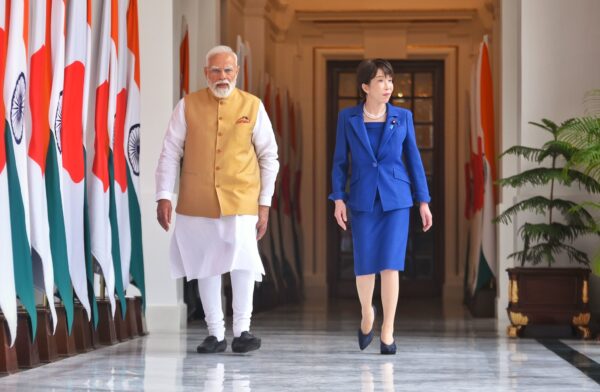
In July 2026, the 16th India-Japan Annual Summit was held in New Delhi during Japanese Prime Minister Takaichi Sanae’s visit to India. The Confederation of Indian Industry (CII) and the Japan External Trade Organization (JETRO) convened the India-Japan Joint Economic Forum, which brought together more than 150 Japanese and 80 Indian companies. The forum was notable for the explicit place it accorded to Africa within the India-Japan bilateral architecture, signaling an intent to move the relationship into effective third-country cooperation. Through these and other engagements – including the August 2025 Modi-Ishiba summit in Tokyo and the January 2026 18th India-Japan Strategic Dialogue in New Delhi – these two Indo-Pacific democracies have begun assembling a parallel, intersecting architecture for engaging Africa’s mineral economy.
India has been in talks with several African countries to acquire critical mineral blocks on a government-to-government basis. In August 2026, India resumed talks with Zambia to explore investment opportunities in copper and other critical minerals, as New Delhi looks increasingly overseas for raw materials to meet rising demand from its rapidly growing economy. In Africa, the Democratic Republic of Congo and Zambia in particular can play an important role in meeting India’s growing requirements for copper and cobalt.
Africa has become a crucial partner given India’s need to diversify energy supply sources to achieve its renewable energy and electric vehicle (EV) goals and the government’s “mines-to-magnets” industrial push. With demand expected to rise nearly fourfold by 2030, and near-total import dependency on lithium and high-purity rare earths, securing diversified offshore supply has become a national-security calculation. India’s mission to build a sustainable future depends heavily on critical minerals. New Delhi’s approach is not built on “extractive models” but rather on long-term capacity building, skill development, and technology transfer to ensure that African countries develop a self-sustaining growth ecosystem.
India’s historical ties, along with its experience in trade and project implementation in Africa, combined with Japan’s strengths in finance and quality infrastructure, can provide an alternative development model in Africa. Tokyo has also been working since the 2010 Chinese rare-earth embargo to engineer its way out of single-source dependency. Hence, this will be a model in which India serves as the industrial concentration and logistics hub for trade with Africa while Japan brings capital, standards, and processing technology.
From Architecture to Action: Making the India-Japan-Africa Partnership Work
The architecture of this partnership reflects solid progress, but design alone does not translate into delivery. While India wants to keep mineral processing at home, Africa, through the African Union’s Green Minerals Strategy and national plans, wants to keep it on the continent. Japan needs access to resources in both cases.
The ultimate test of an India-Japan-Africa trilateral partnership will be its capacity to turn agreements into tangible projects while accommodating the distinct and sometimes competing priorities of all three partners. A Joint Working Group could help bridge ambition and delivery. With no formal group yet established, however, its ability to do so remains untested.
Whether the existing efforts translate into concrete outcomes will depend on execution. This includes whether Japan’s commitment of 10 trillion yen ($68 billion) over a decade through the India-Japan Strategic Investment Pact of 2025, and the critical-mineral, green-ammonia, and pharmaceuticals priorities, convert into bankable third-country projects rather than another shared vision document. There is a deliberate attempt to re-anchor the India-Japan-Africa relationship in a more coherent institutional frame, routing this effort through FOIP rather than presenting Africa as a standalone strategy. In this framework, FOIP has become the umbrella vision under which Tokyo and New Delhi organize their joint external economic diplomacy, from Northeast India to the Indian Ocean to the African continent.
Japanese capital, India’s industrial and digital capabilities, and Africa’s demographic and market potential are increasingly complementary rather than separate strengths. The strategic question is whether these strengths can be integrated into durable investment and supply-chain partnerships. The real opportunity is to turn that complementarity into an economic architecture, one that moves India-Japan ties beyond diplomatic alignment and toward strategic co-investment. Africa is emerging as the arena where India-Japan diplomatic convergence could acquire real commercial weight.