

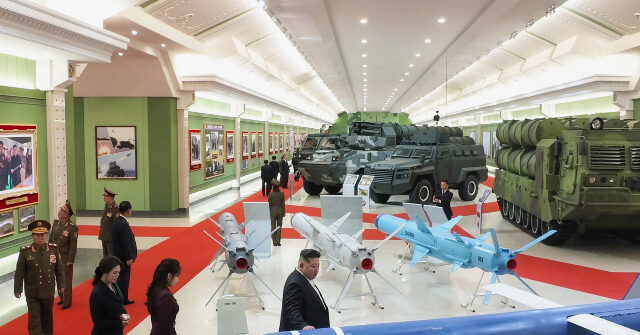
North Korean state media announced on Tuesday the opening of Pyongyang’s “National Defense Revolution Museum,” which features displays of some of the communist regime’s most potent known weapons, including the Hwasong-20 intercontinental ballistic missile (ICBM).
The Hwasong-20 made its debut in a parade last year, but the establishment of the museum will allow the regime to show it off to residents and high-ranking visitors at all times. It follows an enthusiastic boast by the country’s representative at the United Nations General Assembly last month of its illicit nuclear weapons program, in which the diplomat declared that the only reason a state of active war is not ongoing on the Korean Peninsula is North Korea’s decision to regularly violate international law and develop more nuclear and nuclear-capable weapons.
International observers suggested that having a museum for some of its most advanced weaponry will help North Korea develop propaganda to scare America, South Korea, and other enemies into negotiations and deter active hostilities. The North Korean government has set up similar exhibitions in the past – notoriously showcasing armed drones for then-Russian Defense Minister Sergei Shoigu in 2023 – but the National Defense Revolutionary Museum is expected to be a permanent fixture in the nation’s capital.
According to the state-run Korean Central News Agency (KCNA), dictator Kim Jong-un made an appearance on Sunday to celebrate the opening of the museum, declaring that it “intensively and intuitively show how the dignity and security of the DPRK [North Korea] and the happiness of its people are defended and how peace of this land is achieved.”
The continued existence of a communist North Korea, Kim declared, was itself “a priceless victory brought about by the tenacity, patriotism and loyalty of the people who unconditionally supported and encouraged the WPK’s [Workers’ Party of Korea] original line of self-defence and policy of defence development in the face of severe trials and difficulties.”
Kim also reiterated that North Korea’s military and defense industry were the “most powerful in the world,” a claim that he has repeatedly made during various public engagements while discussing his country’s nuclear program or its invasion of Europe on behalf of Russia, where North Korean soldiers are assisting with the ongoing invasion of Ukraine.
Photos of the new museum reportedly show a variety of “intercontinental ballistic missiles, hypersonic missiles and submarine-launched ballistic missiles,” according to South Korea’s Korea JoongAng Daily, which analyzed the photos. In addition to the Hwasong-20, a copy of the older model Hwasong-17 also appeared to be on display. It observed that KCNA was also willing to show details on the Hwasong-20, such as its information panel and its placement on a “transporter erector launcher.”
“The display appears intended to demonstrate that the missile has moved beyond the development stage and entered mass production,” JoongAng suggested.
Many of the most recent missile tests by North Korea appeared to highlight more short-range weapons – some of which were displayed in the new museum – and pose the most direct threat to neighboring South Korea and Japan. The prominent display of a late-model ICBM, which is believed to be able to reach the American mainland with a nuclear payload, has been interpreted as a message to Washington. Displayed with the missile, the South Korean news agency Yonhap observed, was an “explanation board describing the flight range of the new ICBM, encompassing the Middle East, Australia and South America.”
Kim has not displayed the Hwasong-20 for some time. The weapon made its debut almost exactly a year ago at a massive parade to mark the 80th anniversary of the ruling communist party, displayed before visiting diplomats from friendly states such as China.
North Korean officials have repeatedly rejected calls from the international community to abandon its illegal nuclear weapons program, instead asserting they will never give up the weapons and crediting their nuclear abilities with the prolonged survival of the 1953 armistice agreement that ended active hostilities in the Korean War.
Presenting before the U.N. General Assembly in September, Vice Minister for Foreign Affairs Kim Son Gyong declared that it was “obvious” that the tenuous peace in Korea was due to the North’s decision to forge ahead with nuclear weapons, much to the world’s outrage.
He claimed:
No physical conflict has occurred on and around the Korean peninsula, a hot spot of the world, and the security index is being maintained at a higher level than any other part of the globe. We owe it to the fact that the DPRK [North Korea] has a war deterrent in place powerful enough to break anyone’s will to start a war of aggression against the DPRK and that we are thoroughly containing and managing the hostile forces’ intention to use force. … No one can deny such an obvious fact.
North Korea has not had any known direct contact with the United States for years, though Kim Jong-un and his family have publicly maintained that, their distaste for America aside, Kim enjoys friendly personal relations with President Donald Trump. Trump himself has suggested on multiple occasions during his current term that he would be open to one-on-one conversations with Kim, but at press time no such summit has been scheduled.