

Get your daily dose of health and medicine every weekday with STAT’s free newsletter Morning Rounds. Sign up here.
Missed the first day of Summit, but want to tune into day two? Register here.
STAT Summit, Day 1
The first day of the STAT Summit did not disappoint. We had biotech’s biggest stars, the perils and promise of AI, and moving anecdotes from patients. Here are a few snippets of the day’s action.
- FDA heads sound off: In this extremely juicy panel, former Food and Drug Administration commissioners offered sharp criticisms of the current health regime and candid reflections about their own time at the helm. No agency was spared. As Rob Califf opined, “DOGE will go down as one of the biggest disasters in American history.” Read more from STAT’s Chelsea Cirruzzo.
- Whoop! (There it is): Whoop built its reputation as a wearable company mainly used by young, fit consumers. That may soon change. Whoop’s newly appointed Chief Medical Officer Ami Bhatt spoke about the company’s recent acceptance into Medicare’s ACCESS program, which would make their wearables available at no cost to many traditional Medicare patients ages 65 and up. What else did Bhatt say about AI and wearables? Read more from STAT’s Katie Palmer.
Ovaries don’t go gentle into that postmenopausal night
Ovaries stop having a clear function relatively early on in life. For decades, women carry around an obsolescing organ — but is nothing truly all ovaries do after menopause? New research from Northwestern University suggests the answer is no. In a study of healthy ovaries from 28 women aged 50 to close to 80, published on Wednesday in Aging Cell, researchers found that there were hundreds of proteins in the ovaries evolving in the decades after menopause.
“It wasn’t that there was just a cluster of proteins that are being turned on and they’re staying constant; we actually saw quite dynamic changes that were happening across this period of time,” said Francesca Duncan, a professor in the Department of Obstetrics and Gynecology and the study’s corresponding author. As they age, the ovaries’ tissue changes, showing increased inflammation as well as higher concentration of proteins associated with ovarian cancer. This doesn’t mean all aging ovaries will develop ovarian cancer, though it does raise the potential question “of whether or not at a certain point it actually could be beneficial to take your ovaries out,” said Duncan.
40%
Forty percent of high school students in the United States reported binge eating in the last month, according to a new government survey.
It’s the first time the biennial survey, conducted by the Centers for Disease Control and Prevention, has asked about binge eating, and the first data on disordered eating collected by the Youth Risk Behavior Survey in a decade. The high rates were striking, especially among young people of color.
Digging into the crosstabs, the survey found that binge eating was more prevalent among female than male students (19% versus 16%). It was also more common among Black (19%), Hispanic (20%), and multiracial (20%) students compared to white (15%) and Middle Eastern or North African students (10%).
Read more from STAT’s Sarah Todd about this striking survey.
The maddening journey to not to share patient data with Epic
Alex Rosenblat had a goal: stop her Ohio hospital from sharing her health data with Epic’s gigantic health network.
But when she logged into her MyChart account, there was no button to easily opt out. The simple-seeming request turned into an arduous task that would require scores of emails, multiple phone calls with Epic employees, a flight to Las Vegas, and a software update.
That was just one of three months-long journeys Rosenblat embarked on last year to keep her hospital from sharing her personal health data with outside vendors. Read on to find out why the researcher and reporter had to call a notary.
Kenya reports second Ebola case
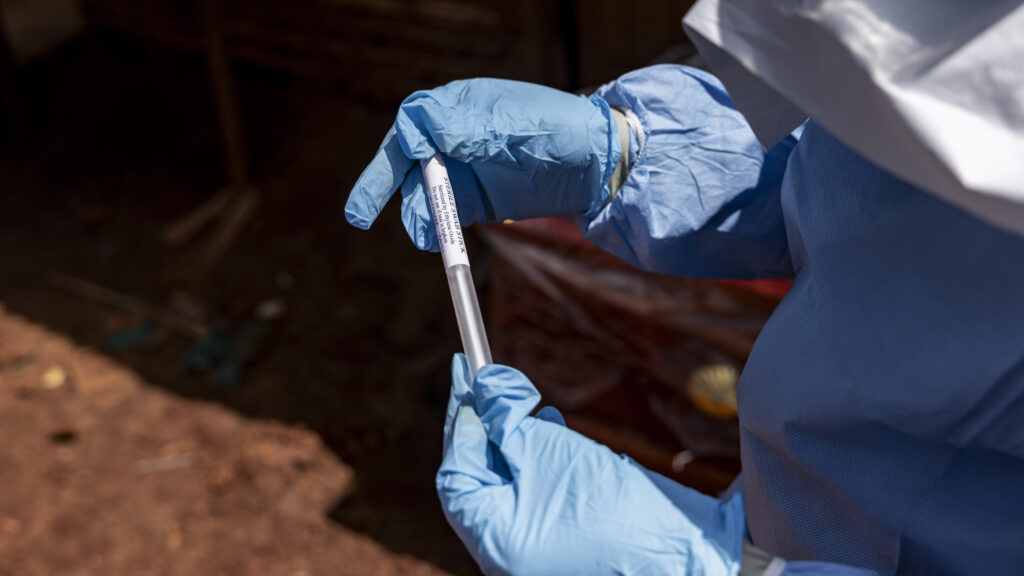
Another person has fallen ill with Ebola in Kenya. The 39-year-old man is a relative of the country’s first case and had already been in quarantine when symptoms appeared, according to Kenya’s Ministry of Health.
A World Health Organization official said Wednesday that despite the two cases, there was no evidence of an Ebola outbreak in Kenya. The initial patient — a Kenyan citizen — caught the deadly virus while living in Congo and died earlier this month. The Kenyan Ministry of Health identified 128 people who had been in contact with this patient; 108 are in quarantine, 5 have left Kenya, and 15 have not been tracked down. Tracing the second patient’s contacts has now begun.
The situation in Congo is still quite dire. Authorities have confirmed more than 4,000 deaths and 9,000 cases as officials have struggled to contain one the fastest-growing Ebola outbreak on record.