

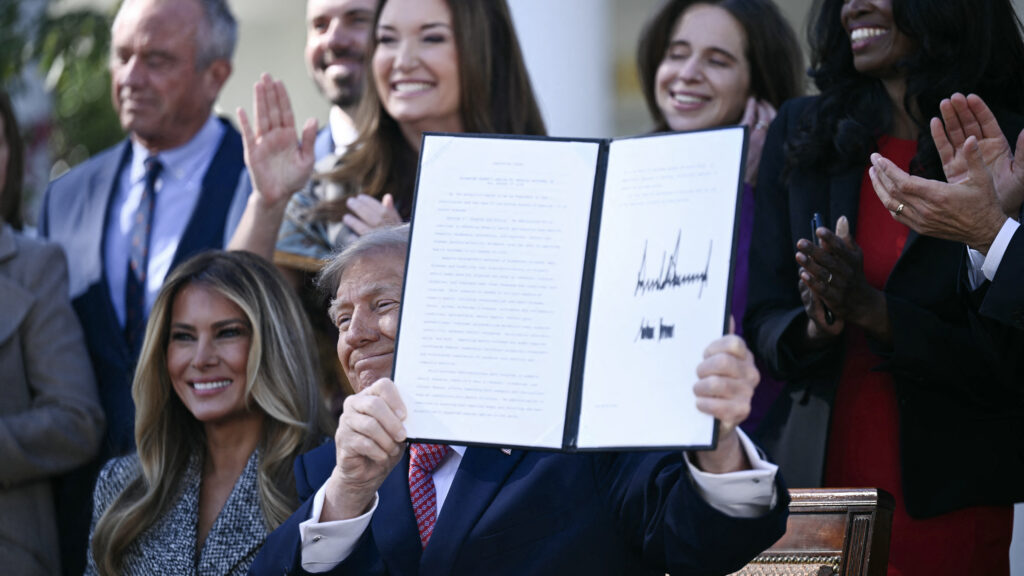
A new division in the National Institutes of Health and a new task force within the White House will advance the cause of women’s health, an executive order signed by President Trump promises.
“Beginning today, we will change the reality of women’s health,” first lady Melania Trump said in announcing the initiative Monday. “Our generation will fight to find the cures to ensure a woman can live her life with health and to the fullest.”
The new NIH division, to be set up within 90 days, is intended to streamline research into understudied diseases in women, advance innovation in diagnostics, and improve treatment, establishing “a new standard for women’s health,” the first lady said.
Funding for scientific research in general and women’s health in particular have come under fire since Trump returned to the White House. The Department of Health and Human Services will pay for the administrative costs of the task force, Monday’s order said, but details about the new NIH division, which does not replace the current Office of Research on Women’s Health, were not disclosed.
In June, Nicole Kleinstreuer, deputy director for program coordination, planning, and strategic initiatives at NIH, predicted a refresh of the NIH-wide strategic plan for women’s health research in the fall. Speaking at a Yale conference, she promised a new effort that “explicitly emphasizes innovative methods and technologies and data science to comprehensively prevent and treat conditions affecting women.”
Working with the NIH Office of Research on Women’s Health, the division would expand and coordinate research on understudied women’s health conditions across all stages of life, improve diagnosis and treatment, strengthen inclusion of women and girls in clinical trials, and increase accountability for considering sex as a biological variable in NIH-funded research, an NIH spokesperson told STAT on background.
The new task force, whose first session was set to convene Monday, will be led by White House chief of staff Susie Wiles, who recently completed a round of breast cancer treatment. Other members include cabinet secretaries such as Robert F. Kennedy Jr. and Pete Hegseth, acting FDA Commissioner Kyle Diamantas, and Erica Schwartz, newly confirmed director of the Centers for Disease Control and Prevention.
In remarks following the first lady, Trump recalled being surprised that there was no women’s health division with the NIH.
“Think of it: a women’s health division, and it hasn’t been done, but it’s been done under Trump” he said, appearing to go off-script. “When I heard about it, I said, ‘Are you sure they don’t have that? Who the hell wouldn’t have a women’s health division?’ Melania said, ‘They don’t have it.’”
Women’s health research has been a flashpoint since early in the second Trump administration, with scientists saying their work was in jeopardy because it fell in the blast zone of “gender ideology.” The word “women” in grants triggered special reviews at the NIH while the nation’s academic research was paralyzed by moves to slash funding or eliminate diversity mentions or both.
Academics and investors have been looking elsewhere. Chronic underinvestment in women’s health calls for new funding structures, Basmah Safdar, an emergency medicine physician and director of Women’s Health Research at Yale, a center within Yale School of Medicine, wrote in a Lancet commentary published Aug. 17.
“Reframing women’s health through a rigorous, biology-based framework corrects a health-care system built on incomplete science and missed opportunities,” she wrote.
That historical neglect places women at greater risk than men for adverse reactions to drugs, makes them more likely to die from undiagnosed stroke, and means they receive less effective treatments for chronic pain conditions, as summarized in a 2025 review published in Science Advances.
Women are seven times more likely than men to have a heart condition misdiagnosed or to be sent home from a hospital during a heart attack, a landmark study said in 2000. If women are admitted to a hospital, they are less likely to leave with prescriptions to reduce their likelihood of another cardiac problem, research presented in 2024 said. These and other factors add up to women being more likely to die after a heart attack.
“Despite amazing advances in medical science, many diseases and conditions that disproportionately affect women remain chronically understudied, but we’re studying that right now,” Trump said Monday.
STAT’s coverage of chronic health issues is supported by a grant from Bloomberg Philanthropies. Our financial supporters are not involved in any decisions about our journalism.