

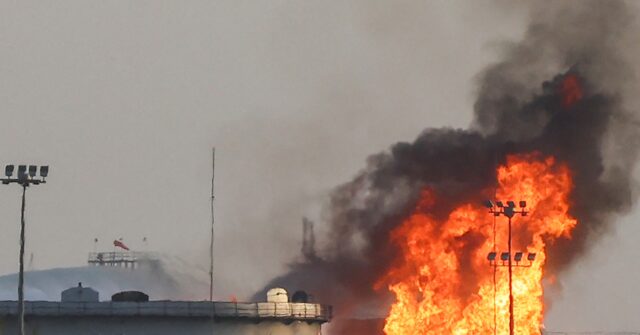
The armed forces of Saudi Arabia confirmed armed drones attacked Riyadh on Tuesday, presumably deployed by the Iran-backed Houthi terrorists of Yemen and intending to target civilians in the national capital. The drones were reportedly destroyed before they could cause any damage.
The attack nonetheless continued an onslaught of attempted Houthi bombings of Saudi civilian sites that has persisted for much of the past month, so far peaking with the horrifying missile attack on King Khalid International Airport on Saturday.
That attack killed at least 13 people and injured over 300, causing massive destruction to commercial flight gates.
The Houthis, a Shiite jihadist terrorist organization supported by the Iranian terror state, has technically been at war with the government of Yemen and its Saudi allies for over a decade, seizing control of the national capital, Sana’a, in 2014. A ceasefire between the Saudis and Houthis paused hostilities from 2022 to 2026 but ended amid the ongoing conflict between America and Iran, as the latter activated Houthi forces to disrupt global shipping in the Bab el-Mandeb Strait, the waterway leading into and out of the Red Sea.
The latest attack, according to anti-Houthi Saudi coalition spokesman Maj Gen Turki Al Malki, consisted of three drones heading towards Riyadh, which the coalition successfully intercepted. The Emirati newspaper The National noted that Saudi state media did not identify the Houthis as the attackers, but the development followed the trend of Houthi attacks on Saudi Arabia in the past month. This drone attack followed a similar announcement by the coalition on Monday that the Houthis had launched various ballistic missiles at Riyadh and the city of Khamis Mushait which were also successfully intercepted. Saudi authorities on Monday declared the current threat concluded, though they discouraged spontaneous mass gatherings.
On Sunday, Saudi Arabia’s General Authority of Civil Aviation (GACA) confirmed an attack on King Fahd International Airport in Dammam, which did cause some unspecified damage, though less than the King Khalid Airport attack the day before.
The campaign against the nation’s capital has created a tense atmosphere among civilians trying to live their regular lives in Riyadh, The National reported on Tuesday. The city has implemented “virtual learning” for its schools to eliminate schools as missile targets and some companies have reportedly told employees they could work from home – a novel implementation of policies first developed to stop the spread of the Wuhan coronavirus during the 2020-2022 pandemic. The Emirati newspaper reported that road traffic also appeared relatively active during rush hour and mass gatherings such as sporting events have not yet been canceled.
“We could hear loud explosions from time to time, but the situation was worse for those living near the airport,” one office worker told The National from his office.
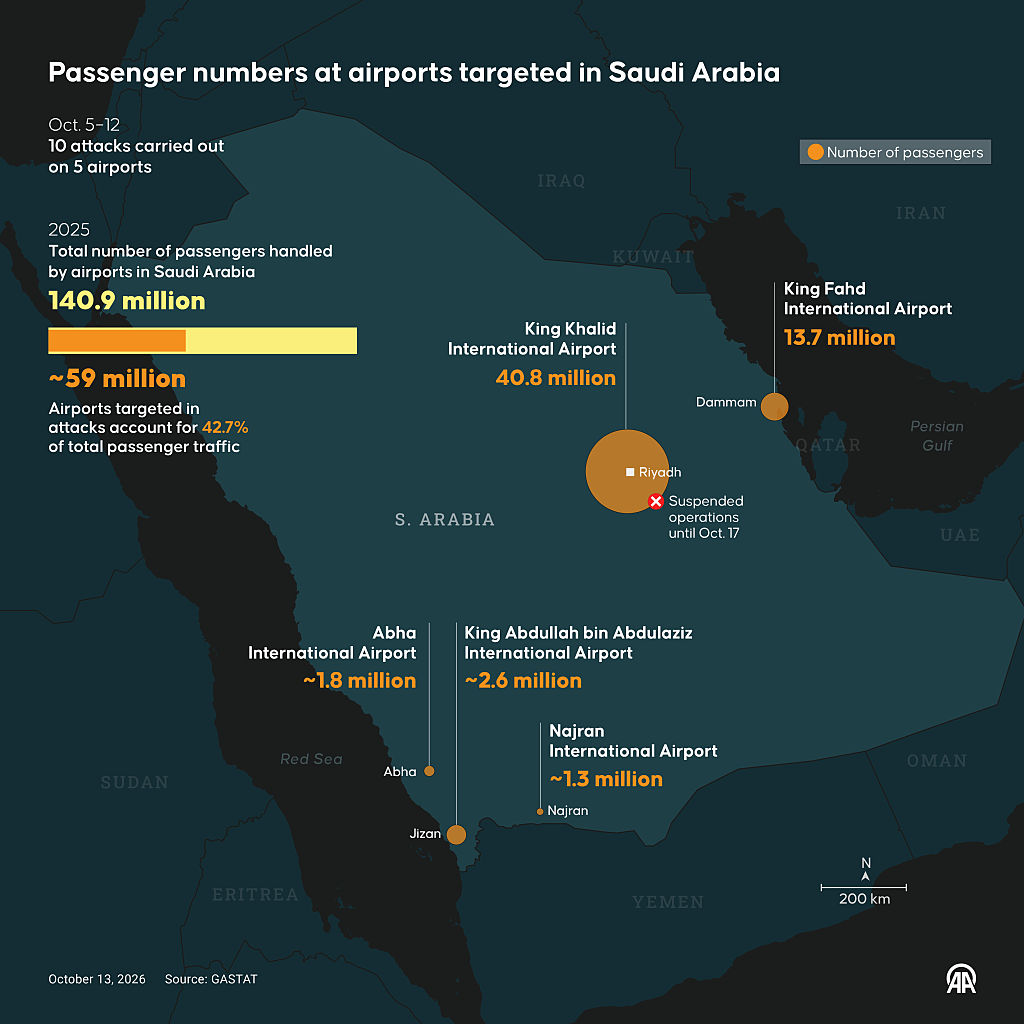
Passenger numbers at airports targeted in Saudi Arabia on October 13, 2026. (Kadri Suat Celik/Anadolu via Getty Images)
The attacks have persisted despite suspected Saudi military action against the Houthis in Yemen. Houthi leaders denounced airstrikes attributed to Saudi fighter jets and warned that any direct attack on Sana’a would trigger an escalation in the targeting of key economic and civilian sites in the country.
“The Yemeni Armed Forces [the Houthis, sic] warn the Saudi enemy that any attacks on the capital, Sanaa, will be met with a harsh and painful response in the Saudi enemy’s capital, Riyadh,” Houthi spokesman Yahya Saree said on Tuesday. The Houthis falsely consider themselves the legitimate government of Yemen and thus refer to their terrorists as the “Yemeni Armed Forces.”
Saree claimed that the terrorists had shot down a Saudi Wing Loong II armed reconnaissance drone and accused the Saudis of targeting the Houthis with 119 airstrikes and missile attacks the day before, an apparent response to the King Khalid Airport attack.
Houthi leaders have made clear they will target Saudi civilians. In particular, Houthi leaders are urging workers at airports and oil facilities not to show up to work, claiming that these are “legitimate targets” in the war.
The Iranian regime has stayed mostly silent on the renewed hostility between its client Houthi entity and Saudi Arabia, but the new attacks followed an incident in which the Saudis accused the Iranians of rebuilding the Houthis’ ability to threaten its neighbors. Riyadh pointed in particular to a flight carrying Houthi leaders from Tehran back to Sana’a on July 13, claiming the flight carried critical military support. The Houthis denied this charge, insisting leaders had flown into and out of Tehran to attend the funeral of late dictator Ali Khamenei. Saudi attacks on Houthi military targets to diminish their ability to bomb the country ultimately led to the current state of the conflict, as the Houthis responded by imposing a “maritime blockade” on Saudi ships in the Bab el-Mandeb Strait.
That “blockade” has since escalated to attacks on civilian sites in Saudi Arabia, most notoriously the mid-September attempted bombing of Mecca, the holiest city in Islam. According to Saudi authorities, the Houthis attempted to bomb the historic sites in the city and, while they failed, attempting to destroy Mecca was a “red line” the world should respond to. The Saudis have not succeeded in galvanizing too much material support for its military actions against the Houthis, however, as its recently signed defense pact with Turkey and Pakistan have not yielded any direct action against the Houthis at press time from those two countries.
Follow Frances Martel on Facebook and Twitter.