

Last week, Fever guard Sophie Cunningham used her platform to defend women’s sports from the infiltration of men claiming to be women.
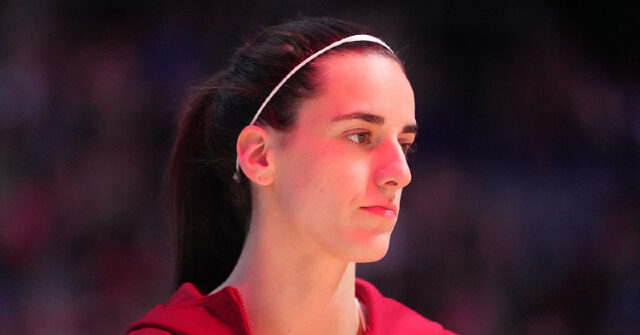
This week, Caitlin Clark was given a chance to do the same thing and passed.
During a Sunday post-game press conference following the Fever’s 108-100 loss to the Minnesota Lynx in Minnesota, an affair that saw throngs of protesters on both sides of the transgender debate, Clark was given an opportunity to back her teammate and asked for her thoughts on the issue.
“It’s for the leagues and governing bodies to work with their athletes to find solutions. My focus is on basketball,” Clark replied.
If Clark’s apparent nonchalance on the issue of whether men can be included in women’s sports is to be believed, it comes as quite the shock. In her 2+ years in the league, the former Iowa Hawkeye has been subjected to some of the vicious hits and flagrant fouls ever seen on a basketball court – men’s or women’s.
Should the league allow men masquerading as women to play in the WNBA, one could reasonably assume that Clark would be subjected to even more violent physical treatment because there would be far bigger, faster, and stronger male players on the floor, in addition to the physically weaker females who are currently roughing her up.
Caitlin Clark is 24 years old; given her youth, many will sympathize with her and give her a pass for not taking a stand on the trans issue. However, the intrusion of men and boys into women’s and girls’ sports is not a political issue in the same vein as gun rights or the economy.
This is common sense.
Men should not be involved in women’s sports is something so basic that up until relatively recently, none would have questioned it.
Clark is young, but she is far from naive. She not only has the most endorsement deals in the WNBA – by far. But she is also among the top endorsing athletes in the world.
That likely has far more to do with her reticence to stake out an opinion on trans athletes than her youth. Lest we forget, the youthful Clark showed no such desire to stay out of the political/social fray in 2024 when she credited black women for building the WNBA, a league no one noticed for 30 years until she arrived—all the while claiming that she benefited from privilege because she is white.
So, it’s not like Clark is completely unpracticed in wading into the dangerous waters of social issues. She just seems only to do it for one side. You know, the side that won’t hurt her shoe deals and other associated endorsements.
In a perfect world, Clark would not get asked these questions. Also, in a perfect world, we would be sane enough to know that you can’t have men in a women’s league.
Sadly, that is not the case.