

Get your daily dose of health and medicine every weekday with STAT’s free newsletter Morning Rounds. Sign up here.
Good morning. Do you consider the end of August the end of summer? When is an appropriate time to start talking about Halloween? I don’t have the answers, but I do have some news below.
CDC releases latest life expectancy data
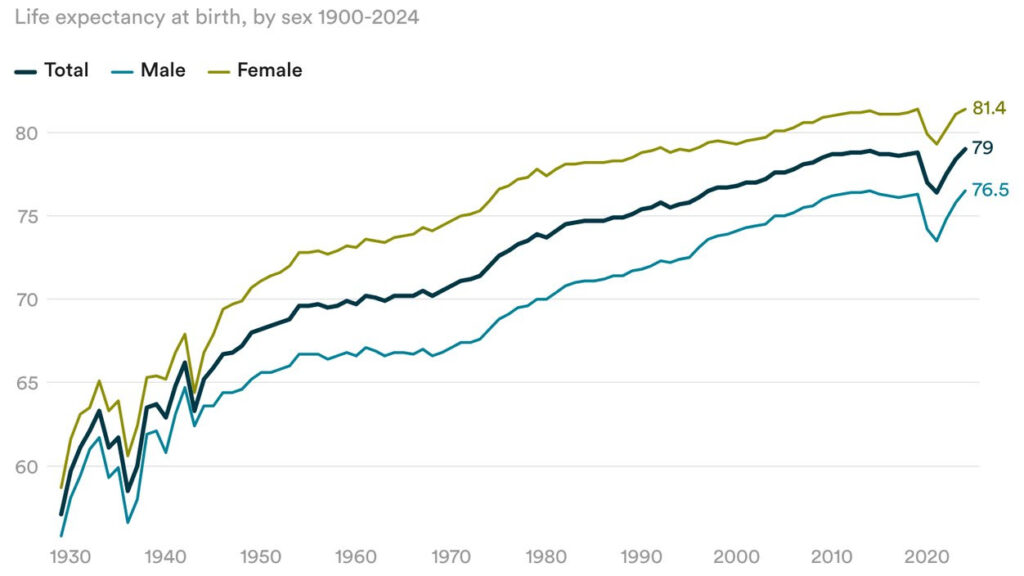
In 2024, American life expectancy at birth surpassed pre-pandemic levels, according to new data from the CDC’s National Center for Health Statistics. Overall, babies born that year could be expected to live to age 79, per the data. That’s up 0.6 years from 2023 and 0.2 from 2019, the last year before Covid-19 started drastically reducing those rates.
A decline in Covid deaths played a major role in the increase from 2023 to 2024, but so did decreases in deaths because of unintentional injuries (the biggest contribution), heart disease, cancer, and homicide.
When Magdeleine Bradford-Butcher heard about a pending White House regulation that would subject federal science funding to increased political intervention, she decided to submit a public comment on the proposal to explain how she has benefited from research funding. Her daughter has cystic fibrosis, as does the daughter of Russell Vought, who directs the White House Office of Management and Budget. “He probably isn’t reading these but just in case: Russell, for the sake of your daughter and mine, please do not make these rules effective,” she pleaded in her comment, mentioning the medication that both children have been treated with.
Then something unusual happened: Bradford-Butcher’s comment was taken down, without explanation. Hers is one of 42 published comments that have been removed, STAT’s Anil Oza reports. Among those, it’s one of 10 that note how Vought’s family has benefited from federally funded research. Read more from Anil on how legal experts reacted to the deletions and what it may mean for future challenges to the proposal.
Can AI surveillance catch hospital drug theft?
Anyone who has ever seen a medical drama knows about drug diversion — when hospital staff skim from or steal a medication that was meant for a patient. “There is diversion going on everywhere,” said Chris Fortier, who previously served as the chief pharmacy officer at Massachusetts General Hospital. “Whether it’s large, whether it’s small, it’s happening. And it’s very, very difficult to identify.”
But machine learning and AI can capture drug diversion by hospital staff at much higher rates than traditional, manual methods, according to a study from the firm Invistics, which has developed its own detection system. Outside experts aren’t so sure and caution that the technology is only as effective as the people using it. Read more from STAT contributor Alexandra Byrne about how well these programs work in reality.
How Trump’s cuts are reshaping America’s health system
The full impacts of the incoming Medicaid cuts won’t be felt for years, but many parts of the health care system are already racing to prepare — especially in rural states, where changes are expected to hit the hardest.
Take Maine, for instance. The state has the nation’s highest proportion of its population living in rural areas and an above-average share of Medicare and Medicaid beneficiaries. STAT’s Daniel Payne visited health systems in “vacationland,” and everyone he spoke to expected the state to end up with fewer hospital services once the cuts are fully enacted. Some had seen an impact already.
“The capabilities in the little hospitals just keep declining,” said Tom Judge, the founding executive director of LifeFlight of Maine. “Demand is going to keep going up.”
Daniel traveled to Louisiana and Maine and interviewed dozens of executives, doctors, and policymakers for STAT’s latest series, Unraveled. His stories will explore the consequences of President Trump’s unprecedented cuts to the health care safety net. Read the first installment now.
Turning island life into a laboratory
Cases of — and news about — alpha gal syndrome have surged over the last decade or so. You’ve likely heard of it: the tickborne red meat allergy. Researchers at Massachusetts General Brigham are launching what they call a first-of-its-kind study focused on who develops the syndrome after a tick bite, and why. The study, based on Martha’s Vineyard, will recruit up to 300 island residents and follow them for two years. The island has been transformed by the syndrome in recent years, per Boston Globe reporting.
It’s not the first time a storied Massachusetts island has forged new ground when it comes to tickborne diseases. In 2016, former STAT reporter Ike Swetlitz wrote about how scientists on Nantucket had proposed genetically modifying tens of thousands of mice to stop the spread of Lyme disease. “If we don’t change how we do science for this, we will be violating our democratic ideals,” MIT researcher Kevin Esvelt told Ike at the time. He’s still working on the project, called Mice Against Ticks. Now, the team will reportedly study the mice on a remote island before moving on to Nantucket and Martha’s Vineyard.
Reflecting on cancer screening in long-term care
As a cancer epidemiologist, Kim Johnson knows that a diagnosis of stage 4 breast cancer is not very common. So when her aunt, at 78, died of stage 4 breast cancer just three weeks after her diagnosis, Johnson knew that something was off. Her aunt lived in a long-term care facility, but it turns out that there are no major national cancer screening guidelines written for older individuals living in these facilities.
“In reading literature on this topic, I came away feeling that substantial attention was devoted to the harms of screening residents of long-term care facilities, with much less attention to identifying those residents for whom screening may still provide meaningful benefit,” Johnson writes in a new First Opinion essay. Read more about how her aunt’s death made her reevaluate existing guidelines.
What we’re reading
-
His research on pregnant opioid users was widely celebrated. Auditors and experts found major flaws, ProPublica
-
Why people want to believe the Lindsay Clancy conspiracy theories, New Yorker
- Opinion: The sounds of love and loss as heard by an OB-GYN, STAT
- High-intensity sprints can trigger molecular changes in the bloodstream, NPR