

This article is the fifth in a series dealing with rail and industrial park developments by Chinese actors in Ethiopia, which began with our analyses of the Addis Ababa Light Rail Train (AALRT) and the Addis-Djibouti railway in The Diplomat in 2018. Part 3 revisited the same two projects in 2019; Part 4 described our visit to Mekelle Industrial Park in 2020. This time, we revisited the AALRT, got on board, and observed the current state of infrastructure and service in Ethiopia’s capital.
The Addis Ababa Light Rail Train (AALRT), sub-Saharan Africa’s first inner-city tram project, was hailed as an exemplary infrastructure development in 2015 and a ground-breaking step forward for Africa-China relations. Today, it faces even more challenges than the ones we noted in 2018, when we first took a ride.
Between our visits, numerous crises hit one of Africa’s most progressively developing economies, including the COVID-19 pandemic and several armed conflicts, the most devastating of which was the two-year-long war in Tigray. Prime Minister Abiy Ahmed and his government have been seeking to restructure Ethiopia’s debt to China, while also trying to convince other international lenders and donors to let Ethiopia use the money that had been earmarked for repaying several of the country’s loans to fund pandemic measures and other development-related projects. As reported by Business Day, last month, China even announced a partial cancellation of Ethiopia’s debt.
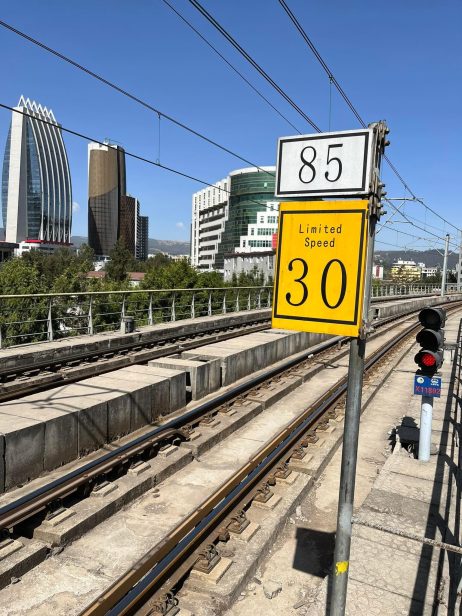
The rail track of the AALRT stretches into the distance. Photo by Istvan Tarrosy
Among the infrastructure development projects that needed substantial external funding, both the light rail (tram) of Addis Ababa and the Addis-Djibouti railway should be mentioned. In our first articles, we underlined the significant amount of loans from China Export Import Bank that, in the case of the AALRT, secured enough funding for construction tp begin in December 2011.
A critical review article by Bouraima et al. published in the Journal of Transport Geography, confirmed our view about the projects’ insufficient feasibility planning, which in the case of the AALRT resulted in a substantial amount of money being needed for maintenance. As Bouraima et al. point out, “poor feasibility studies can contribute to cost and time overruns of mega infrastructure and their subsequent operationalization challenges.” In our follow-up research we could record several of these challenges.
The once impressive-looking tram in Addis has been struggling with many problems. In a report from May 2022, it was highlighted that substantial theft further decimated the electricity supply infrastructure, which was having difficulty providing sufficient backing to the trams running already in 2018. According to one of our local respondents, a university lecturer in political science, this reveals yet another dimension of the problem: As long as people do not feel ownership over the infrastructure, they do not think that it is a sin when they steal “from the government.” The lecturer advocated for more education and efforts to raise societal awareness.
The former grandeur of the AALRT – originally on par with many metropolises around the world – has rather quickly diminished, with broken chairs at stations, litter uncollected along the rail tracks, and substantial dirt on the surface of the rail sheds.

A broken bench at an AALRT station. Photo by Istvan Tarrosy
We noted in our first article on the tram that in the first 14 months of operation, the system – which was initially designed to move up to 60,000 people per hour – carried an average of 105,000–110,000 daily passengers. We noted the power troubles in 2018, which have since been joined by the theft and maintenance issues described above.
Despite the fact that the AALRT began with 41 trains on both lines, we now know that the vast majority of them are no longer in operation. According to a recent paper, only 17 train vehicles remained on both routes by the beginning of 2020 (the Blue North–South line had nine trains in operation, while the Green East–West line had eight trains). According to our weekday rush hour investigation, by the beginning of 2023, the situation is quite similar; a bit better on the Blue and worse on the Green line. The service interruptions continued in 2022 and 2023 with a further reduction in the number of cars, although the exact number of operating trains was never highlighted by the officials. Daily ridership has fallen to 56,000.
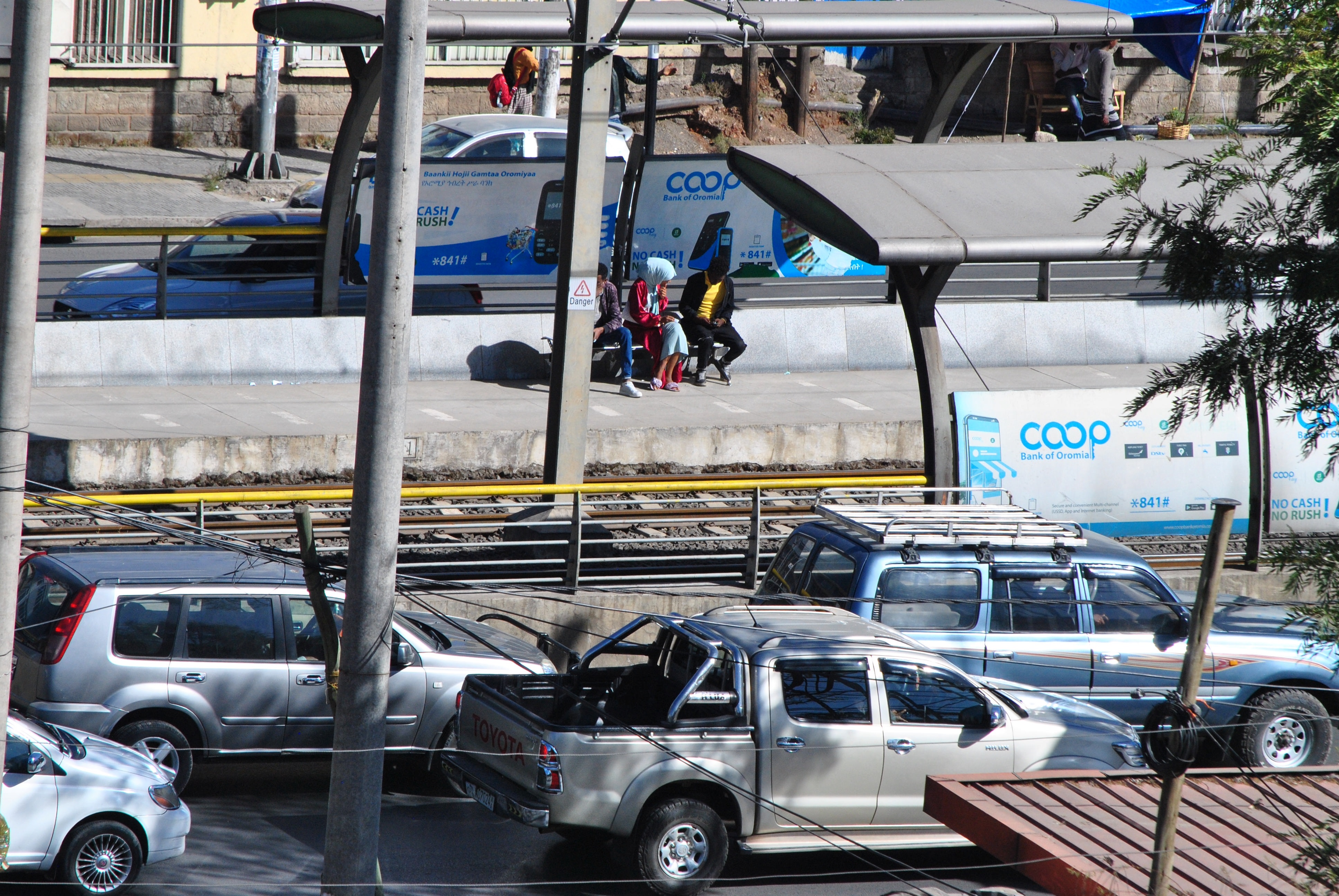
An AALRT station from viewed from a distance. Photo by Istvan Tarrosy.
According to Obsie et al., the average wait time on the Green line in 2020 was 12 minutes, while the average wait time on the Blue line was 15 minutes. However, in January 2023, during rush hour, the average wait time on the Green line was 19 minutes, with only six trains operating on that line, marking a further decrease in the number of trains. The Blue line had 10 trains, with one double train out of these, and the average wait time was 13 minutes, according to our on-the-spot calculation.
All of these statistics indicate that only one additional train has improved waiting times on the Blue line, and our experience indicates that overcrowding has also decreased – far more so than on the Green line, where the loss of two trains has increased waiting times by nearly 60 percent compared to 2020.
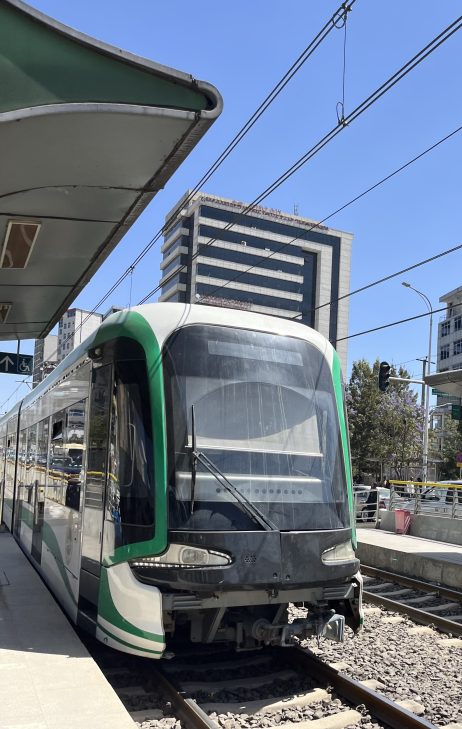
A railcar engine at a station. Photo by Istvan Tarrosy
As we searched for the causes, we discovered two potential, likely interconnected problems: car motor overloading problems and inadequate maintenance. In the first instance, according to a study, the traction motors are supporting a mechanical load that exceeds the train’s intended overload capability. According to this paper, a single train can accommodate 254 passengers at normal capacity and 317 passengers with seats and standing room only when it is overloaded. However, the operational scenario showed that even under the worst traffic conditions, one train may be transporting up to 60 extra passengers.
The second problem is related to insufficient imports of spare parts and a lack of maintenance experts. Although we stated in our first article in 2018 that a complete knowledge transfer was planned in three to four years, maintenance remained a problem even after this period. The situation pushed the Ethiopian Railway Corporation in 2022 to extend contracts with two Chinese consultants tasked with handling such work for the light-rail service. Thus, the knowledge transfer is still not 100 percent complete. The Reporter, an Ethiopian website, claims that $60 million is required for spare parts to fix the vanished vehicles. The cost of the entire project was $475 million, so nearly 13 percent of that amount is required to keep the trams running just a few years after the lines opened to the public.
As we observed last month, these compounding problems have resulted in single trains not being able to accommodate all waiting passengers. It is not always possible for waiting passengers to squeeze into the car they want to take, and we found passengers left outside of trains due to lack of space – even outside of rush hour.
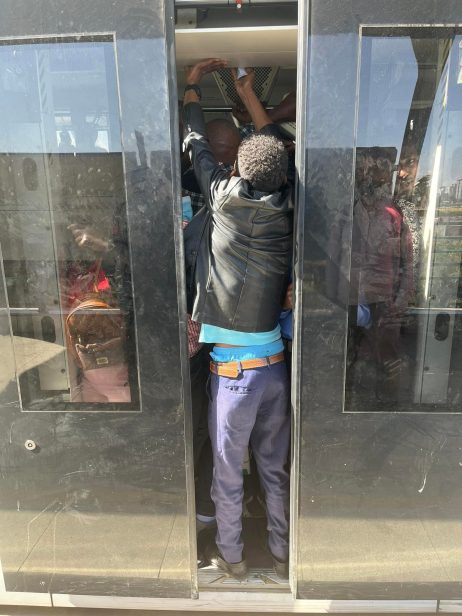
At times, overcrowding makes it a real physical exercise to get on the tram. Photo by Istvan Tarrosy
This modern technology has become like a minibus, which is still among the most used means of transportation on a daily basis. A minibus (the matatu in Kenya, or the dala dala in Tanzania), which is in many cases an old Toyota HiAce originally with 12 seats, often carries 18-20 people.
The bulk of passengers on the tram, like minibus passengers, must wait in long queues for their turn to get on. As long as far fewer trains are in service than the need and number of potential passengers, coupled with the fact that the operating times are rather slow, in numerous instances – especially during rush hour – it is a tough physical exercise to squeeze into the train. We ourselves were not successful in several cases.
After boarding, it may take an hour or an hour-and-a-half to arrive at Ayat junction on a 10-kilometer-long road, as another of our local respondents, a taxi driver, told us.
Addis has taken several promising steps to organize traffic, including traffic lights, signs, and special lights displaying the time remaining to a color change installed at many of the most congested traffic junctions. Near the tram stations such equipment has also been installed, but according to our observations it often does not function. As we wrote in our first piece of the series, sometimes it is life-threatening to cross the road to get to the station. Visible zebra crossings and functioning traffic lights would help a lot.
Overall, if the AALRT worked properly in terms of frequency and predictability, it would help local transportation needs. It is also much cheaper than any other means of transport. However, the fact that it is not working properly leaves Addis not only with irritated passengers, but also with a company that is losing money. In addition, the investment in this way places significant strain on urban transportation by taking space away from minibuses and taxis.