

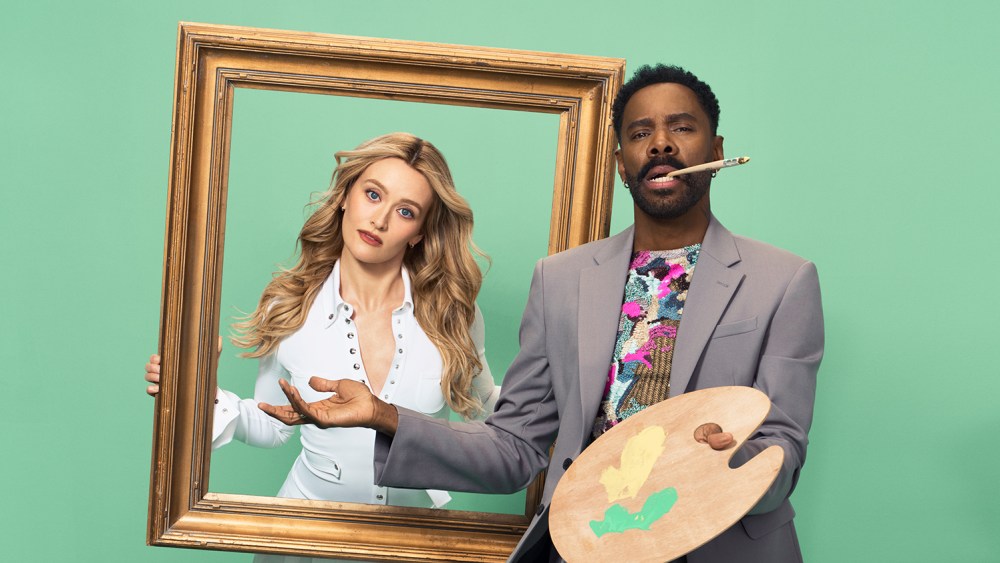
This interview is part of Variety and CNN’s Actors on Actors series. Watch the full video interview now at CNN.com/Watch (or on the CNN app) and on Variety’s YouTube channel starting at 11:59 pm ET.
Colman Domingo and Sarah Pidgeon are true thespians. Both from theater backgrounds, they approach their television work with a certain grandeur and meditativeness that turns heads — and drums up awards attention as soon as they show up on-screen. As they meet to discuss Domingo’s work in HBO’s “Euphoria” and Netflix’s “The Four Seasons” and Pidgeon’s breakout role as Carolyn Bessette Kennedy in FX’s “Love Story: John F. Kennedy Jr. and Carolyn Bessette,” they go deep on the transformative potential of the right costume, their perspectives on the differences between acting and directing and the way their characters stay with them long after the cameras stop rolling.
Colman Domingo: Your Carolyn Bessette is outstanding. I read comments online. They’re like, “You had her mannerisms and her cadence, the way she walked …” You were that ’90s it-girl. What kind of research went into that?
Sarah Pidgeon: While she was so well documented through paparazzi photos, she was so enigmatic and she never sat for an interview. There were very few videos of her speaking. It was this discovery process, and it gave me a lot of freedom. And it was quite intimidating in some ways. I know you’ve played real people as well, and there is this pressure of …
Domingo: People are trying to get it “right,” which I never liked. I’m like, “No, no, no. We’re doing something with a dramatic arc. We’re not trying to ‘get it right.’ We’re trying to be authentic and truthful in our experience.”
Pidgeon: And you don’t want it to be an impersonation. Because it’s your body at the end of the day, and it’s your voice.
Domingo: Yeah. It’s gotta be attached to you.
Pidgeon: I don’t know if you ever struggled with feeling like, “What are the limitations of what I can transform?” I can’t change my height. Well, to a certain extent, with heels. She was 5-10 [like me], though.
Domingo: You’re tall. You’re a tall drink of water. When you walked in, I was like, “She’s tall.”
Pidgeon: I actually think playing her has helped me embrace my height.
Domingo: Wait, wait, wait, wait, wait, wait. You didn’t embrace you height before? Is it because when it comes to women in Hollywood, they’re mostly certain size?
Pidgeon: Yeah. And I’ve always been the tallest in the ensembles that I’ve been a part of. Playing Carolyn, it was so refreshing to play a woman who felt comfortable taking up space. You hope these characters rub off on you, in the positive aspects.
Domingo: Now, were you dripping in Calvin Klein?
Pidgeon: Oh, there was a lot of Calvin. I mean, you have such strong sartorial choices.
Domingo: Thank you.
Pidgeon: The power of dressing, it really changes how you feel.
Mary Ellen Matthews for Variety
Domingo: I’ve been known to dress well on red carpets, but I always tell people that I’m very detailed about every character too. Like Ali in “Euphoria” is a very different character than Danny in “The Four Seasons.” When I go into fittings for Ali, I gave this directive. I said, “Everything I wear probably costs a total of $30. He shops secondhand. He’s got secondhand Timberland boots. Everything is very utilitarian, and he does not care about fashion or style.” Anything that had too much flash, I was like, “Oh no, no.” But Danny, he’s a man of the world.
Pidgeon: He’s so well-dressed. I love the hats you wear.
Domingo: With our costume designer there, I was like, “He’s a creature of the world. We can find him in Milan. We can find him in Japan. He’s an architect, and as a Black man navigating that space, he doesn’t mind standing out. He doesn’t want to fit in. He wants you to embrace all of him. It’s urban, and it’s worldly and it’s designer.
Pidgeon: Carolyn understood the power of clothing. There were such few photos of her before her relationship with JFK Jr. So [we tried] to find that through line: what she might have worn at 26 years old when she didn’t have the budget that she did at 30, and understanding how the world changed the choices she wore.
Domingo: And I saw that. Watching the arc of your show, I saw your body language change.
Pidgeon: The clothes helped. It changes how you feel. When I’m in a sweatshirt, it makes me feel different than what I’m wearing now. You have to hold yourself differently. Yohji Yamamoto is a designer that she wore a lot, and he likes to imagine his clothing as armor for women. I just love that idea. She needed to don this clothing to feel a sense of security while being in the public eye. It changed how I saw her. I understood the person behind the clothes versus just this fashion figure. She really understood the power of the image that she was representing.
Domingo: That’s one of the first moments [of the show], getting the red polish and then suddenly changing it up.
Pidgeon: I loved that. There’s a lot of speculation about this sense of vanity that she had. And my sense in playing that scene was her understanding how scrutinized she would be. She was going to a wedding, and somehow, she knew if she wore the red nails, people would talk about her nail color instead of the couple that was meant to be celebrated. I think it was so much less about her being picky. It was more an understanding of just how under a microscope she was, and feeling that pressure from outsiders.
Domingo: Do you feel that? “Love Story” has become such a huge part of a zeitgeist right now. How do you navigate that?

Mary Ellen Matthews for Variety
Pidgeon: It’s crazy how fast things can change. It’s rarely helpful taking in the conversation that’s happening online. Not to say I don’t. Curiosity has killed this cat. But I want to be able to disappear into roles. And when you become well-known — I want to protect my privacy and my sense of Sarah, because I want to play a whole litany of characters. How have you navigated it?
Domingo: I try to make big swings. In one year, people can see me in drag in a Sabrina Carpenter video —
Pidgeon: Oh, that was fantastic.
Domingo: — and then suddenly I’m playing Joe Jackson in a Michael Jackson film. I never want to do the same thing twice, because we could get known for that thing. I was on a show called “Fear the Walking Dead” for many years, and I noticed that I would always get scripts where they wanted me to play a morally ambiguous villain. I would say, “No, I’ve done a version of that already.”
Pidgeon: Watching your performances, there’s this sense of ease that you have. You transform so wildly, but that’s what is believable about your big transformations and swings.
Domingo: You know what I think it is? I tell people that I feel like I liberated myself years ago from being right or making sure something was perfect. I look for the rough edges. I hosted “SNL” a couple weeks ago. People kept asking, “Are you nervous?” And I was like, “Should I be nervous? Why am I not nervous?” Because I’m OK with being a little messy. I trust that I have a deep sense of research and development and curiosity. I’m like, “I believe I have everything I need to go out and do the thing. Now let me go do it.” Any director out there will know: My first three takes are terrible.
Pidgeon: I’m sure they’re not.
Domingo: They’re terrible.
Pidgeon: Playing Ali throughout these three seasons, I don’t know how much about his backstory you knew.
Domingo: I didn’t know a lot of his backstory. Sam Levinson wrote this character for me based on his sponsor. I did a lot of research on people who suffer from the disease of addiction. I looked at people in my own life, and created this character. In Season 3, we get into his origins. Ali is someone who’s hung onto faith, and he’s trying to instill that into Zendaya as Rue. And he’s now being tested about the thing he’s been preaching. I love working with Sam Levinson. He really is truly one of the best storytellers that I know.
Did you have many directors over the arc of “Love Story”? How was that? Because after you start owning a character, I’ve had this experience with a director coming in and saying, “OK, this is who I think she is.” And you’re like, “Well, wait a minute …” Did you ever get that?
Pigeon: No, I felt very lucky with Ryan Murphy and the collaborators that he brings in. I would call myself a trusting person. I guess maybe I can be a bit naive, but —
Domingo: What’s your sign?
Pidgeon: Cancer. What about you?
Domingo: I’m a Sagittarius.
Pidgeon: My mother’s a Sagittarius. Actually, she might be a Capricorn.
Domingo: What do you mean you don’t know what sign your mom is? We’re going to have to unpack that in another episode.
Pidgeon: That’s another 45 minutes.
Maybe it’s because I’m trying to figure out the language they’re speaking and what they mean by their direction. But it takes me a little bit, and television’s so quick. I don’t know how long it took you guys to do “The Four Seasons” or “Euphoria.”
Domingo: “Euphoria” is seven months at a time, but I really did my scenes maybe over the course of a month. Now, “Four Seasons” is my first experience with half-hour comedy, and I’m a director on the show too. Do I love that schedule or what? It’s three months. We get to go to all these different locations.
Pidgeon: I mean, you have to do four seasons.
Domingo: Tina [Fey, series co-creator] wanted a show where it’s 50-something-year-old people, and we’re going to wear cute sweaters, and we’re going to have witty banter, and we’re going to fun places. I’m like, “Sign me up.” And then she asked me to be a director on the show. “Sign me up.” This season, she directs as well. “Sign me up.” We get to really craft the show. A couple of our writers also direct, so it does feel in-house. It’s the first time I’ve had that experience, not having a lot of outside directors. These are all people who understand what we’re making.
Pidgeon: How did you find directing [on “The Four Seasons”]?
Domingo: I leaned into 360 turns and group elements, so that when the show goes on and it’s more complicated, you’re going to long for that feeling again. You see people from above, coming in and out, flowing together — that sense of community you can get with your camera lenses. And then when it falls apart, you miss it.
Have you ever thought about directing?
Pidgeon: Yeah, I’d like to be on the other side. Have you found that it’s helped your acting?
Domingo: Yes. It’s made me a more patient actor as well, looking at what a director has to do, and how they’re there way before you, prepping. A lot of times, actors come to the set like, “Why is this set up this way?” There’s all these reasons.
Pidgeon: Exactly. You think so much about your character, and you’re your character’s advocate. Speaking of, in “Euphoria,” there’s a sense of finality in this season. How did you navigate that?
Domingo: The thing about Sam Levinson is, every season, he said, should feel like a finale, and there’s always a possibility of more. You give every last drop of the character’s story, so if this was the end of it all, you really investigated every part of it. And I feel like we have. I love working with Zendaya so much, and I do know that that is final, because it’s very clear in the storytelling. You can always go to flashbacks, but I love the grace notes that we have with each other, and it makes the whole season make sense. If people started judging the season by the first two episodes, it’s kind of false because it’s all a setup for the whole arc. I actually wish it all just came out at once so people can see that.
How about you? How do you feel about that?
Pidgeon: It’s interesting telling a story when the majority of the audience knows how it ends. We meet these people at the very end of their lives, and then the next scene flashes back six years. But in terms of the finality of working on this show, I’m just so grateful for it. I feel so lucky to embody this woman, to hopefully have taken some of her qualities.
Domingo: Do you feel that way with most characters, that you want to take something with you?
Pidgeon: I think you automatically do. I think everyone should take an acting class. It’s radical empathy. And who knows what bad qualities I’ve taken from characters. But you know what? I don’t know if any of them have bad qualities, because when you’re playing them —
Domingo: You’re their cheerleader.
Pidgeon: Exactly.
Domingo: There’s a darkness in Ali this season that comes out, and people have asked me, “Well, how do you find that darkness?” And you’re like, “We all have it. It’s not something so foreign. It is the human experience.”