

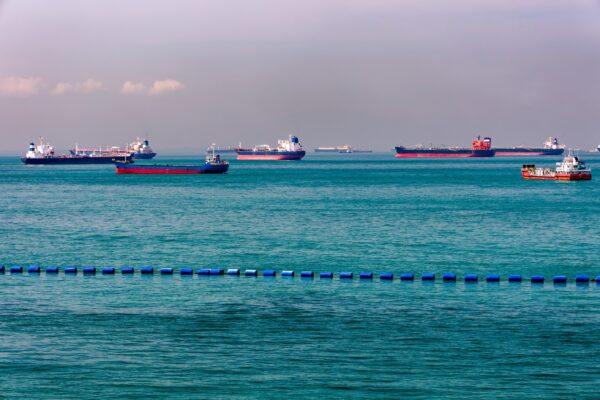
Iran’s blockade of the Strait of Hormuz in response to U.S. and Israeli strikes has once again highlighted one of the world’s most persistent strategic vulnerabilities. Around 80 percent of global trade by volume is transported by sea, and a remarkably large share of that traffic passes through a handful of narrow maritime chokepoints. Roughly one-quarter of all seaborne oil trade and about one-fifth of global liquefied natural gas (LNG) shipments normally transit the Strait of Hormuz; farther east, the Strait of Malacca, which links the Indian and Pacific Oceans, handles more than one-fifth of global maritime traffic, including an even greater share of energy supplies, industrial components and manufactured goods.
The Red Sea crisis in 2023, triggered by Houthi attacks on commercial shipping transiting the Bab el-Mandeb Strait, had already exposed the fragility of these maritime corridors. More recently, Iran’s use of Hormuz as a geopolitical lever demonstrated how a single actor can exploit geography to exert strategic pressure during a conflict. Together, these episodes have underscored two enduring vulnerabilities: the ability of states to weaponize their geographic position, and the difficulty the international community faces in preventing both state and non-state actors from disrupting essential trade routes.
Indeed, even without a closure, attacks or threats against key maritime corridors can drive up insurance premiums, force vessels onto longer and more expensive routes, and significantly increase transportation costs. In an interconnected global economy, a single chokepoint can quickly become a source of worldwide economic disruption.
Yet the vulnerabilities of Hormuz and Malacca are fundamentally different. Hormuz is primarily exposed to geopolitical coercion: the possibility that a coastal state could deliberately restrict navigation to achieve political objectives. Malacca, by contrast, owes much of its strategic importance to geography itself. Any prolonged disruption would not simply affect a regional market but would reverberate across the entire trading system connecting the Indian and Pacific Oceans. For Asian economies, which rely on the strait for most of their energy imports and a substantial share of their raw materials, the economic consequences would be immediate and severe.
Stretching roughly 900 kilometers between Indonesia’s island of Sumatra and the Malaysian Peninsula, the Strait of Malacca is the shortest maritime route linking Europe, the Middle East, and East Asia. It connects the Indian Ocean with the South China Sea and, ultimately, the Pacific, making it one of the busiest shipping lanes in the world.
Its geography, however, presents significant operational challenges: the waterway narrows dramatically at the Phillip Channel near Singapore, where it measures less than 3 kilometers across. This narrow passage represents the principal bottleneck of the entire corridor and one of the most congested stretches of water. Its physical characteristics make Malacca vulnerable not only to geopolitical tensions but also to operational risks. Heavy traffic increases the likelihood of collisions, while piracy – although significantly reduced compared to previous decades – continues to pose a security concern.
From an energy perspective, its importance is even greater: more than one-quarter of global seaborne oil shipments transit Malacca – an even larger share than passes through the Strait of Hormuz. The two waterways are, in fact, deeply interconnected. Much of the crude oil crossing Malacca originates in the Persian Gulf and has already passed through Hormuz before continuing toward the major economies of East Asia, particularly China, Japan, and South Korea.
Unlike the Suez or Panama Canals, Malacca is not an artificial waterway administered by a single authority. Instead, the strait falls under the jurisdiction of Indonesia, Malaysia, and Singapore, which jointly share responsibility for ensuring its security and managing navigation. Its legal regime is governed by the 1982 United Nations Convention on the Law of the Sea (UNCLOS), ratified by all three littoral states. Under the convention, the strait is subject to the principle of transit passage, which guarantees vessels of all nations the right to navigate continuously and expeditiously without coastal states being able to suspend transit, arbitrarily restrict access or impose tolls.
This legal framework does not make a disruption impossible, but it does make a deliberate closure considerably less likely. Any attempt to block navigation would require one or more littoral states to openly violate their obligations under UNCLOS. Barring a major regional conflict, a politically motivated closure of Malacca therefore remains a relatively unlikely scenario.
Moreover, Malacca is not the only available route between the Indian and Pacific Oceans. Alternative passages, including the Sunda, Lombok, and Makassar Straits, provide possible detours through the Indonesian archipelago. None, however, offers a fully comparable substitute. The Sunda Strait presents significant navigational constraints, while Lombok and Makassar can accommodate larger vessels but require considerably longer voyages, increasing sailing times, fuel consumption, and shipping costs. In other words, alternative routes may reduce the risk of complete maritime paralysis, but they would do little to limit the substantial economic costs of a prolonged disruption in Malacca.
Governing the World’s Busiest Waterway
The stability of the Strait of Malacca ultimately rests on a delicate balance between regional cooperation and great power competition. Malacca’s management is the product of decades of institutionalized cooperation between Indonesia, Malaysia, and Singapore, built around a common objective: keeping one of the world’s most important trade routes open.
For all three countries, freedom of navigation is not simply a legal principle but a vital economic interest. The uninterrupted flow of maritime commerce underpins their prosperity, making cooperation less a political choice than a strategic necessity. This does not mean, however, that the strait is immune from instability. On the contrary, Malacca has increasingly become a space where commercial interests, national security concerns, and geopolitical competition intersect.
Since the 1970s, Indonesia, Malaysia, and Singapore have progressively strengthened cooperation on maritime security, coordinating naval patrols, counterpiracy operations, and traffic management. The durability of this framework helps explain why, despite its immense strategic importance, Malacca has avoided the kind of prolonged disruptions experienced by other major chokepoints. Geography itself reinforces this cooperative approach. None of the three littoral states exercise exclusive control over the entire strait, nor could any of them secure it independently.
Yet cooperation should not be mistaken for complete strategic alignment. While all three governments have a strong interest in preserving stability and freedom of navigation, they do not necessarily attach the same strategic value to the strait.
Singapore has perhaps the most to lose from any disruption. The city-state has built much of its economic success on its role as Southeast Asia’s premier logistics and financial hub. Its port – the world’s second busiest container port – serves as the principal transshipment hub linking the Indian and Pacific Oceans. Any prolonged interruption to maritime traffic would therefore strike at the very foundation of Singapore’s economic model.
Malaysia similarly views stability in the strait as essential to maintaining the competitiveness of its ports, particularly Port Klang, one of the region’s largest maritime gateways.
Indonesia occupies a more complex strategic position. Beyond controlling a significant portion of Malacca’s coastline, Jakarta also exercises sovereignty over the Sunda and Lombok Straits – the main alternative routes should traffic through Malacca be disrupted. This gives Indonesia a unique geopolitical advantage: it is the only littoral state capable of influencing not only the principal maritime corridor but also its most viable alternatives.
It is hardly surprising, therefore, that President Prabowo Subianto has repeatedly described Indonesia’s geography as one of the country’s greatest strategic assets. In Jakarta’s view, control over these waterways is not merely a matter of maritime security but also a means of enhancing Indonesia’s geopolitical influence and reinforcing its central role in the Indo-Pacific.
This broader strategic thinking became evident during the Hormuz crisis earlier this year. At the height of the tensions, Indonesia’s Finance Minister Purbaya Yudhi Sadewa floated the idea of introducing transit fees for ships crossing the Strait of Malacca. The proposal was quickly rejected by Malaysia and Singapore, drew widespread international criticism and was subsequently withdrawn, with Jakarta reaffirming its commitment to international law and the existing legal regime governing the strait.
Although short-lived, the episode was nevertheless revealing. As maritime chokepoints become increasingly central to global geopolitics, coastal states may begin to view them not only as international public goods that require protection, but also as strategic assets capable of generating political and economic leverage. The Hormuz crisis contributed to this shift. Discussions surrounding the possibility of introducing transit charges in the Strait of Hormuz inevitably reignited similar debates elsewhere.
In Malacca’s case, such proposals remain highly unlikely to materialize given the legal constraints imposed by UNCLOS and the opposition of the other littoral states. Yet the significance of Indonesia’s proposal is that it entered the regional political debate at all. Until recently, freedom of navigation was largely treated as a settled principle of international order; today, however, strategic waterways are becoming progressively more politicized.
The China-U.S. Competition
The future of the Strait of Malacca is shaped not only by the cooperation among its littoral states, but also by the broader strategic rivalry between the United States and China. Its geopolitical significance lies not simply in the sheer volume of trade it carries, but in the fact that it remains one of the most critical arteries for Asia’s – and, specially, China’s – energy security.
Indeed, Beijing has long been acutely aware of this vulnerability. As early as 2003, then-President Hu Jintao coined the expression “Malacca Dilemma” to describe China’s dependence on a maritime corridor beyond its direct control. More than two decades later, that concern has only grown, considering that around 80 percent of China’s crude oil imports still transit through the Strait of Malacca, alongside a substantial share of the country’s manufactured exports destined for Europe, the Middle East, and Africa.
This dependence takes on particular significance in any potential regional crisis. A conflict over Taiwan, a further deterioration in China-U.S. relations or a broader escalation in the Indo-Pacific could all transform Malacca into an instrument of strategic pressure against Beijing. Although a deliberate blockade of the strait remains unlikely, Chinese policymakers cannot ignore the possibility that an adversary could disrupt or delay the country’s energy and trade flows, making them significantly more expensive. Reducing this vulnerability has therefore become a long-term strategic priority.
China has pursued two complementary approaches. The first has been to strengthen its naval presence across the Indo-Pacific. Over the past decade, the People’s Liberation Army Navy has steadily expanded its operations in the South China Sea and surrounding waters, enhancing its ability to protect the country’s sea lines of communication and trade. Beijing’s increasingly assertive behavior in the South China Sea – including its maritime disputes with the Philippines and other Southeast Asian claimants – should also be understood in this broader context. Beyond questions of sovereignty, these disputes reflect China’s determination to secure greater control over the maritime routes on which its economy depends.
The second strategy has focused on diversifying transport corridors to reduce reliance on Malacca. For example, under the Belt and Road Initiative, Beijing has invested heavily in alternative overland routes connecting China directly to the Indian Ocean. One example is the China-Myanmar Economic Corridor, which links China’s Yunnan Province to the deep-water port of Kyaukphyu on Myanmar’s Bay of Bengal coast. A similar logic underpins the China-Pakistan Economic Corridor, which is designed to connect Xinjiang with the Pakistani port of Gwadar on the Arabian Sea.
Both initiatives, however, face substantial limitations. The oil and gas pipelines running through Myanmar, operational since 2013 and 2017 respectively, can satisfy only a small fraction of China’s energy demand. Meanwhile, persistent political instability in both Myanmar and Pakistan, combined with geographical and security challenges, continue to limit the viability of these routes. As a result, no alternative currently offers the same combination of efficiency, capacity and cost-effectiveness as the Strait of Malacca. For the foreseeable future, Malacca remains China’s indispensable maritime gateway to global markets.
The United States has watched these developments closely. For decades, Washington has been maintaining an extensive military presence across the Indo-Pacific, stretching from Guam in the western Pacific to Diego Garcia in the Indian Ocean, while relying on a dense network of alliances and security partnerships throughout Southeast Asia.
Singapore occupies a particularly important place within this strategy. The 1990 Memorandum of Understanding granted U.S. forces access to Singaporean military facilities, while the 2005 Strategic Framework Agreement expanded cooperation to include counterterrorism, joint military exercises and defense technology. More recently, the United States has further strengthened its regional security ties, particularly under the second Trump administration. In 2025, Washington signed a bilateral defense cooperation agreement with Malaysia and elevated its relationship with Indonesia to a Major Defense Cooperation Partnership.
Taken together, these partnerships mean that the United States now enjoys formal security relationships with every country controlling access to the Strait of Malacca. While this does not translate into direct control over the waterway, it reinforces Washington’s ability to influence the strategic environment surrounding one of the world’s most critical maritime corridors – one on which China continues to depend heavily.