

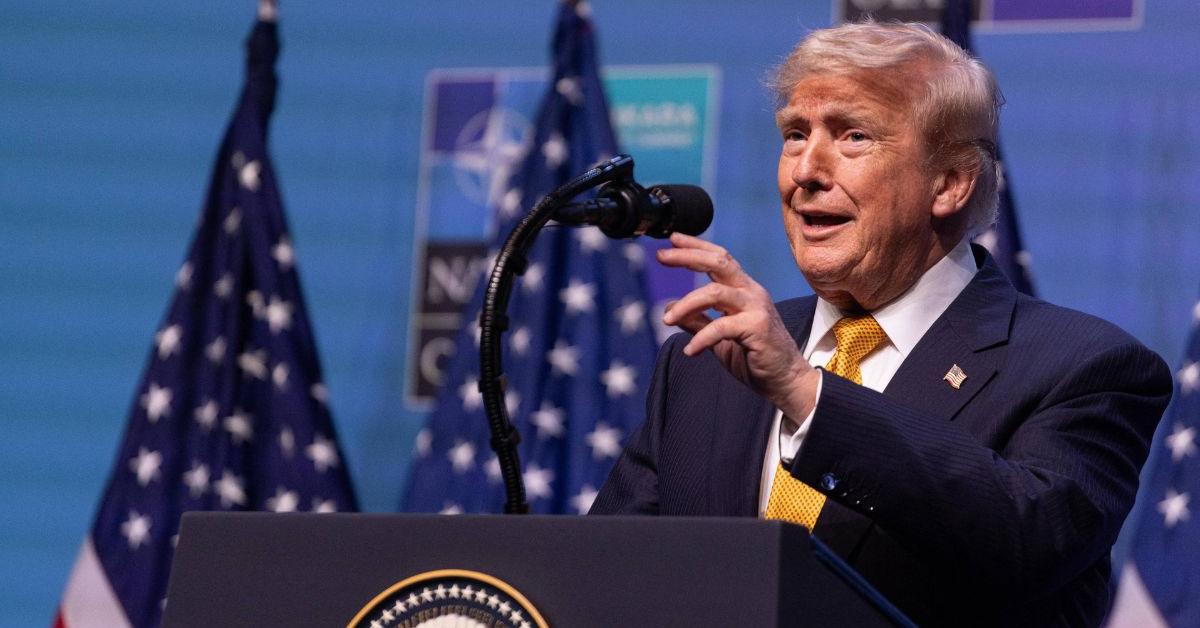
Donald Trump is battling to remember the names of his enemies as fears mount the 80-year-old president is hiding a secret dementia battle, RadarOnline.com can reveal.
The MAGA leader is also portrayed in a new book as so consumed by grievances during his second term he fights to recall the names on his “hit list.”
Those claims appear in Regime Change: Inside the Imperial Presidency of Donald Trump, a 464-page book by New York Times reporters Maggie Haberman and Jonathan Swan.
Drawing on interviews with anonymous sources and accounts of internal White House discussions, the authors describe what they characterize as a presidency driven by personal instincts, political retribution, and an effort to reshape government institutions.
They write those named in the book were contacted and given opportunities to respond during the reporting process.
According to the book, one source said Trump had become increasingly fixated on settling old scores, while struggling to identify the individuals involved.
The source said: “He knew exactly what he believed they had done to him, but sometimes he needed prompting to remember who they were talking about.”
The account is presented by the authors as an example of what they describe as Trump’s enduring focus on perceived enemies.
The book describes Trump as the “most powerful president of our lifetimes” and says he governed on “grievances and instincts.”
It also recounts an occasion during which, according to the authors, he was found decorating part of the White House with a tube of super glue, presenting the episode as an illustration of his hands-on approach to reshaping his surroundings.
Haberman and Swan write that, after returning to the White House, Trump became consumed by what they describe as a desire for retribution against those he believed had undermined him during and after the 2020 presidential election. They argue this preoccupation frequently dominated internal conversations and influenced decision-making across the Trump administration.
One episode detailed in the book is said to have taken place during the spring of 2025, when Trump reportedly tried to recall the identity of “this lawyer” from his first administration who he believed had publicly stated the 2020 election “was fair and there’s no fraud.”
According to the authors, Stephen Miller – a senior adviser who had become known inside Trump’s circle for keeping track of longstanding grievances – suggested the president might have been referring to a former homeland security official.
The book said Boris Epshteyn, one of Trump’s private lawyers, searched on his phone before replying: “Chris Krebs,” referring to Christopher Krebs, the former head of the Cybersecurity and Infrastructure Security Agency during Trump’s first administration.
“Yeah, Chris Krebs,” Trump replied, according to the book. “Whatever happened to him? He was a bad one. Take a look at him.”
Haberman and Swan write days after the exchange, the White House issued an executive order directing the Justice Department to investigate Krebs.
The authors present the sequence of events as emblematic of what they argue was Trump’s determination to pursue those he believed had opposed him, even when aides first had to help him identify the people he wanted to target.
A source told us: “This material in the book misses one key fear – that the reason Trump cannot remember the names of his so-called enemies isn’t because he has too many of them to remember, but that he might be hiding a secret dementia diagnosis that seems to be prompting worse and worse behavior from the president.”
Critics and medical professionals point to Trump’s rambling speeches, verbal slips and fatigue as potential warning signs he is suffering from dementia.
Meanwhile, the White House dismisses these concerns as political attacks and maintains that his cognitive evaluations are excellent.
Speculation has mounted following confusing moments at high-profile events. For example, critics and Trump’s estranged niece, Mary Trump, highlighted a G7 incident where he briefly referred to Elon Musk as “Leon” as a potential sign of cognitive decline.
Some medical professionals and psychologists argue the Trump administration’s repeated use of the same “cognitive tests” – such as the MoCA – may be an indication of continuous monitoring for dementia, rather than routine screening.
A statement has been signed by dozens of mental health professionals who expressed concern Trump’s erratic behavior, difficulty completing complex thoughts, and impulse control issues point to conditions such as frontotemporal dementia.