

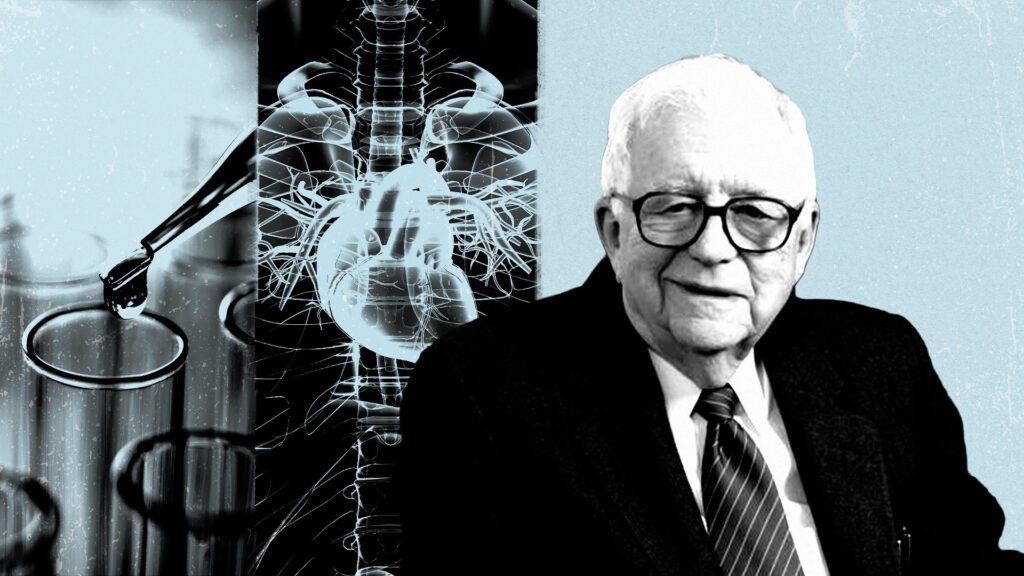
Eugene Braunwald, who was widely recognized as “The Father of Modern Cardiology,” died on April 22 at the age of 96. When I first learned about his death, I thought about our many conversations — particularly the two major visions he told me that he had for his career.
His first vision was to work with other scientists to successfully turn a theory into real ways to help prevent a heart attack and to minimize heart muscle damage after an attack began. He achieved that, becoming the most important cardiologist of his generation and radically changing the everyday practice of medicine.
A scandal may have made his second, already unrealistic vision impossible.
Like many other doctors before and since, Braunwald did not envision that a young doctor would commit flagrant fraud in his laboratory. His team’s flawed investigation of the fraud not only tarnished his otherwise stellar record but also forced the scientific research community to more openly confront its dirty laundry that it customarily swept under the rug.
It’s difficult to overstate how much Braunwald’s major research findings transformed the everyday practice of medicine.
While working at the National Institutes of Health in 1962, he developed a test known as the ejection fraction. It measures the proportion of blood that the heart’s main chamber, the left ventricle, pumps with each beat. Doctors use it every day to determine the degree of an individual’s heart failure.
After moving to the University of California, San Diego, in the late 1960s, Braunwald challenged the then-prevailing dogma that development of a blood clot in one of the coronary arteries feeding the heart instantly acted like a light switch to destroy the organ’s muscle. From careful observation of electrocardiograms recorded during a patient’s heart attack, he theorized that the muscle damage in a heart attack often progresses more slowly, over the first few hours. He likened the process to moving a rheostat switch up and down. He went on to prove the theory in experiments on anesthetized dogs showing that restoring blood flow was key to salvaging heart muscle.
At Harvard in 1972, Braunwald continued his research to provide an improved understanding of the relationship between coronary artery disease and heart attacks. With a colleague, Marc Pfeffer, he showed that a drug in the angiotensin-converting enzyme inhibitor class prolonged life in patients whose ejection fraction had dropped after a heart attack.
Braunwald’s research did not cure heart disease but helped extend the lives of many affected patients by years, even decades. The price of success, however, is that many of these people end up developing heart failure. A major goal of today’s cardiology research is focused on improving their care.
In the early 1980s, Braunwald was simultaneously chairman of medicine at Brigham and Women’s Hospital and Beth Israel Hospital, two storied Boston institutions affiliated with Harvard. One day, he invited me to make rounds with his doctors-in-training at the Brigham. After examining their patients in their hospital rooms, he led the entourage to a conference room to discuss each’s medical problems.
As we went through the issues involved in one woman’s care, it was clear that the Harvard team had nothing more to offer her medically except palliative care. The only possibility — a heart transplant — was not an option because no one was performing heart transplants in Boston at the time. Although doctors were carrying out a small number of heart transplants at the Texas Medical Center in Houston (and elsewhere), she was too sick to be transported safely. (The first heart transplant performed in Boston took place not too long after, at the Brigham and Women’s Hospital in 1984. Although he was not a surgeon, I strongly suspect that Braunwald’s influence was responsible for that milestone.)

After the discussion ended, Braunwald and I walked to Beth Israel Hospital, about a third of a mile distant. There he led me to the roof of the hospital.
As we stood there in a strong breeze, he related his second dream, to substitute one form of academia for another: for private donors and taxpayers to help expand the Harvard medical campus to land occupied by a private girls’ school and nearby colleges into a medical research, patient care, and teaching area to rival the larger 2.1-square-mile Texas Medical Center complex in Houston.
I sensed Braunwald brought me to the roof because he was frustrated about being unable to offer a heart transplant to the woman whose case we had just discussed. I thought his vision preposterous and gently expressed my skepticism. Who would be the philanthropists? No oil fortunes were made in New England, although there were many wealthy families. Why would schools already occupying the land he was eyeing agree to move from long-established locations? Braunwald held to his vision. I said I’d wait and see.
Although his vision was never realized, Harvard’s campus expanded with taxpayer and private support. But not to the size of Houston’s complex.
As we stood on that rooftop, Braunwald could not have imagined what was about to unfold in his lab.
In 1981, a year after he became chief of medicine at both Harvard-affiliated hospitals, John R. Darsee, a young research fellow whom Braunwald had hired based on receiving glowing recommendations from Emory faculty, was caught fabricating data in experiments on dogs. Darsee admitted the fraud. After an initial in-house investigation, Braunwald believed it was a one-time infraction and let him continue to participate in research.
However, lurking questions raised concerns about the integrity of articles Darsee published, including in the New England Journal of Medicine. Over the next couple of years, the concerns slowly spawned independent investigations. One by the National Institutes of Health found that Darsee had fabricated large amounts of data from experiments that he had never conducted. Other investigations showed Darsee had fooled co-authors of many papers that dated back to his college days at Notre Dame. The NIH criticized Braunwald for lax supervision and pressure to publish. It also barred Darsee from receiving federal research funding for 10 years, and he lost his medical license to practice. Brigham and Women’s Hospital had to return $122,371 in research funds to NIH; it was the first time an institution was required to return money to the federal agency because of research fraud.
Such a debacle might have deterred another scientist from training young researchers to help him achieve his research goals. Not Braunwald, whose vision of saving hearts drove him to found the TIMI Study Group (Thrombolysis In Myocardial Infarction) in 1984. Since then, the group has conducted 80 scientifically rigorous clinical trials involving 450,000 participants that have validated the safety and effectiveness of a number of drugs and techniques that are routinely prescribed for patients today.
Over the years, Braunwald continued his work, his brusque manner occasionally rubbing his subordinates and colleagues the wrong way. With the development and widespread use of angioplasty to squash the plaques that narrowed coronary arteries and insertion of stents to keep the vessels open, Braunwald turned his goal of limiting muscle damage from heart attacks to a standard of care.
When caring for patients and writing articles for the New York Times over the years, I frequently looked to the major textbooks of medicine and cardiology of which he was an editor, and when I interviewed him about various issues he was always helpful.
He didn’t just want to transform the field for his colleagues. He hoped to help the public better understand heart disease. He succeeded in both.
Lawrence K. Altman is a physician, a clinical professor of medicine at New York University, and former reporter and “The Doctor’s World” columnist for the New York Times. He is researching and writing a book on the health of political leaders.