

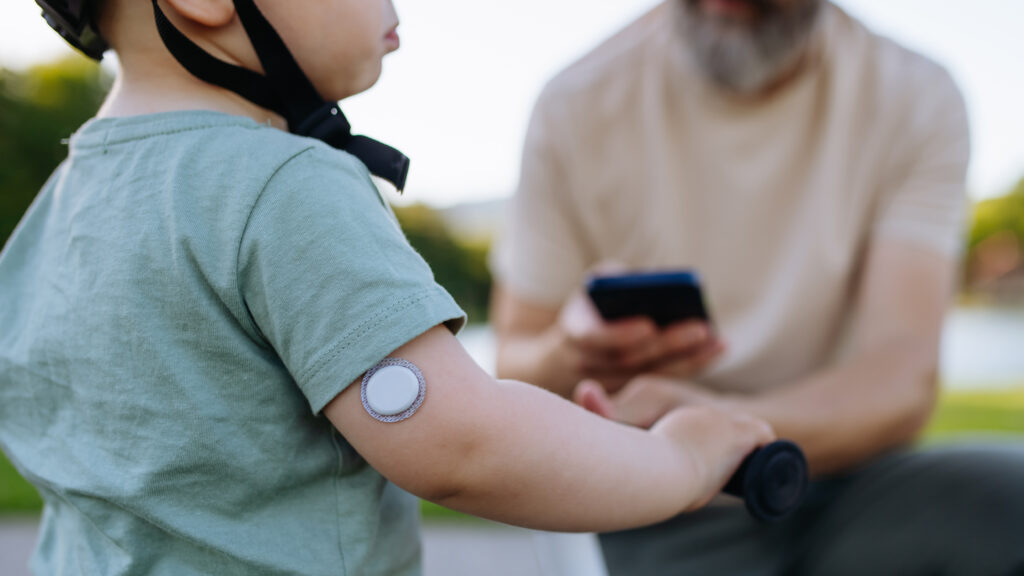
You get a CGM, you get a CGM, everybody gets a CGM? For the first time in the United States, children 2 and older can also get a continuous glucose monitor without a doctor’s prescription.
Is that a good thing? The Food and Drug Administration thinks so.
“By providing real-time glucose data, these devices can help pediatric patients and their caregivers build greater glycemic awareness, track patterns in response to meals and exercise, and make informed adjustments to support healthier long-term outcomes and quality of life,” the agency wrote last month when clearing Dexcom’s Stelo for marketing.
But experts have mixed views on how over-the-counter CGM access will affect children. Some clinicians say gathering more data on children at high risk for diabetes would inform clinical interventions. Others worry the onslaught of information will create a culture of hyperfocusing on data, leading to unnecessary panic and restrictive food behaviors.
“So many of the wellness trends that are alive and well in our culture right now are being directed to our families,” said Wendy Schofer, a pediatrician who specializes in eating disorder prevention. “Thinking about [CGMs] as a part of the clinical standard of care, let alone over the counter, is really premature right now. It’s something that we don’t have enough information, let alone enough guidance for families to be able to really understand what this tool is providing and how to use it without harming the child.”
CGMs are a wearable device that pierces the skin with a needle and places a small sensor under the skin to sample blood sugars around the clock, recording values every 15 minutes. They are being advertised as a way to combat chronic disease, conditions that have been starting earlier in the U.S. An estimated 1 in 3 adolescents have prediabetes or type 2 diabetes, and 1 in 5 children have obesity. Without meaningful intervention, children are more likely to carry these chronic conditions into adulthood to their health detriment, risking progression to diabetes, metabolic syndrome, and other health problems.
CGMs are also a popular talking point for MAHA supporters, with health secretary Robert F. Kennedy Jr. advocating for Americans to use CGMs and other health tech wearables to collect their own health data. The expanded over-the-counter availability for children opens up a large new market of prospective customers for Dexcom. These customers could include “worried well” parents who use CGMs themselves and may start looking to expand their wellness fixation to their children.
Supporting the decision, FDA’s premarket notification points to a clinical trial including participants 2 years and older. The trial is linked to one study in children and adolescents with type 1 diabetes who used the Dexcom G7 prescription CGM, but not Stelo. It seems likely that other CGM companies may try to follow suit and seek approval for their over-the-counter devices in a pediatric population.
The opportunities of glucose monitors
The American Academy of Pediatrics told STAT it had not yet reached a position on the use of over-the-counter CGMs in children and adolescents. Some clinicians, though, shared tentative excitement.
Kristen Nadeau, a pediatric endocrinologist at Children’s Hospital Colorado, works with children who have obesity, prediabetes, and diabetes, and regularly prescribes CGMs. She saw Stelo as potentially a more affordable option. “It may increase the access of an underserved population,” Nadeau said. The biggest barrier to getting her patients a CGM is accessibility. High out-of-pocket costs and a lack of insurance coverage for children not on insulin therapy particularly restricts patients with a high risk of diabetes who could benefit from a CGM before needing insulin.
Dexcom said the devices expand “access to glucose insights for millions of families at a time when youth onset type 2 diabetes continues to rise,” especially for patients unable to access prescription options. Prescription CGMs are indicated specifically for use in people with diabetes requiring insulin therapy. However, Stelo is approved for use in those with diabetes who do not take insulin as well as broadly approved for those who want to understand lifestyle impacts on blood glucose.
Stelo costs $99 a month for two 15-day sensors, along with applicators and adhesive patches to help keep the device in place. Stelo’s accompanying app is free. As over-the-counter CGMs become more accessible and affordable, Julie Wilson, clinical dietitian and certified diabetes care and education specialist at Rady Children’s Health in San Diego, thinks the devices could have a greater impact on blood sugar levels than traditional education by a health care professional.
“It would be giving them a little bit more knowledge, more of an ability to see what is happening. … I think it would cause some dietary change,” she said. Wilson, who has type 1 diabetes and herself uses a CGM, said the patients she works with who could most benefit from access to over-the-counter CGMs are those with obesity, prediabetes, and type 2 diabetes not on insulin, who do not typically get insurance coverage for prescription devices.
Pediatric blood glucose data is limited
A potential downside to greater CGM accessibility is that “healthy” children who do not have diabetes, elevated blood sugars, or obesity will also have access to these devices, and experts are not certain how that will affect them. “There’s a little bit of ‘the cart before the horse’ happening,” Nadeau said, noting there is not enough data about “normal” blood sugar ranges for children without diabetes.
Nadeau and researchers across the country are collaborating on the DISCOVERY trial, a study of blood glucose levels throughout puberty for children who have high BMI, family history, or other risk factors for diabetes. She hopes this work will help fill the knowledge gaps around blood sugar ranges where children are at elevated risk for diabetes during their major growth and development period. The trial plans to enroll about 3,600 children ages 8 to 15 for the longitudinal study, but it leaves out children in younger or older age ranges, as well as those not at high risk for diabetes.
Inadequate data regarding “normal” blood sugar levels for children without diabetes could make CGM data challenging to interpret, especially if clinicians are not involved. One study that evaluated blood sugar ranges across multiple age groups reported participants, including children, experiencing both hypo- and hyperglycemia episodes during the trial, even if they maintained a normal blood sugar during the majority of the trial. Blood sugar levels oscillate throughout the day in reaction to food, sleep, and activities; significant variation in CGM values may lead parents to overreact.
“I worry about kids being told, ‘Your blood sugar went too high last time you had a cupcake, you’re never allowed to have another one again,’” Wilson said. She expressed the potential for friction between parents and children that might occur if food is overly restricted, which could also lead to children sneaking food or having unhealthy relationships with foods. Wilson notes that families will need help learning how to interpret CGM values. Factors like language barriers and family culture could also complicate what parents and children do with the data.
Stelo’s website and phone app for use alongside the device currently contain information related to adult users only. Dexcom did not respond to questions about the company’s plans for adding information specifically for pediatric users and families.
Laura Burross Jackson, a registered dietitian nutritionist working in the Pediatric Weight Management & Obesity Medicine clinic at Children’s Hospital of The King’s Daughters in Norfolk, Va., is worried CGM usage may cause children and families to focus on eating foods based on blood glucose response, shifting away from a balanced diet with variety. “Plenty of nutrient-dense foods contain carbohydrates,” she said, “and growing brains and bodies need carbohydrates to thrive.”
The risk of disordered eating in children and teens
With eating disorders on the rise in children and adolescents globally, another potential risk is that CGM use might lead to excessive diet control and disordered eating.
The FDA news release indicated that patients with a history of eating disorders should speak to their health care providers before using Stelo. Experts, however, say that eating disorders are underrecognized in the U.S. Generating large amounts of data for children and families to guide health decisions can backfire, several experts told STAT.
“If you’re paying too much attention to variations that may be normal or using it as a way to get feedback on restriction of food or certain types of food, yes, that could feed into a disordered eating pattern,” Nadeau said.
Schofer said many people are focused on getting as much information about their bodies as possible, but she worries what will be done with that information. “This fuels orthorexia” — an obsession with healthy eating — Schofer said. Parental orthorexia can impact the way they feed their children, Schofer said, with parental food control playing a role in the development of future mental health and orthorexia struggles in the child. Given all those risks, she suggests talking with a health care provider about the child’s and family’s goals to decide whether CGMs are an appropriate tool.
She challenged the assumption that all children at high risk for diabetes would benefit from CGM access. “If we keep on looking at diabetes and obesity as the big, bad wolves and not understanding what’s going on with the individual child, we are running significant risks of harming the child,” Schofer said.
“When ‘healthy’ is boiled down to a number, it is very normal to want to react to the individual numbers and try to fix them,” Schofer said. “It means that parents become more responsive to the number than the child.”