

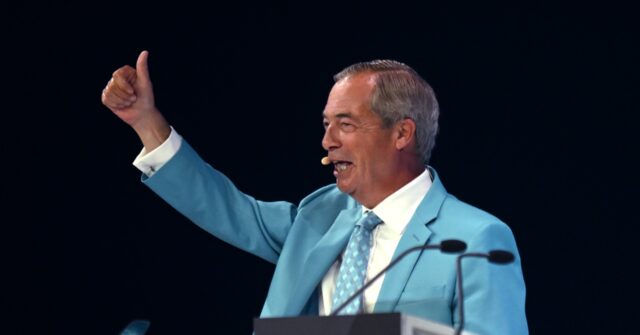
Nigel Farage’s Reform UK party has reclaimed pole position in Westminster voting intention as the so-called “bounce” for the parachuted-in Prime Minister Andy Burnham appears to be evaporating just weeks into his tenure in Downing Street.
Following a disastrous performance at the ‘midterm’ local elections in May, the Labour Party jettisoned Sir Keir Starmer, forcing the only leader to win a general election for the party since Blair nearly 20 years before out the door, with the hopes that a mere change of face in Number 10 (in the form of Manchester Mayor Andy Burnham) would save them from the wrath of the voter.
While the British public continues to be gracious and willing to give new prime ministers a honeymoon period, that patience appears to be wearing thin, with the “Burnham bounce” for Labour in the polls already collapsing less than two months after he took office on the back of just 25,000 votes in a special election specially crafted for Burnham by Westminster insider and anti-Breitbart activist Josh Simmons.
Though Labour held the top position in YouGov’s party polling as recently as last week, Nigel Farage’s Reform UK has retaken the lead, as it has for most of the past year. In a survey of 2,310 adults in Britain between Sunday and Monday, Reform UK rose four points to 25 per cent, compared to Labour’s 24 per cent, which also rose by a point.
The biggest losers of the week, however, appear to be the Conservatives of Kemi Badenoch, whose support fell by three points to just 19 per cent.
Rounding out the rankings, the Liberal Democrats remained static at 12 per cent, while the Greens fell by three points and the breakaway Restore Britain party of former Reform MP Rupert Lowe fell by one point to 3 per cent support.
Celebrating the return to form for Reform, deputy leader Richard Tice said: “YouGov have spotted the error of their ways and put Reform back in our number one spot. Labour are behind us as Burnham bounces down. As for the Tories, they are disappearing down into the teens, becoming irrelevant.”
The polling may prove to limit the political options of Prime Minister Burnham, with some London prognosticators predicting that he may have preferred to call for an early election at his presumed apex of popularity and wrong-foot Farage and Reform.
If the trend continues, it would likely force Burnham to deliver on the public’s major issues, rather than relying on party preference and a relatively blank state to carry him through a snap vote.
Laying out some of his strategy to turn the country’s fortunes around on Tuesday at the Labour Party conference on Tuesday, Burnham said that his government will look to put large portions of the British economy back under state control, claiming that the privatisation push under former PM Margaret Thatcher in the 1980s had led to the current economic woes facing the country.
“When people hear the phrase public control, I am sure some think it’s anti-business. It’s the opposite. Businesses need the basics to be functional and affordable too, as does the wider economy. As someone said to me recently, there’s a reason why you can’t build all over the Water Works and the Electric Company on the Monopoly board,” he said.
“Energy, water, housing. Back under stronger public control. We rely on them, we pay for them and once again we will have power over them,” he added.
Burnham also pitched bringing Britain back into closer alignment with the European Union, arguing that “Brexit has done more harm than good”. Despite anaemic growth rates among major EU players like Germany, the PM pitched closer ties as the solution to Britain’s faltering economy.
The Labour PM also indicated that closer ties with the EU would ease the migrant crisis in the English Channel. However, he provided few details on how this would be accomplished and has so far refused to commit to sending illegal migrant boats back to France. Meanwhile, his government announced plans to import more migrants from Afghanistan and Palestine this week, indicating that the far-left of the Labour Party has won control of the issue.
Meanwhile, Burnham also said that his government would seek to implement pension reforms after 2030, eliminating automatic increases based on inflation to save money for social care spending. Potentially laying out the fault lines of the next election, Reform UK leader Nigel Farage said: “I will cut foreign aid, migrant welfare, welfare fraud, and mad net zero spending. Andy Burnham will cut your pension.”