

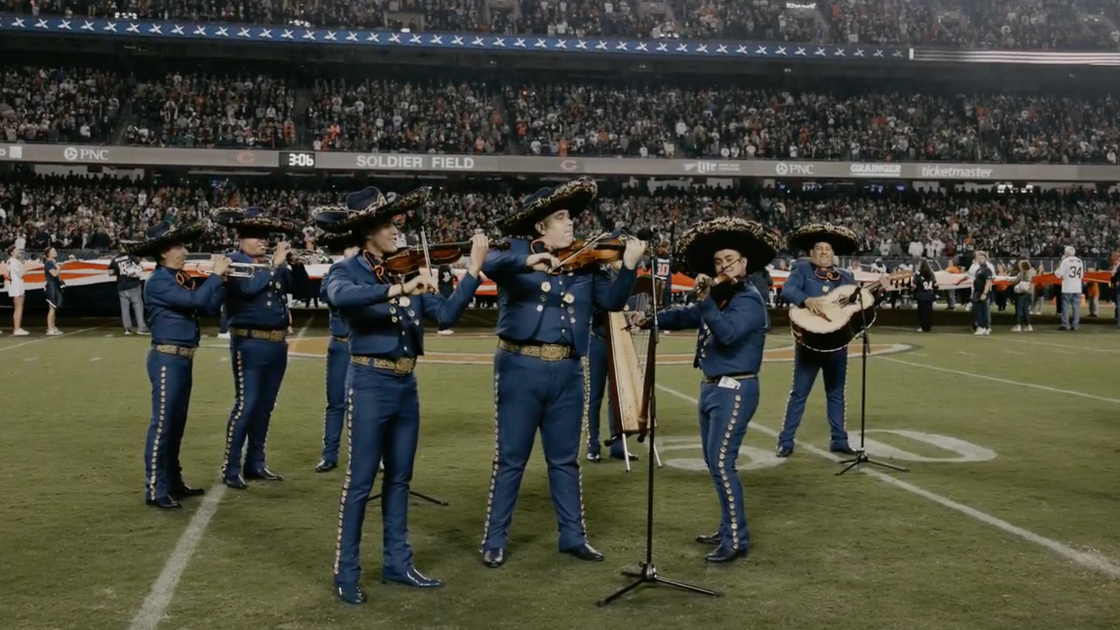
On Monday night, Mariachi Herencia de México — a beloved, Grammy-nominated mariachi group based in Chicago — performed the most seasoned rendition of the Star Spangled Banner to kick off the Bears vs. Eagles game at Soldier Stadium.
If you haven’t seen the performance yet, you definitely should: The band blends trumpets with violins and even a harp, making the anthem sound chirpy and deeply emotive all at once. Many saw the performance as a goosebumps-inducing interpretation of an iconic song we all have heard dozens of times.
It was a monumental moment for everyone involved, given the city it happened in. Chicago is nearly 30% Latino, and most of that demographic is of Mexican descent. As an integral part of the city’s fabric, it felt right to see Mariachi Herencia representing. And since it was the first broadly televised Mariachi performance at an NFL game, the country got see a Latino culture — a la Bad Bunny at the Super Bowl — amplified proudly during a time when the demographic is particularly vulnerable.
In 2026, though, we can’t have anything nice without the haters chiming in.
“Last time I checked, Mexicans have their own country and national anthem. We don’t need people dressed like Mexicans performing America’s national anthem,” someone commented under the video of the performance ESPN posted on X. Others have had similar reactions, with some even calling the performance disrespectful and un-American.
Cèsar Maldonado, the 42-year-old founder and CEO of the 15-person mariachi group that performed the anthem, is, in fact, American. He grew up in Chicago, where Latino culture is virtually everywhere. Maldonado’s parents, who are from Mexico, put him on to icons like José Alfredo, Vicente Fernández and Aída Cuevas early on.
Chicago is also a city that has become a target in mass deportation campaigns. Last year, Operation Midway Blitz — which targeted immigrants in the city and is believed to have caused businesses up to $1.26 billion in lost revenue across Cook County — ended up deporting up to 2,700 people.
Perhaps this dichotomy is part reason why this particular performance ended up going viral now — and why we, as a community, felt seen by their performance.
“You just saw a huge stadium in awe,” Maldonado told JS about the moment. “People with their jaw open like, ‘Who are these guys?’”
The band, comprised of several members born and raised in Mexico, has never received this much attention. They have done renditions of the national anthem for other sports teams, but never at this scale.
The overwhelmingly positive response is testament that even those with biases can’t fight the visceral experience of being deeply moved by music, especially a genre that is as powerful as mariachi. “Hopefully this can be a moment of unity,” Maldonado tells me. “Hopefully people see that performance, and they hear the amazing music, and hopefully their minds are changed.”
That positivity is refreshing during a time when nearly 40% of Latinos worry that they or a family member will be deported, according to a Pew Research Poll, and entire neighborhoods across the country have been completely transformed as a result of the looming threat of ICE.
Moments like these make me realize that it’s only a matter of time before the community and culture gets its due respect.
“Mariachi [music] is a sleeping giant in this country,” Maldonado says. The genre is clearly resonating with people of all different backgrounds. And whether people realize it or not, Mexican culture is a fixture of American culture itself. No amount of fear can undue that.
Other national sports teams are already reaching out to the group to perform for their games, Maldonado says. This is hugely affirming not only for Mariachi Herencia, but also for many Mexican Americans around the country like myself who have found themselves increasingly losing hope.
There is a lot of divisiveness out there, but there is also a lot of joy and support, even in places that might surprise us. For Maldonado and his band, moving forward is simply a matter of continuing to sing.
“They are finally looking at artists like us as people who can add value to what they do,” Maldonado says. “And for that reason, it’s an amazing moment.”