

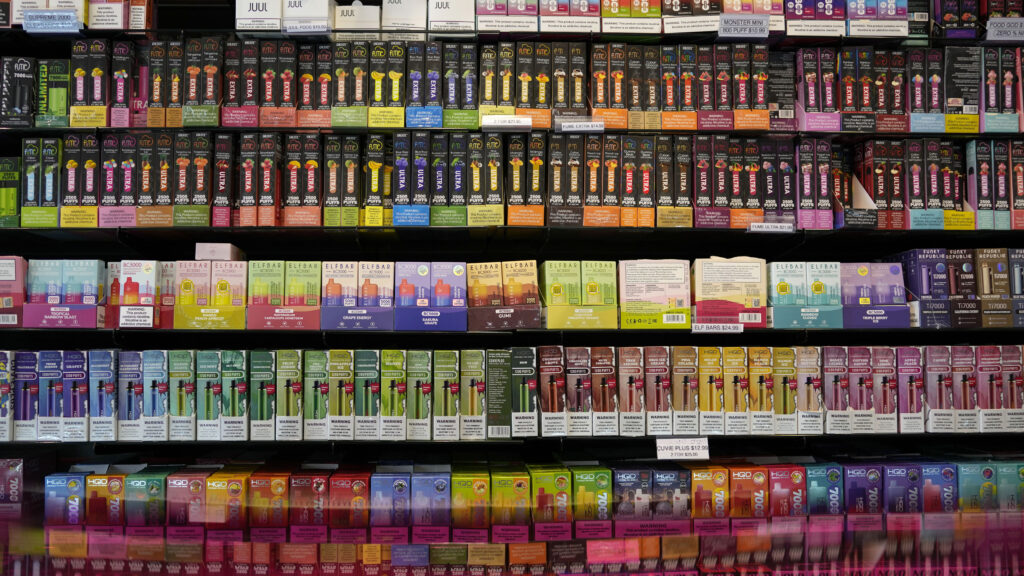
The tobacco industry chalked up another win on Friday with a new policy announced by the Food and Drug Administration that gives what one expert called a “get-out-of-jail-free card” to some manufacturers illegally selling e-cigarettes and nicotine pouches.
The FDA has a significant backlog of applications from the makers of vapes and nicotine pouches seeking authorization to sell their products. Some have gone ahead and put their products on sale anyway while awaiting word from the agency. In the new guidance, first reported by the New York Times, the agency said it will not prioritize cracking down on illegal sales under two conditions.
First, the manufacturers’ applications must have been filed and accepted by the FDA. Second, in the case of flavored vapes, the manufacturers must have provided what the agency deems sufficient data to evaluate whether the product is “appropriate for the protection of public health” — that is, whether the risks for potential youth uptake are outweighed by the benefits it may offer to adult smokers looking to quit. (Notably, the FDA doesn’t have to actually evaluate the public health data for companies to receive carte blanche — that can happen later.)
The guidance is troubling for several reasons, said Mitch Zeller, a former head of the Center for Tobacco Products at the FDA.
First, the FDA skipped the process of first issuing a draft and allowing public comments before publishing its final draft. “It is alarming,” Zeller said, because typically the FDA only goes straight to final guidance if there’s a public health emergency.
“The only thing that I can figure out is that this was a desperate attempt by the commissioner to try to save his job,” said Zeller, noting that his comment was purely speculative. President Trump reportedly plans to fire FDA commissioner Marty Makary, though no official announcement has been made. The agency last week also authorized two fruit-flavored vapes from Los Angeles-based company Glas, reversing a previous decision by Makary, who told STAT he’d been “skeptical” that the devices’ technology would be enough to stop underage people from using them.
A second concern, Zeller said, is that the FDA is effectively granting a “get-out-of-jail-free card” to companies that charged ahead with their products without authorization, which is “fundamentally unfair to companies that were following the rules and kept their products off of the market.”
When companies put their products up for sale without the FDA’s permission — whether for tobacco, drugs, or medical devices — that’s illegal, he said. “It’s a horrible precedent that makes no sense legally.”
Meanwhile, the new policy does not address the problem of the many illegal flavored vapes imported from China that make up about 70% of the black market, and which the Trump administration has frequently spoken out against. Implicit in the new guidance is the idea that the FDA will concentrate its enforcement efforts in that area.
STAT’s coverage of chronic health issues is supported by a grant from Bloomberg Philanthropies. Our financial supporters are not involved in any decisions about our journalism.