

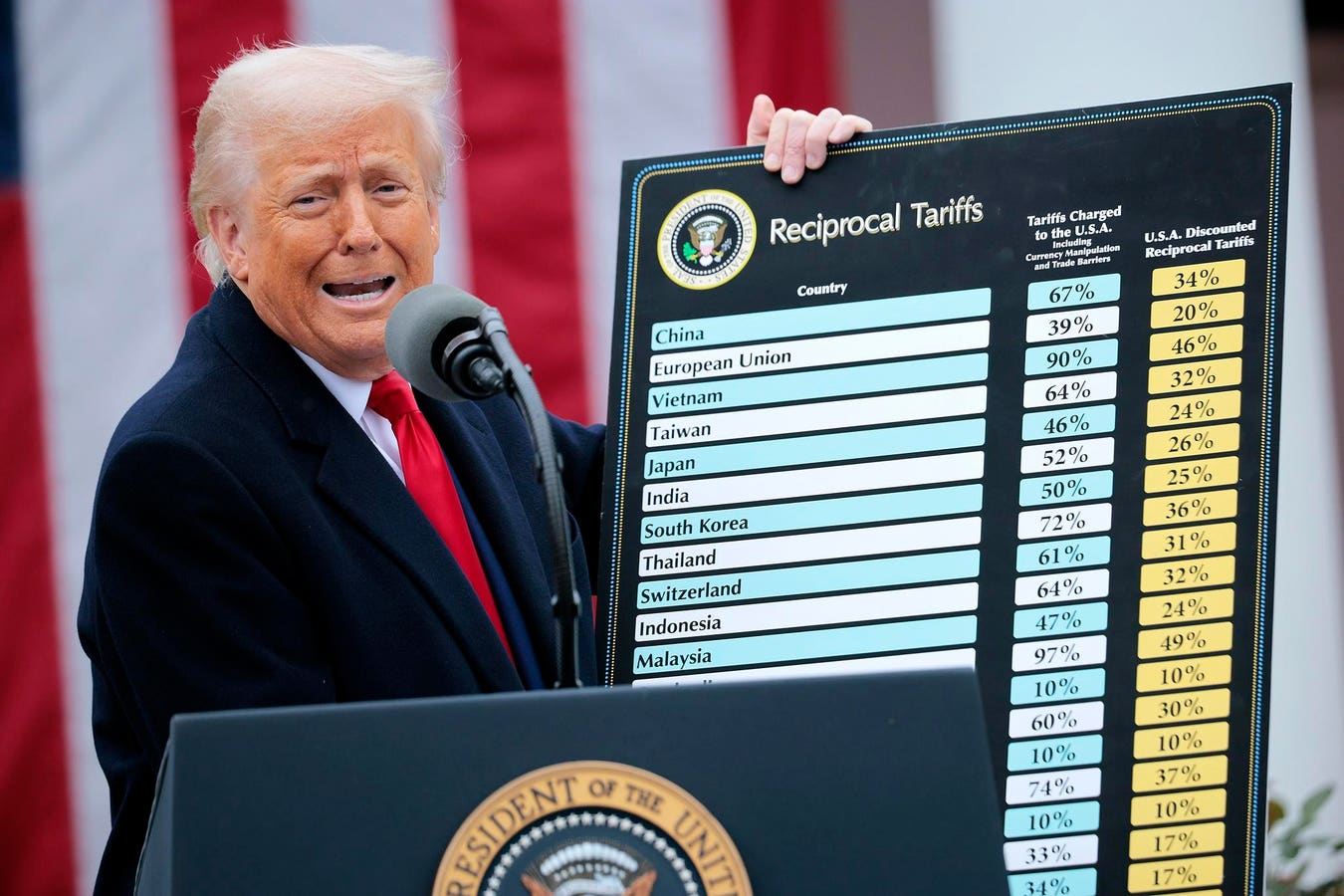
WASHINGTON, DC – President Donald Trump holds up a chart while speaking during a “Make America Wealthy Again” trade announcement event in the Rose Garden at the White House on April 2, 2025 (Photo by Chip Somodevilla/Getty Images)
Getty Images
On July 21, 2026, President Trump uploaded the following post to his social media platform: “Effective August 1st, 2026, all Generic Drugs being brought into the United States will continue to have a TARIFF of ZERO PERCENT for a two year period of time, after which the TARIFF will be raised to 100% for a one year period of time, and 200% thereafter.” Trump wrote. “This is done in order to RESHORE Generic Pharmaceutical Production into America, with a penalty to those Companies that decide not to build Plant and Equipment within the stated period of time given to them.”
To justify such high tariffs, the White House intends to invoke Section 232 of the Trade Expansion Act of 1962, which addresses national security concerns arising from reliance on imports. I’m glad that the President recognizes this threat, but his approach could do more harm than good. In fact, imposing high tariffs on generic drugs could backfire.
The Economics Of Generic Drugs Differ Sharply From Brand-Name Drugs
Brand-name drugmakers spend huge sums developing new medicines in hopes of reaping enormous profits when one is approved for sale. Years later, when the drug’s patent expires, generic manufacturers crowd in and prices sharply fall. At that point, the lowest bidder generally wins. To minimize manufacturing costs, most generic drug companies moved offshore to countries with low labor costs and less stringent regulatory oversight than exists in the U.S.
Trump’s first confrontation with the drug industry unfolded last September, when he announced his intention to impose a 100% tariff on manufacturers of “branded or patented” imported drugs, unless the company “…is building a manufacturing plant in America.” Generic drugs were excluded. Several deep-pocketed multinational companies quickly announced plans to boost U.S. drug production. Others struck drug pricing deals with the White House or qualified for lower regional tariffs (e.g., Switzerland, Japan, and EU member states).
Trump has now set his sights on generic drugs. Although they represent a much smaller share of drug spending than brand-name pharmaceuticals, they account for more than 90% of prescriptions filled in the U.S. each year, and a substantial share of the IV and oral medications administered every day in America’s hospitals, outpatient surgery centers and dialysis facilities.
Tariffs on Generic Drugs Could Backfire
There are at least four reasons why generic drugs will be a tough nut to crack:
Price volatility: In contrast to brand-name drug makers, which account for more than 80% of drug spending, the generic drug sector operates on razor-thin margins. It’s therefore possible that many will pass the cost of tariffs on to American wholesalers. If that happens, their retail price could double in two years and triple in three.
Unrealistic timelines: The 100 percent tariff is supposed to take effect August 1, 2028 – less than six months remaining in the current administration. Political uncertainty makes it highly unlikely that offshore generic drug companies will rush to invest hundreds of millions of dollars each towards building U.S. manufacturing facilities.
U.S. generic drug manufacturers cannot fill the gap: Today, 90% of America’s generic drug supply is manufactured overseas. This includes nearly all of the active ingredients required to make our antibiotics. Even if many new U.S. plants were built in record time, we don’t have enough trained pharmaceutical workers to staff them. With concerted action, these realities can be changed, but not as quickly as President Trump expects.
The geopolitical stakes are high: India and China dominate global production of generic drugs and the ingredients required to make them. Trump’s proposed tariffs could lead them to take challenging countermeasures.
There’s A Better Way To Meet This Challenge
Market economics, exploited by illegal trade practices and weak regulatory enforcement, drove most of our generic drug production offshore. With public and private-sector cooperation and a healthy dose of innovation, we can bring it back.
Here’s how:
1) The FDA should publicly acknowledge that all generic drugs are no longer equally safe and effective. Some versions may be harmful due to improper manufacturing.
2) To detect potentially harmful drugs before they are dispensed to patients, U.S. health systems should require drug importers to agree to independent testing by ISO-accredited laboratories. If and when concerning results are found, the FDA should be promptly notified.
3) To boost accountability, drug quality ratings should be shared with the public (as they are for many other consumer products). This would create a powerful market signal to encourage high-quality manufacturing.
4) Federal purchasers, including the VA, the U.S. military, Medicare and Medicaid, should immediately switch from purchasing drugs based on “lowest cost” to “best value” (which considers quality as well as cost). If they do, private health systems and pharmacies will follow suit.
5) The administration has already taken tentative steps to rebuild America’s capacity to manufacture essential medicines. It should incentivize construction of manufacturing plants. To ensure a consistent supply, health systems should provide high-quality manufacturers with long-term contracts that include price floors and guaranteed volumes.
Before Trump’s team formally implements his tariff threat, I hope they’ll realize there is a surer, safer path to reducing America’s dependence on foreign drugs of dubious quality. It’s grounded in three principles that made our economy great: American ingenuity, informed consumers, and homegrown industries committed to ensuring our health and security.
The views in this commentary are the author and do not necessarily reflect those of any current or past employer