

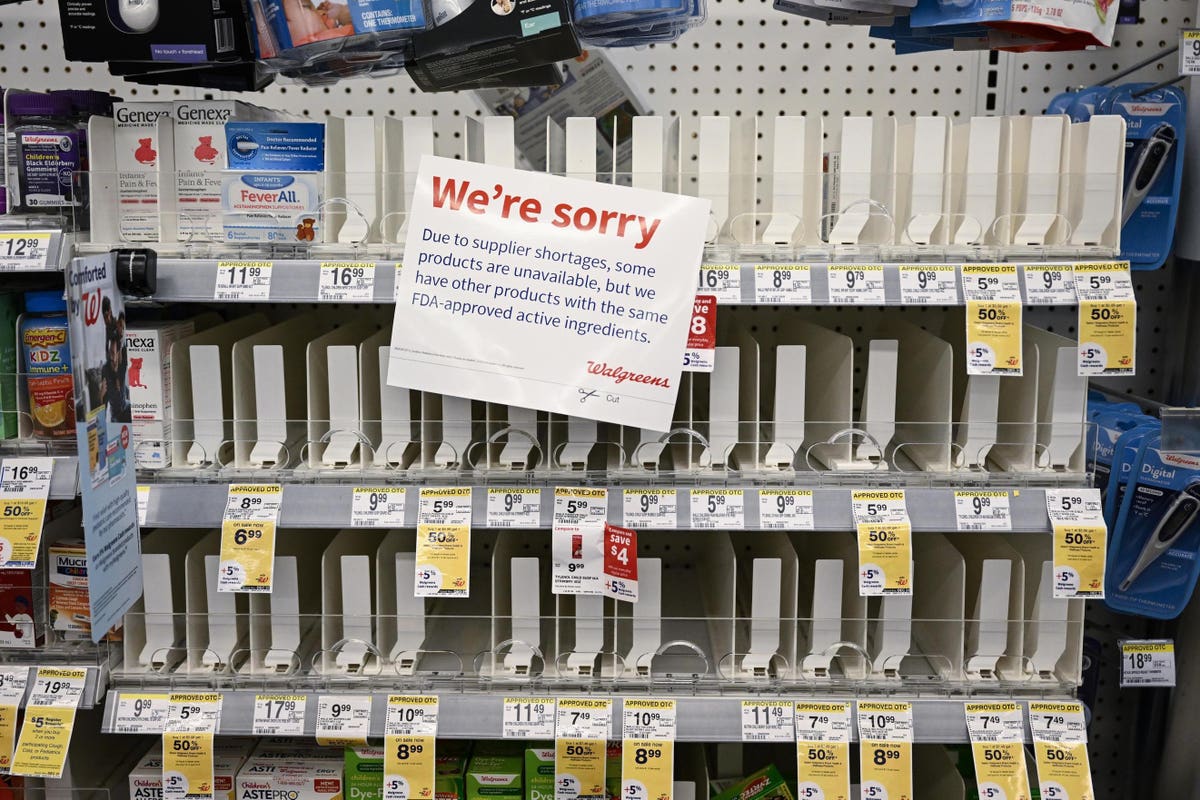
NEW YORK, NY: A sign is placed near the section for children’s medicine at a Walgreens on December, … [+]
According to the FDA database, there are currently more than 135 drugs in shortage, with medical devices also in short supply. A recent U.S. Senate Committee on Homeland Security and Governmental Affairs report found that drug shortages in the U.S. increased 30% between 2021 and 2022. The report also found that “more than 15 critical drug products have been in shortage for over a decade.”
The U.S. has endured drug shortages for some 20 years, and, unfortunately, little has changed during that time. Headlines about critical drug shortages certainly feel both more frequent and more serious. Headlines such as “Cancer drug shortages could put chemo patient treatment at risk,” and “US cancer drug shortage forces doctors to ration life-saving treatments” highlight not only the scarcity of chemotherapy drugs but also shortages of other life-saving medicines and even emergency room (ER) supplies. What’s particularly troubling is that while supply chain related shortages in many other areas have eased, those related to drugs and medical supplies have become worse, suggesting a problem that is endemic.
While pharmaceutical and medical device companies’ approach to inventory and foreign outsourcing, coupled with supply chain disruptions, are to blame, a closer look at Wall Street uncovers the root of a much deeper problem. All of this was predictable, and it has come at a high cost.
We still remember the severe shortage of personal protective equipment (PPE) that beset U.S. healthcare delivery during the Covid-19 pandemic, which in one instance led to reports of nurses in New York donning trash bags for protection against the virus. A more recent echo was last year’s recall and severe shortage of baby formula. My assessment then was that incompetence and lack of foresight and contingency planning by the Food and Drug Administration (FDA) and others in government were largely to blame for that debacle. While the current cancer drug shortages can be traced back to “serious quality-control violations” found at a pharmaceutical plant in India, that is not the root cause. What is going on now with shortages more broadly has different origins and are clearly not isolated incidents.
Every day, we are reminded of our nation’s dwindling medicine supply, ranging from penicillin to drugs used to treat chronic conditions and even pain relievers. In a more distressing sign of the times, a close associate told me about a recent trip he made to the ER after sustaining injuries from a fall. While there, the hospital staff wrapped his knee wound with a compression bandage because he was told they didn’t have any more adhesive stick bandages. For a country that has all the technology, capabilities, resources and know-how one could imagine–this scarcity of basic things is very concerning. The current trajectory is unsustainable and fortunately, the federal government acknowledges the need for urgent action.
The Importance of Ending U.S. Reliance on Foreign Countries for Drugs
Discussions of the problem have centered around ending the U.S. reliance on foreign countries for medical supplies and active pharmaceutical ingredients (APIs), or the primary components of drugs. According to a Johns Hopkins study, of the 42 countries producing generic APIs for the U.S. market, India, China and Italy were the top producers. And the aforementioned report from the Committee on Homeland Security and Governmental Affairs also revealed that the number of Chinese-based API manufacturers registered with the FDA more than doubled, from 188 to 445, between 2010 and 2015.
Last month, Senators Gary Peters (D-MI) and Joni Ernst (R-IA) introduced bipartisan legislation in Congress to tackle the issue by calling for comprehensive coordination among appropriate federal agencies “to determine how potential shortages can impact national security and broader public health.” Ernst emphasized that “the United States cannot continue to rely on our foreign adversaries, like China, for critically important materials to meet the medical needs of Americans.” While this is a pressing national security concern, it overlooks a larger point about how we can tackle shortages.
At the start of the Covid outbreak, I opined in this column about global supply chain disruptions caused by the pandemic and the negative implications of our dependence on China and other foreign countries for critical medicines and APIs. As I explained, the rationale for outsourcing in large part boils down to economics for pharmaceutical companies.
For years, it has been more cost effective to manufacture off-shore and companies have done just that. In the case of relatively inexpensive drugs like antibiotics, there is no incentive to maintain a significant inventory of such inexpensive drugs that are used for short durations. Instead, many of these companies have focused on more high profile, high risk, expensive biopharmaceuticals and drugs that are more likely to be taken for chronic conditions. A case in point is Tel Aviv based Teva Pharmaceuticals’ recent announcement that the company would be cutting back on some of its portfolio in generics to focus on more profitable lines of business aimed at growth. Teva is a major producer of the ADHD treatment drug Adderall, which is currently facing shortages in some doses due to increased demand.
Addressing Big Pharma’s Relationship with Wall Street is a Must
There is no easy fix to the drug, medical device and other supply shortages we are experiencing. Yes, we need to end extreme foreign reliance on manufacturing. Yes, we need to fix broken supply chain issues, and yes, we need to bolster strategic reserves for certain critical drugs and APIs, much like we have for petroleum. And we need to address the enormous burden of the bureaucracy that surrounds the process of getting drugs to market, managing the complexity of government reporting, and the additional costs incurred by patients as actors in the ecosystem add their markup to the price of drugs. But we also need to get to another fundamental root of the problem.
For far too long, pharmaceutical companies, along with those in other industries, have made business decisions that favor investors with a short-term profit driven perspective. Consequently, foresight and decisions regarding long-term investments have taken a back seat. This situation has resulted in the current predicament, where there is often little to no incentive to strategically prepare for the needs that future pandemics, natural disasters, or other crises may bring. This dynamic needs to change, and it requires companies to take a hard look at rethinking profitability in a way that focuses on both short and long-term sustainability, while also making a strong value argument in both areas.
It certainly is a delicate balancing act, but one that is achievable. To capture all of this, Giacomo Chiesi of the Chiesi Group, an Italian family-owned pharmaceutical company, said “an important advantage of being a family business is the opportunity to focus on the long term – we look ahead to the next generation of people and not necessarily the next month or the next quarterly report.” This approach offers valuable advice for any company, whether public or private, but it also requires a deliberate and intentional mindset.
Big pharma is the natural champion for bringing safe and cost-effective therapies to market on a global scale, and it continues to possess enormous competitive advantages in that role. But until the current investment criteria are modified to put more importance on managing strategic risk, the pharmaceutical industry will continue to undermine its own credibility. And that goes for our health and security too.