

The intricate dance of romantic relationships creates powerful feedback loops that can significantly enhance mental health and wellbeing. Scientific research reveals that the quality of our intimate partnerships doesn’t just reflect our psychological state; it actively shapes it through complex, bidirectional mechanisms that operate on emotional, behavioral, and physiological levels.
The Science Behind Relationship Feedback Loops
Relationship feedback loops operate as circular processes where partners’ behaviors, emotions, and responses continuously influence each other, creating either upward spirals of connection and wellbeing or downward cycles of distress. When functioning positively, these loops become self-reinforcing systems that promote mental health through multiple interconnected pathways.
Research demonstrates that couples in high-quality relationships experience what scientists call “physiological linkage”; their heart rates, cortisol levels, and other biological markers begin to synchronize, creating a shared regulatory system that buffers against stress. This phenomenon extends beyond mere correlation; partners literally co-regulate each other’s nervous systems, with responsive support from one partner directly influencing the other’s stress recovery and emotional stability.
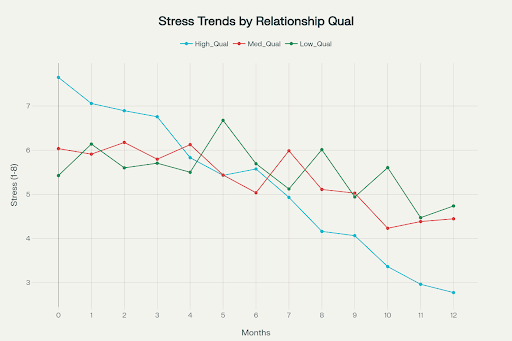
Stress level reduction over time varies significantly by relationship quality, with high-quality relationships showing the steepest decline in stress
Mechanisms Of Mental Health Enhancement
Partner Responsiveness and Psychological Wellbeing
The cornerstone of beneficial relationship feedback loops is partner responsiveness; the extent to which individuals feel understood, cared for, and appreciated by their romantic partner. Studies consistently show that perceived partner responsiveness serves as a powerful predictor of mental health outcomes, with effects that persist over decades.
Research involving over 1,000 couples followed for 20 years found that higher levels of perceived partner responsiveness predicted better physical health, psychological well-being, and even lower mortality rates. The mechanism operates through enhanced perceived control and reduced negative affect reactivity to daily stressors. When individuals feel their partners truly understand and support them, they develop greater confidence in their ability to handle life’s challenges, creating a buffer against anxiety and depression.
Higher partner responsiveness is associated with reduced anxiety and depression symptoms while increasing life satisfaction

Dyadic Coping And Stress Reduction
Dyadic coping; the process by which couples jointly manage stress; represents another crucial mechanism through which relationship feedback loops improve mental health. When partners engage in positive dyadic coping strategies, they create mutual support systems that benefit both individuals simultaneously.
A comprehensive study of 288 couples dealing with infertility stress revealed that positive dyadic coping not only reduced participants’ own anxiety and depression but also decreased their partner’s psychological distress through “partner effects.” Conversely, negative dyadic coping patterns increased psychological symptoms in both partners, demonstrating the bidirectional nature of these feedback processes.
The research showed that individuals whose partners employed positive coping strategies experienced significant reductions in anxiety (β = -0.05, p < 0.01) and depression (β = -0.06, p < 0.01), independent of their own coping efforts. This finding underscores how relationship dynamics create shared mental health outcomes rather than merely individual ones.
Physiological Synchronization And Stress Recovery
Perhaps most remarkably, intimate relationships create physiological feedback loops that directly impact stress response and recovery. Studies using continuous monitoring of couples’ heart rates, cortisol levels, and other biomarkers reveal that partners’ physiological states become interconnected in ways that promote healing and resilience.
Physical intimacy and emotional support provide the greatest physiological stress relief benefits, reducing cortisol levels and accelerating recovery time
Research on romantic couples found that partner touch increased interpersonal physiological coupling during both painful and non-painful experiences. When couples engaged in supportive physical contact, their heart rate and respiratory patterns synchronized, and the partner’s empathetic response enhanced the analgesic effects of touch. Women who embraced their romantic partners before undergoing stress showed significantly reduced cortisol responses compared to those who didn’t receive partner contact.
The physiological benefits extend beyond immediate stress relief. Couples who demonstrated spontaneous intimacy behaviors; such as hand-holding, hugging, and affectionate touch; showed accelerated cortisol recovery following stressful experiences. For women, partner intimacy reduced cortisol reactivity to stress by an average of 28%, while both men and women experienced faster return to baseline cortisol levels when their partners provided intimate support.

Long-term Mental Health Outcomes
Depression and Anxiety Reduction
Longitudinal research tracking couples over multiple years demonstrates that positive relationship feedback loops create lasting improvements in mental health. A 20-year study of married couples found that higher relationship satisfaction at baseline predicted significantly lower rates of depression and anxiety disorders over time, with the protective effects strengthening rather than diminishing with age.
The mechanisms underlying these long-term benefits involve multiple reinforcing processes. Partners in responsive relationships develop better emotion regulation skills, experience reduced inflammatory responses to stress, and maintain more stable sleep patterns; all factors that protect against mood disorders. Additionally, the security provided by a supportive relationship enables individuals to take healthy risks, pursue personal growth, and maintain optimism about the future.
Enhanced Resilience And Recovery
Quality relationships don’t just prevent mental health problems; they accelerate recovery when difficulties do arise. Research shows that individuals with highly responsive partners recover more quickly from episodes of depression, experience less severe symptoms during anxiety periods, and demonstrate greater resilience to major life stressors.
A study of couples dealing with chronic illness found that relationship quality predicted not only individual adjustment to the condition but also the speed of psychological adaptation. Partners who engaged in effective dyadic coping strategies helped each other maintain positive identities, find meaning in their experiences, and develop confidence in their ability to handle future challenges.
The Bidirectional Nature Of Influence
One of the most important discoveries in couples’ research is the bidirectional nature of mental health influences. Unlike traditional models that view individual therapy as separate from relationship factors, modern research reveals that partners’ mental health states continuously influence each other through multiple feedback mechanisms.
Emotional Contagion And Co-regulation
Partners develop shared emotional patterns through processes of emotional contagion; the automatic tendency to catch and mirror each other’s feelings. In healthy relationships, this creates opportunities for positive emotions to amplify while negative states are buffered through partner support.
Research on daily emotional experiences in couples found that on days when one partner experienced high positive affect, the other partner was significantly more likely to also report elevated mood, creating upward spirals of well-being. Conversely, when one partner was distressed but received responsive support, both partners’ negative emotions decreased more rapidly than when support was absent or inadequate.
Behavioral Reinforcement Patterns
The feedback loops in relationships operate through complex behavioral reinforcement patterns. When one partner engages in supportive behaviors; such as active listening, physical affection, or practical assistance; the recipient typically responds with increased warmth and appreciation, which in turn motivates continued supportive behavior from the original giver.
These positive behavioral cycles create what researchers term “relationship maintenance feedback loops.” Partners develop habitual patterns of mutual care that become self-sustaining, requiring less conscious effort over time while providing increasingly sophisticated forms of support tailored to each other’s specific needs and preferences.
Practical Applications and Interventions
Understanding the science of relationship feedback loops has led to the development of evidence-based interventions that can help couples create more positive cycles of interaction and mental health support.
Mindfulness-Based Approaches
Research shows that mindfulness training for couples enhances their ability to respond rather than react to each other’s emotional states, creating more intentional and supportive feedback patterns. A study of couples practicing mindfulness-based relationship techniques found significant improvements in relationship quality (r = .28, p < .001) and reductions in individual stress levels over a 12-week period.
The mindfulness approach works by helping partners become more aware of their automatic responses and choose more skillful ways of engaging with each other’s emotional experiences. This conscious approach to interaction disrupts negative feedback cycles and promotes the development of positive ones.
Communication Skills Training
Interventions focused on improving couples’ communication skills have demonstrated substantial effects on mental health outcomes. Research on couples who completed structured communication training showed that participants developed better conflict resolution strategies, with 64% reporting stronger relationships and reduced individual anxiety symptoms after one month of practice.
The key mechanisms involve teaching partners how to provide effective feedback to each other; expressing needs clearly while also demonstrating understanding and validation of their partner’s perspective. These skills create more satisfying interactions that reinforce continued engagement and mutual support.
Implications For Mental Health Treatment
The research on relationship feedback loops has profound implications for how we approach mental health treatment, particularly for individuals in romantic relationships.
Integrative Approaches
Rather than treating individual mental health symptoms in isolation, an increasing number of therapists are adopting integrative approaches that address both individual and relationship factors simultaneously. This approach recognizes that lasting improvements in mental health often require changes in the relationship dynamics that either contribute to or protect against psychological distress.
Studies comparing individual therapy alone to combined individual and couples interventions show significantly better outcomes for the integrated approach, with lower relapse rates and greater long-term satisfaction. The relationship context provides both additional resources for healing and opportunities to practice new skills in real-world situations.
Prevention-Focused Interventions
Understanding relationship feedback loops also supports prevention-focused approaches to mental health. By helping couples develop positive interaction patterns before serious problems arise, interventions can build resilience that protects against future mental health challenges.
Research on preventive couples programs shows that participants maintain better mental health outcomes for years after completing relatively brief interventions, suggesting that strengthening relationship feedback loops creates lasting protective effects that continue to benefit partners long after formal treatment ends.
The Positive Feedback Loop Of Love And Health
The scientific evidence reveals that healthy romantic relationships create what can best be described as a “positive feedback loop of love and health.” When partners respond to each other with understanding, care, and support, they initiate cascading processes that enhance both individuals’ mental health through multiple interconnected pathways.
These benefits compound over time as couples develop increasingly sophisticated ways of supporting each other’s well-being. Partners learn to recognize early signs of distress, provide targeted support that matches their partner’s specific needs, and create shared meaning systems that help both individuals navigate life’s challenges with greater resilience and optimism.
The research demonstrates that investing in relationship quality isn’t just about partnership satisfaction; it’s a fundamental component of mental health maintenance and enhancement. By understanding and nurturing the feedback loops that connect romantic partners, couples can create powerful resources for psychological wellbeing that benefit both individuals far beyond what either could achieve alone.
The implications extend beyond individual couples to suggest that supporting healthy relationship dynamics should be considered a public health priority. As our understanding of these feedback mechanisms continues to evolve, the potential for developing even more effective interventions to harness the healing power of love becomes increasingly promising.