

Highlights
UCSD researchers have spent years building trust in communities of unhoused people who use drugs in San Diego and across the border in Tijuana.
Since spring, some 10% of their research participants have been found to have active syphilis — cases that might otherwise have gone undiagnosed and untreated.
NIH restrictions on foreign research collaborations have complicated the team’s infectious disease monitoring, and a shortage of intramuscular penicillin makes full treatment for these patients less certain.
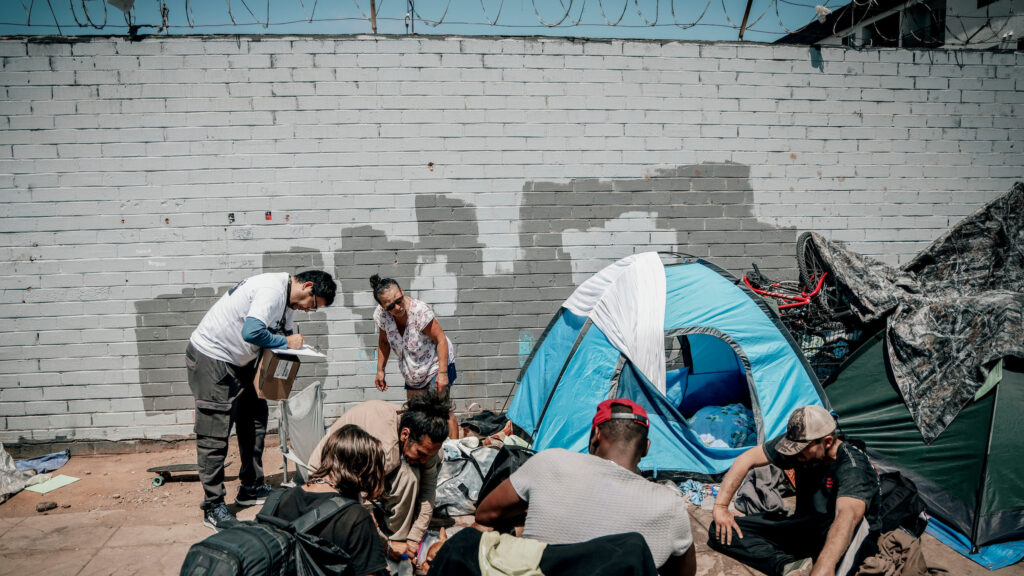
SAN DIEGO — She first came to Park Boulevard for the money and the snacks. A friend told her there was a place they could go with free fruit gummies, granola bars, and rice crispy treats — and she could make $20 if she answered some survey questions. It sounded like a dream. GB had been spending her nights crinkling through garbage bags for bottles and cans. Aluminum got $1.66 per pound; to make $20, she had to collect hundreds of empties. As far as she understood, on Park Boulevard, all she had to do was show up. One morning in May, she and her friend walked over from the tent city where they lived.
The place was a research office: sterile, with frosted glass. Sure enough, there was good, strong coffee and a little basket of snacks. She was surprised, though, when the researcher who’d been interviewing her asked if he could draw her blood. She was 47. She’d been using meth since 2021, but she was terrified of needles. She snorted her speed, never did heroin, never injected anything at all. She thought about saying she needed the bathroom and sneaking off. But she liked Carlos Vera, the guy who was asking. He was gentle, and talked to her like a real human being, unlike so many people, who treated her like a bug, like something dirty to be rid of.
She gave consent — and she was even more surprised when Vera told her that her initial results were coming back positive for syphilis. How could she have syphilis? Her boyfriend had overdosed back in February. She’d been doing CPR when the paramedics arrived. By then he was already gone. He was the only person she’d slept with for years. She had no symptoms.
They’d have to do confirmatory testing, but if she was infected, Vera offered to take her to the county clinic for free treatment. He was seeing this more and more. He wasn’t a doctor or a nurse, or officially speaking, a health care worker at all. He was an outreach coordinator for the University of California, San Diego, recruiting people for studies about drug use and infectious disease in communities that span the U.S.-Mexico border. A prerequisite for enrolling participants was being a steady, trusted presence under bridges, in tent encampments, at the cracked and weedy city margins where the most vulnerable ended up. Lately, he’d often found himself delivering diagnoses. Since March, of the 81 people his team had interviewed for their latest study in San Diego, eight of them turned out to have active syphilis.
It was an alarming twist in what might’ve been a moment of cautious optimism. After over 20 years of rising syphilis rates in the United States, the latest data had finally shown the numbers easing a bit. Then again, by the time GB was being tested, the latest data were nearly two years old, from 2024. Earlier this spring, the local Planned Parenthood affiliate had warned of a “silent crisis” of unreported sexually transmitted infections — the same trend Vera and his colleagues were seeing in their research. These were people often alienated by doctors and hospitals, who might not have gotten tested at all if they hadn’t signed up as study participants. “I wouldn’t have fucking known,” GB said.
Now, there was an added hitch. GB lives less than 20 miles from the busiest border crossing in the Western Hemisphere. According to the Department of Homeland Security, some 90,000 people cross it every day — and that’s only counting those traveling northward. For many, going between San Diego and Tijuana is part of their commute. The study through which GB learned she was infected was supposed to take place on both sides of the border — but then the scientists’ liaison at the National Institutes of Health told them international collaboration was no longer a priority and that they would only receive funding if they removed the part of their proposal that involved research in Mexico.
When Vera took GB to the county clinic for free syphilis treatment, he found another surprise. He was expecting her to get an intramuscular form of penicillin that dissolves slowly, over the course of a week or so, disrupting the corkscrew-shaped bacteria’s reproductive machinery every time they divide until none are left alive. But there was a shortage of that drug. Instead of getting the recommended injections — one or three, depending on the stage of disease — GB emerged from the examining room with a prescription for oral antibiotics, to be taken twice a day for 30 days. That was hard for someone who had stable housing. For someone sleeping in a tent, it seemed untenable.
It was so easy for study participants to be robbed, or to lose track of a pill bottle. “When there are occasional police sweeps, they dispose of everyone’s belongings. Many times, medications are included in those belongings,” said Britt Skaathun, an epidemiologist at UCSD and one of the leaders of the study Vera was working on. They’d seen people lose daily HIV, diabetes, and depression medications that way, as well as the naloxone that could save someone from an overdose.
Syphilis, caught early enough, was curable. But with recruitment cut off in Tijuana, it was likely there were cases the researchers weren’t catching — and among those cases in San Diego they were finding, the shortage of intramuscular penicillin made full treatment less certain. As Vera Ubered back from that appointment with GB, he couldn’t help but wonder: Would she be able to finish the medication she needed to be cured?
Study as safety net
“What’s the role of an epidemiologist? Do you just publish the data and let other people interpret it for policy implications, or do you, as a researcher, have that responsibility, because you know the data better?”
Steffanie Strathdee knew just how high the stakes for that question could be. In the 1990s, when she was first starting to research HIV transmission among people who injected drugs, she’d co-published a paper called “Needle exchange is not enough: lessons from the Vancouver injecting drug use study.” Providing free, clean syringes was “crucial,” she and her co-authors wrote, but to stop disease spread they needed to be accompanied by personalized services like counseling and education. Supplies could only be beneficial if people were able to properly use them.
She was advocating for more resources, not fewer. So she was shocked when a Republican congressman from Colorado entered her paper into the congressional record, claiming it showed that needle exchanges don’t work and actually exacerbate public health crises. “I was absolutely livid,” said Strathdee, now a professor at UCSD. “I’m proof that if you don’t help interpret the data for the policymakers, it can get misinterpreted — or misused intentionally.”
Strathdee and Skaathun knew the work they were doing at UCSD could easily be twisted in the same way. The lives they were documenting were a kind of triple whammy of possible politicization. These were stories shaped by substance use disorder, which could increase risks of sexually transmitted infections, and which played out in communities spanning the San Ysidro Port of Entry. In 2016, Donald Trump had campaigned on the idea of a border wall and halting drug epidemics by keeping out “bad hombres.” It wasn’t hard to see how research on sex, drugs, and U.S.-Mexico travel might be used as fuel for that isolationist narrative.
When traffic between Tijuana and San Diego was restricted during the Covid-19 pandemic, it presented a real-life experiment. Past studies had found that infectious diseases were often passed back and forth across the border. In 2009, for instance, 18% of Americans confirmed to have H1N1 flu had recently traveled to Mexico. In 2015, Strathdee was among a team of researchers to take samples from people with HIV in both Tijuana and San Diego and use the virus’ genetic sequences to understand the geography of transmission. Although many networks of patients were located either on one side of the border or the other, among the 14 clusters they found in Tijuana, five included patients who lived in San Diego — not surprising, perhaps, given that Americans cross not only to commute to work or visit family members, but also, in other cases, for sex tourism. In 2020, Strathdee and Skaathun wondered whether the pandemic-time border closure would be associated with less infection moving between the countries.
Although all nonessential crossing was in theory suspended, northbound travel into the U.S. was most significantly reduced — but that didn’t seem to stop cross-border HIV transmission. In fact, of the two viral clusters that were in both San Diego and Tijuana, one grew, while the other one stayed stable. Even when traffic was paused with the express purpose of blocking disease spread, the study suggested, these places remained epidemiologically intertwined.
Strathdee and Skaathun were hoping to keep delving into that question — and in September 2023, Strathdee noticed an NIH funding opportunity that seemed perfect. “I see that while the focus is on the US, foreign components are allowed. I am assuming the Tijuana component of our cohort can be included, but wanted to check,” she wrote to an administrator at the agency, explaining that her team had evidence that ending the HIV epidemic among people who use drugs in San Diego depended on prevention and treatment in Tijuana, too.
“Foreign components are allowed, and therefore your Tijuana site is acceptable,” the official responded a few days later.
But then, in April 2025, after Strathdee and Skaathun had written an application and their project had received a score that made funding seem likely, Strathdee said, the same NIH administrator wrote with new questions about the need for the foreign component of the study, how it strengthened the project, exactly how much it would cost, and whether the research was still viable without it if State Department clearance could not be obtained.
A few weeks after that, during a Zoom meeting with the NIH administrator, Strathdee and Skaathun recalled being told their application was no longer eligible if it included research in Mexico. Citing the need for greater transparency, on May 1, 2025, the agency had stopped funding proposals with “foreign subawards,” in which labs share their grants with collaborators abroad to do research that would be hard to accomplish without cross-border cooperation. A new grant structure for that sort of partnership was supposed to begin that September, though it would only end up taking effect in January 2026. In the meantime, they would have to rewrite their proposal, increasing the participants they’d be recruiting in San Diego and reducing those in Tijuana to zero. To comply was to ignore their previous findings, but the UCSD team hardly had a choice.
They had to lay off eight staff members and shutter their Mexican research office, losing people who’d spent years forging relationships with vulnerable communities there. Not only would the resulting research be less complete. “Our study sort of serves as a safety net for a lot of people,” Skaathun said.
The team was careful not to use NIH dollars to provide services, which isn’t allowed. But the trust they’d built over decades — through snacks, through lifts to the clinic, through nonjudgmental visits and conversation — meant that they were the ones to unearth cases of HIV and syphilis that otherwise wouldn’t be caught. Now, it was impossible to know how many diagnoses they were missing in Tijuana, and how they might be linked to cases they were still able to find in California.

From a $100,000 salary to Tent City
GB didn’t put much stock in doctors or hospitals. Health care was a business, she thought, always trying to squeeze more out of you. She’d been in a car accident years ago, had been told she needed opioids, surgery, this and that. She refused and walked out. “They want you to do PT? I PT’d myself,” she said. More than the snacks or the $20, what had made her give the research office on Park Boulevard a chance was that she’d heard about it from someone she trusted.
They’d lived in an “abando” together. It was one of the nicer places she’d slept since she’d been without stable housing. It was a three-bedroom with a detached garage and a garden out back, no longer safe for the older lady who owned it, nice if run down. The lady’s kids didn’t have enough money to fix it, and had made a deal: The folks occupying the place could stay as long as they kept it up. They did. They laid new tile. They cleaned. They sat in the garden drinking coffee.
When one person arrived with a dog, and another with a cat, GB made sure the animals weren’t carrying bugs. “I don’t know how to do no flea bath, but you know what? You can watch a YouTube video for everything,” she said.
It carried hints of the life she’d lived before. The contrast was so crazy she often thought about writing a book. She was married 23 years. She’d had a career in military contracting, a security clearance, a $100,000 salary. Her kids had braces and everything. When her son fell in love with “Beverly Hills Chihuahua,” she got him a dog just like the one in the movie. It all started coming apart around 2020. Covid arrived. Her sister, who worked in health care on an American base overseas, died by suicide. The two of them had been close. They’d talked every day.
GB started getting high. Then she started needing the high. She began losing everything. She hopscotched around the city. She lived in a broken-down RV that a friend of hers left her when he died — but it had a bunch of tickets on it, and eventually it got towed. She lived in the “abando” until a sex worker moved in. “One of my homeboys comes by, and he’s like, ‘Look, you should shake the spot here. This girl clearly has a lot of traffic coming in and out. You don’t want to get your reputation compromised.’” She lived in a tent with her boyfriend up in National City, up where many of the folks using fentanyl lived. Her boyfriend was one of them. He’d initially gotten hooked on heroin. “But where are you finding heroin now? Finding heroin is like finding a fricking diamond,” she said.
She’d vowed she wouldn’t hang out with people using opioids, but her boyfriend had won her over. He was deeply addicted, in a gang, in and out of jail, but sweet. On her birthday, he’d gotten her ice cream and cake from the food bank and made her a picnic on the rooftop terrace of the downtown public library. She showed up for every one of his court dates.
Then, he was gone. She’d always been wary of the city’s official homelessness programs — they processed you, identified you, made you follow their rules — but now she was grieving and tired and alone. Plus, she knew someone who’d spent some time living in the military-style tents of the municipal tent city and eventually got real housing. She’d seen the inside of the apartment, and it was nice. She wanted that. She called the number. Someone came to pick her up. She moved into one grayish tent in a long line of them in the shadow of I-5.
The stigma of syphilis, she found, dwarfed even the stigma of addiction and living on the street. People talked about their drug use. People talked about where they were camping out. No one she knew had ever talked about having syphilis, and she didn’t want anyone to know she had been diagnosed. (For that reason, she agreed to be interviewed on condition that only her initials be used.)
She liked the clinic Vera took her to. The doctor treated her well, explained that the rash on her face wasn’t syphilis-related, but simply the result of years of harsh living, and gave her a cream for that. Without testing, she wouldn’t necessarily have known about this infection: The bacteria could spiral through a person’s blood unnoticed for years. At first it might cause a round mark — painless, and easy to miss, but which could make you more vulnerable to HIV. Then, it could trigger an itchless rash, sometimes so faint it was hardly visible. It might feel briefly like a cold or a flu: sore throat, swollen lymph nodes, muscle aches, fevers. For GB to feel fatigued was hardly abnormal.
In a way, as far as study participants went, she was among those best placed to keep track of twice-daily pills. She had a stable place to sleep; she wouldn’t wake up to find a highlighter-yellow notice on her tent saying that if it wasn’t gone in a matter of hours it would be forcibly removed. She was, by her own account, “an uppity homeless.” Her speech was fast with meth use but her addiction wasn’t as deep as it could’ve been; she knew people with opioid use disorder who were either desperately dope sick or in a stupor, their need having supplanted almost everything else. She was still able to care for herself. She made sure she got a daily shower. She wasn’t about to eat expired food. Plus, she was motivated. She wanted this infection gone. She kept the pills in her purse, which was always with her. Still, the researchers who knew her worried. Sometimes, after she’d been up all night recycling, she lost track of what day it was. If they had a meeting, Vera sometimes had to go looking among the tents to find her.

‘How many people did you revive in the last two weeks?’
“Do you guys need any Narcan here?” Vera called out to a man in a black T-shirt.
“Yeah!” He was 32 but looked older, his back curved under some enormous but invisible weight.
Vera was out around 17th Street, where he’d found someone overdosing the week before and had used the nasal spray to bring the person back from the edge of death. Now, it was mid-morning, the marine fog burned off, and the tents that lined the sidewalk were stirring. A local program recognized that Vera had spent years in places like this, that the people living here didn’t see him as a threat, and the organization gave him doses of naloxone to hand out. He was driving around to make sure that people had enough to save lives if they needed to. It was also an opportunity to check in with people who’d already enrolled in the study, and to see if they’d spread the word to anyone else.
Every tent had a neon yellow paper taped to it. “24 Hour Notice of Cleanup and Property Removal,” it said, citing the articles of the San Diego Municipal Code that the resident was violating.
“Do you need any Narcan?”
A woman emerged from a tent, squinting. “How many can you give me?” she said. Vera handed over 10 boxes, one by one, until her arms were full and teetering.
“How many people did you revive in the last two weeks?”
“One. No, two.”
“How many did you provide to those two? How many Narcans?”
“Seven.”
“Wow, that’s a lot.”
Next, he leaned his head into a makeshift shelter — a quilt pegged on one side to a graffitied wall of corrugated iron, held up on the other by a shopping cart filled to the brim with bags and clothes and odds and ends — and saw someone he knew lounging in the shade: a study participant. His voice rose with recognition. “Hey, Christina! How are you? Do you need some Narcans?” Her dog barked, and Vera went to say hello, scratching the mutt between the ears. “Hey, Buttercup.”

Christina had business to discuss with him: Samples she wanted to give him, a wound on her ankle she was hoping he could look at and disinfect. He led her to the relative privacy of the van, and she rolled up her pant leg. He rummaged around in a bin for alcohol swabs. Though he wasn’t on the clock for the NIH-funded study in that moment — he would come back later for official research purposes — this was what was being lost in Tijuana, the daily interactions that undergirded the study: knowing people’s names and whereabouts and stories, seeing that Christina was here, next to someone she affectionately referred to as the Bird Lady, that she didn’t have a phone at the moment but could be reached on her boyfriend’s, who stood nearby, steadying himself with a walker in one hand and clutching a bag of Honey-Comb cereal in the other.
Even without shifts in federal funding, this was slow work: data points and diagnoses emerged in Vera’s movement from tent to tent, a direct product of the rapport he built one person at a time. Population-level case numbers hid individual after idiosyncratic individual — and just how closely research and practice could be intertwined.
The shortage of intramuscular penicillin only underscored the fragility of public health. Demand for the drug had outstripped supply on and off for years. This partially had to do with the American syphilis boom, fueled by a lack of funding for treatment and prevention, as well as an easing of sexual precautions as better HIV treatments reduced the terror that had surrounded the AIDS epidemic in the 1980s and 1990s. But it also had to do with vulnerable manufacturing: Only one factory in the United States produced these prefilled syringes, and only one company was approved to sell them. A recall in 2025 worsened a preexisting problem.
That triggered a nationwide recommendation of rationing. The intramuscular formulation of penicillin was the only treatment that could prevent pregnant patients from passing syphilis to their newborns. Doses needed to be saved for them. In theory, people like GB had another option: specifically, weeks of daily doxycycline pills. The problem was their ability to take them. Not only were they hard to remember; they could also make you sick and more sensitive to the sun.
There were people Vera worried about even more than he worried about GB: those whose substance use disorders had almost completely severed their connections to the rhythms of daily life. “She’s not using that often,” he said, as he steered the van toward a bridge where he knew people sometimes slept in RVs. “When you see the heavy users, you will see: It’s not a functional person. They cannot do anything.” To catch them in a moment of lucidity and bring them to the free clinic already felt like a lucky break. In this scenario, every dose mattered.
The federal government was trying various strategies to ease the shortage. Testing to see if syringes could be used past their expiration dates. Temporarily approving batch-by-batch shipments of a similar intramuscular drug that was used in Europe. Unlocking extra funds for public health departments to buy drugs like those temporarily being imported.
While some government-funded syphilis research was continuing apace, issues within the NIH were hampering science that could one day help with efforts to combat the shortage. There was some evidence that certain patients could be cured with only one injection rather than three, which might increase the available supply. But that evidence was preliminary, not the robust data needed to change official recommendations. In June of 2025, Jeffrey Klausner, a researcher at the University of Southern California, had submitted an application to the NIH to do exactly the sort of clinical trial that might shift the guidelines. The whole project would take three or four years, and he hoped to start as soon as possible. It had been reviewed, and received a favorable score. Normally, it might take three to six months to get an official answer — but a year later, he was still waiting.
On June 11, when he inquired, a grants management specialist wrote back, “Currently there are an overwhelming number of grants that are due and overdue for processing.” Other researchers had reported similar delays from the agency, which was still reeling from the effects of mass layoffs in 2025. Then on July 1, 2026, Klausner said, he heard that the grant had received funding and that the official “notice of award” would come within two weeks. Three weeks later, though, he went on, it still hadn’t arrived. When asked about the delay, the NIH said it does not comment on internal deliberations about specific grants applications.
Such federal funding intricacies could seem far removed from the denizens of a tent city under the highway in San Diego. But how much medication ended up available could depend on the slow accretion of evidence, built up one grant at a time. A diagnosis might depend on one friend giving another intel about how there was this research office on the other side of Balboa Park where you might be able to get $20 and some snacks.

‘Something to drink, something to eat?’
When Vera got back to the office after doing his naloxone rounds, there were three men waiting for him. One kept moving, dancing nervously from foot to foot, pacing back and forth to the corner. Another flopped himself over a sidewalk sign that the neighboring liquor store had put out advertising 200 ml of vodka for $4.99. They’d tried the study office door but it was locked. The staff was at lunch.
Vera’s cellphone rang as he was parking the van.
“UCSD, this is Carlos. How can I help you? Yes, sir, I remember you. I see you right now. I’m across the street.”
He let himself into the office first, to get settled, then went to unlock the door. The nervous man came in. He was wearing a Dodgers jersey and had tied a green bandana around his head, so it rose up above him in a point like a bird’s crest.
“Hello, sir,” he said.
“How’s it going?” Vera replied.
“I just wanted to let you know I was here, and to thank you for everything.”
“No worries. I appreciate you.”
The man sat down. He was already enrolled. Vera had been visiting him on the street downtown the day before, which had piqued the curiosity of the other two men, and so Green Bandana had brought them by. One of them walked in next. He had a tattoo over his right eyebrow, a yellow ballcap, and a stained gray hoodie.
“You can come in and sit down, we’re going to help you in a little bit, OK?” Vera said. “You want something to drink, something to eat?”
“Sure, to eat.”
“We can make a cup of noodles. We have coffee, we have chocolate, we have candy.”
“That sounds good.”
STAT’s coverage of health inequities is supported by a grant from the Commonwealth Fund. Our financial supporters are not involved in any decisions about our journalism.