

Indonesia’s President Prabowo Subianto has fired and replaced his finance minister, Purbaya Yudhi Sadewa, just over a year after his appointment.
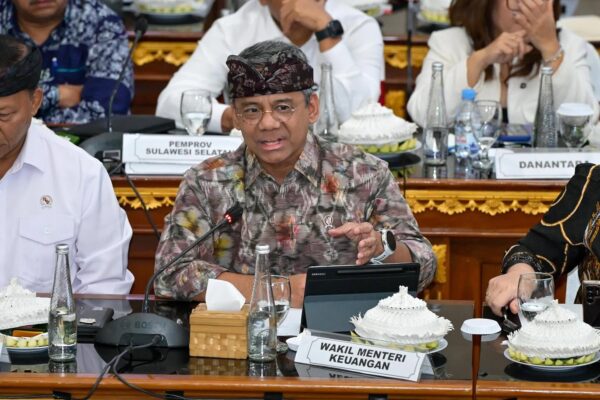
Suahasil Nazara, 55, who has served as deputy finance minister since 2019, was yesterday sworn in as Purbaya’s replacement.
The government did not say why Purbaya was removed, but his year in the post has been marked by ructions in the Indonesian economy, including a sharp depreciation of the rupiah and growing investor skepticism.
After being sworn-in yesterday afternoon, Suahasil told the press that he had only learned about his appointment in the morning.
“This is, of course, an expression of the trust placed in me by the president and the country. I am grateful for that trust, and I hope I can carry out the responsibility entrusted to me by the president,” Suahasil said, as per the Jakarta Globe.
He added that Prabowo had instructed him to safeguard “the health and credibility” of the state budget.
The replacement of the finance minister comes after a turbulent year at the top echelons of Indonesia’s major economic institutions. In late July, Perry Warjiyo, the governor of Bank Indonesia, the country’s central bank, stepped down, two years before the expiry of his current term as BI governor.
Purbaya was appointed finance minister last September, after the resignation of Sri Mulyani Indrawati, who had served in the post under three presidents. While Sri Mulyani initially agreed to serve in the role under Prabowo after he took office in October 2024, she eventually was forced out, reportedly due to differences between her conservative economic approach and Prabowo’s fiscally expansive economic agenda. The Indonesian president has set an ambitious goal of 8 percent annual GDP growth for the rest of his term, and he introduced a number of high-spending populist policies, including a multibillion-dollar free meal program, that have widened the fiscal deficit.
The removal of Sri Mulyani unsettled investors who were already unsure about Indonesia’s economic trajectory under Prabowo. The year since her departure has only compounded these concerns. In March, both Moody’s and Fitch announced ratings outlook downgrades for Indonesia, with the latter citing the “increasing policy uncertainty and erosion of Indonesia’s policy mix consistency and credibility” and the “growing centralization of policymaking authority.”
This came shortly after the global index provider MSCI threatened to downgrade Indonesia to “frontier market” status due to a number of transparency concerns in its stock market, including the high concentration of ownership in certain companies and the limited “free float” of shares. MSCI will announce its verdict in November.
At the same time, the rupiah has fallen to record lows this year, passing the psychological threshold of 18,000 rupiah to the U.S. dollar in June. A spike in the fuel subsidy budget following the rise in global crude prices has added to the deficit and pushed it toward its legally mandated ceiling of 3 percent of GDP.
Amid these various challenges, Purbaya’s tendency to veer off script – Channel News Asia described him yesterday as “brash and unfiltered” – has not helped calm investor sentiment. In April, Purbaya courted international controversy when he half-jokingly floated the idea of imposing a levy on ships passing through the Malacca Strait, describing it as a possible way that Indonesia could leverage its proximity to a key artery of global trade. The Foreign Ministry was subsequently forced to walk back his comments.
While the removal of Sri Mulyani was intended to align the Ministry of Finance with Prabowo’s economic goals, the cashiering of Purbaya appears to be aimed more at outside constituencies. According to the Financial Times, Suahasil “is seen as a technocrat and has extensive experience in fiscal policymaking, having previously led the country’s fiscal policy agency for more than three years.”
Reuters described the move as an attempt “to win back investor confidence amid long-festering concerns about policymaking and fiscal profligacy.” Richard Borsuk of Singapore’s S. Rajaratnam School of International Studies told the news agency that Suahasil’s appointment was a “good move.” He said, “The market should like it and rating agencies would already know and like Nazara.”
Speaking yesterday, Suahasil said that he would ensure that the country’s fiscal deficit would be kept under the legal ceiling of 3 percent. “This is just a continuation, not a change… We will continue to manage the state’s finances in a better way,” he said.