

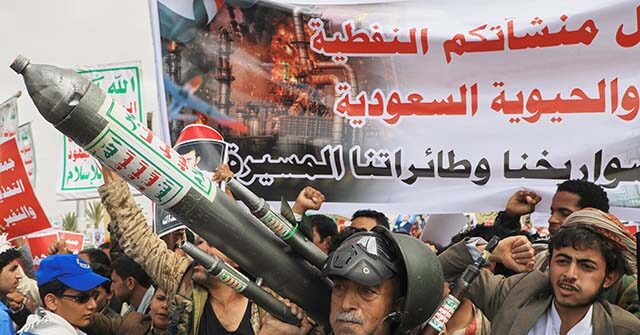
The Iran-backed Houthi insurgents of Yemen on Monday declared a “maritime ban” against Saudi Arabia, implicitly a threat to attack Saudi oil tankers passing through the Red Sea on their way to the Suez Canal.
Houthi military spokesman Yahya Saree did not specify exactly what the “maritime ban” would entail in his video statement on Monday, saying only that it would be an “eye for an eye” response to what he described as a Saudi “blockade” of Yemen.
“The Yemeni armed forces affirm their complete readiness for all options, and any foolish act committed by the reckless Saudi enemy through all escalation will be met with a comprehensive and decisive escalation, by Allah’s will and power,” he declared.
The Houthis are an Islamist insurgency supported by Iran that captured Yemen’s capital of Sanaa in 2014. Their slogan is: “God is Great, Death to America, Death to Israel, Curse Upon the Jews, Victory to Islam.”
Saudi Arabia led a coalition to intervene in the Yemeni civil war on behalf of the internationally recognized government from 2015 to 2022, when an informal ceasefire agreement was reached. That agreement was broken this month when the Houthis resumed their effort to conquer territory in Yemen.
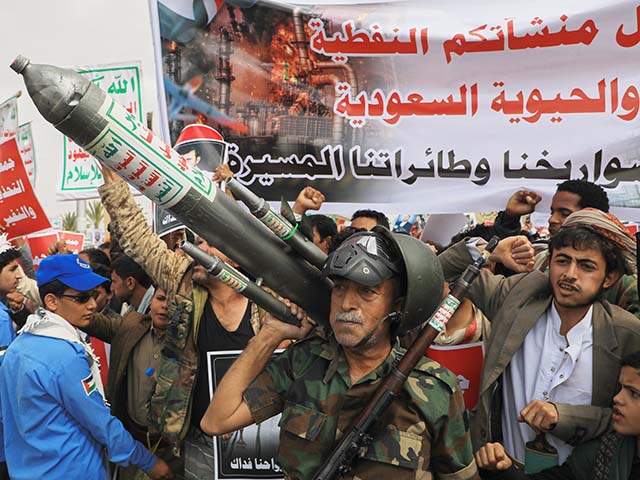
Houthi supporters hold a rally in Sanaa, Yemen, Friday, July 17, 2026, against the Saudi-led coalition. Banner in Arabic reads, “All Saudi oil facilities are targets to our missiles and drones.” (AP Photo/Osamah Abdulrahman)
Saudi Arabia bombed the airport in Sanaa last week to counter Iran’s efforts to support the Houthis with weapons and military experts, and the Houthis retaliated by launching missiles at Saudi targets, including an airport. The Houthis often describe Saudi Arabia’s economic pressure against their regime as a “siege” or “blockade,” as Saree did on Monday.
The Houthis menaced international shipping in the Red Sea with missile and drone attacks during the Gaza War, inflicting tremendous costs on the world, so their “maritime ban” threat against Saudi Arabia could be a return to such activity. The shipping industry would probably react with comparable alarm, since the last time the Houthis waged a campaign of piracy, they were supposedly “blockading” Israel – but they frequently targeted ships that had little or nothing to do with Israel.
Saudi Arabia is highly exposed in the Red Sea at the moment because it has shifted much of its oil exports to Red Sea ports via pipelines to bypass the Strait of Hormuz due to Iranian terror attacks on shipping in that vital waterway.
Iran recently threatened to order its Houthi allies to shut down the Bab el-Mandeb strait leading out of the Red Sea, much as Iran has closed down the Strait of Hormuz to increase economic pressure on the rest of the world. The Houthis indicated they were ready and willing to carry out Iran’s orders.
The deputy chief of the Houthis’ media office, Nasruddin Amer, said on Monday that the Bab el-Mandeb strait would be closed by force, at least to ships linked to Saudi Arabia.
Both the Houthis and the government-in-exile said over the weekend that they were moving reinforcements to their respective front lines, possibly in preparation for renewed large-scale hostilities.
Israel Hayom on Monday quoted “a source close to the Houthis” who added that senior Houthi officials are attempting to recruit additional fighters from tribes in their sphere of influence – and threatening punishment for tribes that join a growing resistance movement against their rule in northern Yemen.