

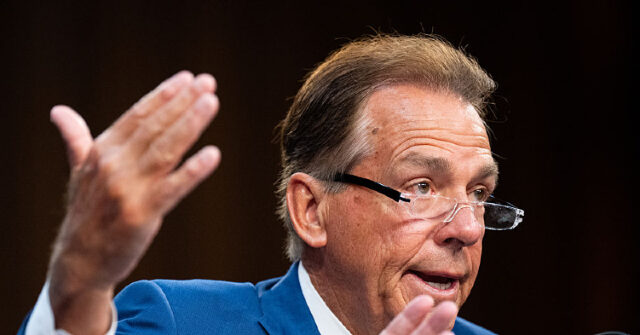
Legendary college football head coach Nick Saban did not mince words on Capitol Hill on Wednesday, telling members of the Senate Committee that the name, image, and likeness (NIL) landscape has turned college sports into an “arms race” to the “bottom,” with potentially disastrous ramifications.
“It’s become an arms race, who spends the most has got the best chance to win,” Saban said. “But I think it’s a race to the bottom because if you don’t spend to win, you lose your fan base and you don’t have any revenue.”
Saban’s concerns, which have been echoed by other former and current college coaches and administrators, center on what happens when programs already operating at a loss or barely breaking even attempt to enter the spending spree that has become the race for a national championship in football or basketball.
Absent the sudden influx of tens of millions of dollars from former alums or other associated groups, such as what occurred at Texas Tech last year and, to a lesser extent, at Indiana, those schools will be mortgaging their future on what is likely to be a losing effort that will leave them broke, and their fanbase disheartened and disinterested.
The SCORE Act appeared to be a potential remedy for this issue and others, but ultimately failed in the U.S. House of Representatives. The latest glimmer of hope for reformers is the Protect College Sports Act, sponsored by Senator Ted Cruz (R, TX) and Senator Maria Cantwell (D, WA).
The Protect College Sports Act takes a specific aim at several factors that have exacerbated issues in college sports. Notably, the “Lane Kiffin Rule” seeks to block coaches from leaving their teams before the season ends. The measure also limits the number of transfers athletes can make during their years of college eligibility.
“I really think that the concern is the health of college athletics, not just football,” Saban said on The Paul Finebaum Show last month via On3. “I think people look at football and basketball. But how about the 22 other sports we have that are really, probably, non-revenue sports that create lots of opportunities, actually trained 85% of our Olympians in the last Olympics? We’re the only country in the world that the university system and college athletics actually develop our athletes for the Olympics.
“So if we’re creating a situation where there’s not enough balance between the revenue sports and the non-revenue sports. Then, people are going to start dropping these sports, which you saw Arkansas drop tennis … the other day. That’s exactly what we don’t want to see.”