

Another 19 Kyrgyz companies are being ordered to close down as Bishkek strives to assuage Western concerns about the evasion of Russia sanctions.
Kyrgyzstan’s top leaders, including President Sadyr Japarov, have long denied that the country was aiding in the circumvention of sanctions on Russia over the war in Ukraine. In August 2025, Japarov told state media outlet Kabar, “On our part, not a single case has been reported of circumvention of sanctioned goods going to Russia.” That same month, he denounced sanctions against Kyrgyz banks as “politicized.” Then, during his U.N. General Assembly speech in September 2025, Japarov railed once again against sanctions targeting Kyrgyz banks, claiming, “The sanctions imposed on Kyrgyzstan are based on false information spread by certain non-governmental organizations and dishonest people.”
A year later, Japarov may not have changed his tune but the Kyrgyz government has changed its tactics from outright denial to action. The proximate trigger appears to have been pressure from the European Union.
In February, the EU’s sanctions envoy, David O’Sullivan, paid a visit to Kyrgyzstan. O’Sullivan told reporters that trade flows suggest that some goods “are being imported into Kyrgyzstan with the sole purpose of being re-exported to Russia, in breach of our sanctions.” He went on: “We are not asking Kyrgyzstan not to have trading relations with Russia. We only ask that that trading relationship does not involve the deliberate circumvention of our sanctions by the transmission through Kyrgyzstan of sanctioned EU goods to Russia.”
Two months later, in April, the EU used its “anti-circumvention tool” for the first time, and the target was Kyrgyzstan. This paved the way for the EU to “restrict the sale, supply, transfer or export of specified sanctioned goods and technology to certain third countries” considered to be at high risk of providing pathways for the circumvention of sanctions. These goods included machining centers – used in the production of high-precision metal components for missiles and drones – and communications technologies.
The EU’s decision was based on trade data, which is difficult to explain in any way that isn’t sanctions evasion. According to the EU, available trade data for the first 10 months of 2025 revealed an 800 percent increase in Kyrgyzstan’s imports of goods that appear on the EU’s Common High Priority (CHP) list – that is, the list of prohibited dual-use goods and advanced technology items used in Russia’s war effort. In the same period, trade data revealed a 1,200 percent increase in the export of CHP items from Kyrgyzstan to Russia.
After the EU’s decision, Kyrgyzstan began to shift its approach from outright denial to at least the appearance of compliance.
In May, Kyrgyzstan’s Ministry of Justice announced that it had ordered 50 companies “involved in operations with high sanctions risk” to close down. The Kyrgyz government did not name the companies or the sectors affected.
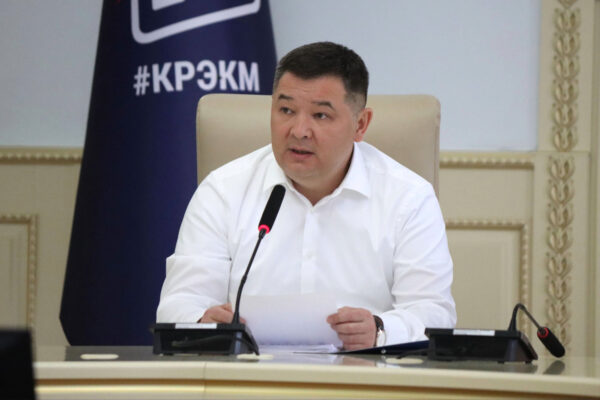
Then in early June, Kyrgyzstan’s Minister of Economy and Commerce Bakyt Sydykov was appointed special representative for sanctions policy and minimization of sanctions risks.
Later that month, two state-owned Kyrgyz banks – Eldik Bank and ABank – ended partnerships with more than 130 companies due to alleged sanctions risks. Again, the companies were not named, complicating any effort to verify the government’s claims.
Following an August 18 meeting chaired by Sydykov, the government offered an update. Of 40 companies “whose activities could be associated with increased sanctions risks” that were identified in June, 19 will be ordered to liquidate. From July to August, a press release following the meeting noted, Eldik Bank had ended business relations with 109 companies, with 20 more in the process of being shut out. ABank, the release stated, had ended relations with 35 companies and had 40 more “undergoing due diligence.
Absent any information about the companies that are being ordered to close or pushed out of traditional banking, observers, it seems, are simply asked to trust Bishkek. The real proof will be in the trade data. The EU will have to decide whether to accept Kyrgyzstan’s efforts as both genuine and, more importantly, effective in stemming the flow of dual-use goods to the Russian war effort.