

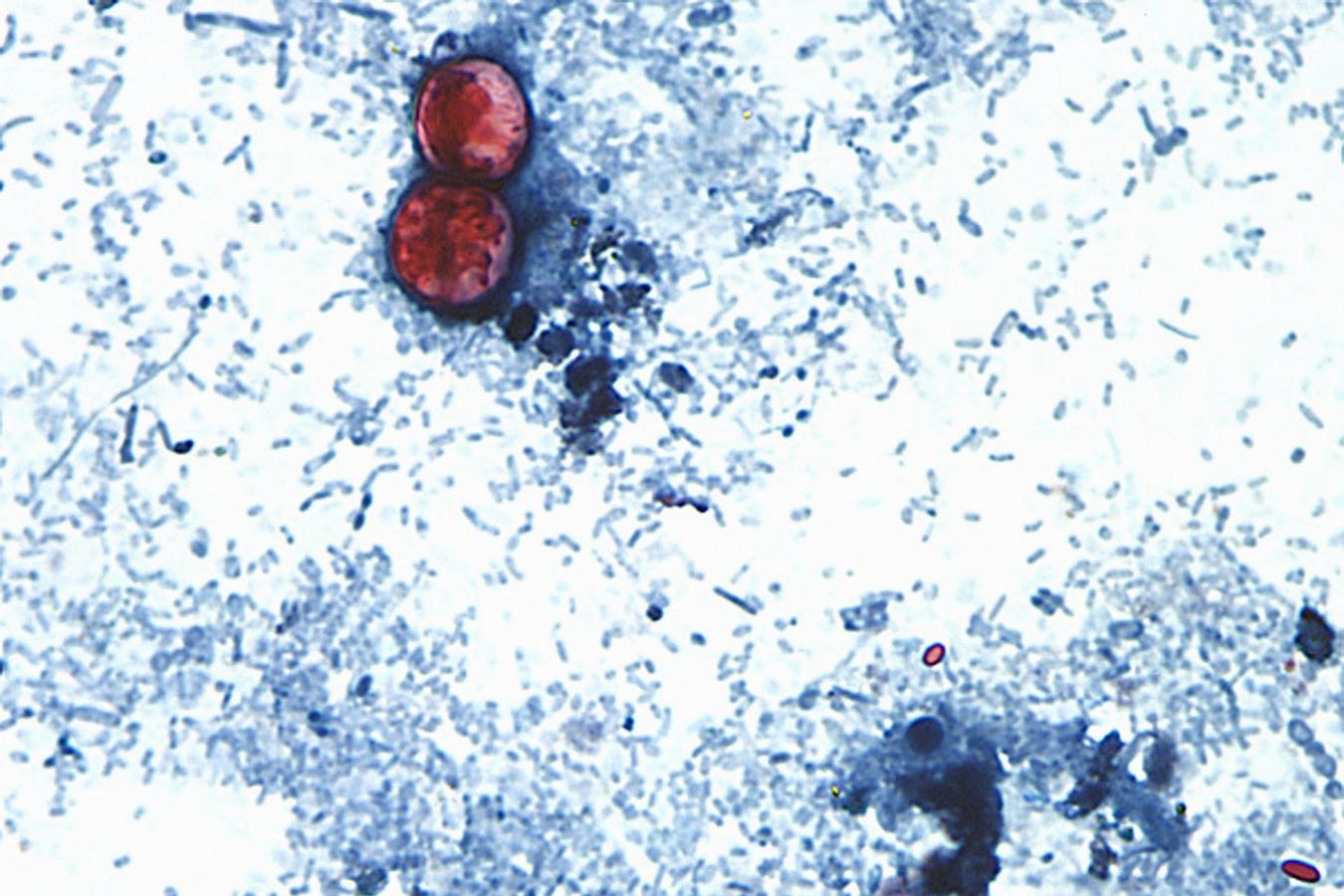
This photo taken through a microscope provided by the CDC shows Cyclospora cayetanensis oocysts found in a fresh stool sample which had been prepared with a formalin solution and stained with safranin. (CDC via AP, File)
Associated Press
In 2014, three Mastercard data scientists filed for a patent on a way to catch disease outbreaks from the traces people leave when they pay. Jeremy Pastore, Michael Zhao and Arun Elangovan proposed scanning payment-card records in real time and flagging an outbreak as it spread through a population. The patent was granted in 2019. Then it was set aside. It has never been deployed.
This summer showed what such a tool was for. The United States is having its worst cyclosporiasis season on record. Cyclosporiasis is an intestinal illness caused by Cyclospora cayetanensis, a microscopic parasite people acquire by eating fresh produce grown or washed with water carrying human waste. It brings on watery diarrhea, often for weeks, starting about a week after the contaminated meal. The parasite needs one to two weeks in the environment before it can infect anyone, so it does not pass between people.
The largest cluster was worked the way foodborne outbreaks have been for decades, by interviewing the sick until a common thread appeared. Michigan’s health department went through the food histories of 190 people already sick with the parasite who had eaten at Taco Bell, and 90 percent of them had eaten iceberg lettuce. The FDA traced that lettuce to a single grower in central Mexico, and Taylor Farms de Mexico pulled it from the American market on July 17.
How firm is that conclusion? Firmer than the laboratory evidence, which does not exist. A lettuce sample appeared to test positive on July 18, and the FDA withdrew the result the next day as a false positive that did not represent true amplification. No product sample has tested positive. The agency says the interviews and the traceback still support the recall, and the recall stands, but the vehicle here was identified by epidemiology alone. That cluster also accounts for a minority of the summer. Cyclosporiasis has been reported this year in 34 states, and most of those cases have no identified source of any kind.
Nearly all of the delay went to naming the restaurant. The first illnesses began on May 13. A cluster reached the FDA’s watch list in mid-June with no source attached, and Taco Bell pulled fresh produce from restaurants in the affected states on July 9. The lettuce was named a week after that, the grower a day later. Reaching the vendor took two months. Everything downstream of the vendor took days.
The slow step was never the lettuce. It was Taco Bell. “Once you know it’s Taco Bell,” Pastore told me, “triangulating the rest is probably fairly straightforward. And the hard part is the Taco Bell.” Getting there means asking people to remember where they ate weeks earlier, which is the weakest instrument in the kit and the one the system leans on hardest.
A Taco Bell fast food restaurant is shown Tuesday, July 14, 2026, in Taylor, Mich. (AP Photo/Paul Sancya)
Copyright 2026 The Associated Press. All rights reserved
Everything We Eat Is Bought
Memory is not the only record of what people eat. Almost nothing in the American diet arrives outside the transactional economy. Food is bought, and buying leaves a trace. Groceries, restaurant meals, delivery orders and drive-through runs all throw off a timestamped record of what changed hands and where, sitting on a server that belongs to somebody. Whether those records can be turned on an outbreak is a question people have already answered.
They can. In 2009 and 2010 a nationwide Salmonella outbreak resisted investigation until warehouse-club membership records turned up 19 sick shoppers who had all bought the same salami. A 2018 review found purchase data identified the source in 19 of 20 outbreaks where investigators tried it. A 2022 simulation on nearly a million Norwegian shoppers named the contaminated product with 90 percent accuracy after a median of six cases.
If we read those cases closely we see they share a shape. Investigators already knew which store to ask. A loyalty program is a window into one merchant, and it opens only after somebody has decided that merchant is worth a look. The warehouse-club records that broke the salami case were pulled because investigators already suspected the warehouse club. Michigan reached Taco Bell by interviewing 190 sick people over eight weeks. Purchase data confirmed a hypothesis that conventional epidemiology had to generate first, which is useful and which is a different job from finding the vendor.
The Norwegian study puts a number on the gap. If we restrict the model to one grocery chain when the contaminated product was sold in two, accuracy falls from 92 percent to 67. Outbreaks do not respect a retailer’s customer base, and neither does anybody’s diet. That problem needs a record that follows a person across every place they spent money.
That record exists. A payment network holds it although almost nobody else does, and it is precisely what Pastore, Zhao and Elangovan proposed turning on an outbreak in 2014.
Built for a Different Job
They abandoned it for a reason that seems strangely beside the point now. The project grew out of an internal push to try out-of-the-box ideas, said Pastore, now a data scientist leading a team in Mastercard’s economic intelligence group, and it was “just a kind of fun idea that we tinkered with a bit and kind of set aside.” What stopped it was the absence of SKU-level data, the item-by-item detail that shows what was in the basket rather than which store the basket came from. The patent’s own claims require it. His team spent about a month overlaying influenza trends on card spending, hunting for spikes at drugstores, and found a relationship that was never clean enough to use.
They were chasing the product, and the product is the one thing a card cannot see. What a card sees perfectly is where a person spent money, which is precisely what the Michigan interviews spent two months establishing. Asked whether they had considered the problem of identifying the merchant, the Costco or Taco Bell, Pastore said they had not.
What sits on the shelf is more than a sketch. Pastore’s team ran a prior art search, built a prototype, took the idea to internal executives who liked it, and came away with a granted patent that specifies the method in detail. Mastercard also already runs the plumbing. Card authorizations clear within minutes, Pastore said, and the company mines that stream continuously to track consumer spending for economists, banks and merchants. The real-time infrastructure is built and in daily commercial use.
The item-level data Mastercard lacked is sold by brokers. “It’s out there. People buy it all the time,” Pastore said. A payment network, though, carries privacy commitments a broker does not, and there has never been a buyer for the finished product. Government, the natural customer, is slow to buy, Pastore said, and slowest for what he called “rainy day stuff,” by which he meant capability bought against a bad day that has not yet arrived. Nobody is blamed for lacking it until the day comes.
Consent is the obvious way through, and it does not require anyone to build a surveillance apparatus. A patient sick enough to be interviewed by a health department could be asked to sign a form at intake authorizing investigators to see where they had shopped, or simply to upload a recent card statement. When I put that to Pastore he said it could work. The privacy problem then gets solved one patient at a time, and the numbers involved are small. Michigan worked with 190.
Public health has begun mining new kinds of data to spot outbreaks sooner. Those streams carry people reporting that they got sick, on social media and the sites where the poisoned go to complain. What they bought stays invisible.
A Detector Without an Owner
When I reached out to Pastore, he had not thought about the patent in years, not even during an outbreak that has been a fixture of the health news cycle all summer. Asked who should build such a thing now, he did not point to his own industry. “Honestly, I think the government could do this,” he said, the way it runs economic surveys.
He is right, and the case is stronger than his modesty allows. The obstacle that stopped Mastercard does not apply to the problem that actually slowed this summer’s investigation. Identifying a merchant takes no SKU-level data at all.
Surveillance sits adjacent to my own field rather than at its center, and I have never heard of an operational system anywhere that does this. It belongs among the standing capabilities public health runs on, next to notifiable disease reporting and pathogen sequencing, quiet in ordinary months and valuable in the ones like this.
What the idea has never had is an owner. Whose job is it to watch economic data for signs of an outbreak? Guarding the food supply is a public health function, and it is not the job of a payment company to be the country’s outbreak detector, even if its data would serve. That leaves two candidates. One is a federal office willing to treat standing surveillance as infrastructure rather than emergency spending. The other is one of the young firms trying to build a market in infectious disease intelligence. This is the sort of capability it exists to produce.
A system of the kind Pastore and his colleagues sketched would not be enough on its own. Knowing that sick people had all eaten at Taco Bell, or had all bought the same salami, is a lead and not an answer. Buying a bag of lettuce is not proof of eating it. The data reaches only people who use cards and apps, and the hardest barriers are consent, privacy law and access to records held by companies rather than health agencies. A purchase record moves investigators to the right question faster. It does not answer it. No laboratory ever confirmed the lettuce, and what stands behind the recall is a chain of reasoning built by people who knew which questions separate coincidence from cause. But an outbreak that takes two months to trace is an argument for using every objective record we have, and one of the best has been patented, shelved and left unopened.