Moneywise and Yahoo Finance LLC may earn commission or revenue through links in the content below.
After a year of sharp swings and surprise rebounds, some investors are taking a closer look at their portfolios and wondering whether betting on America is still a good idea.
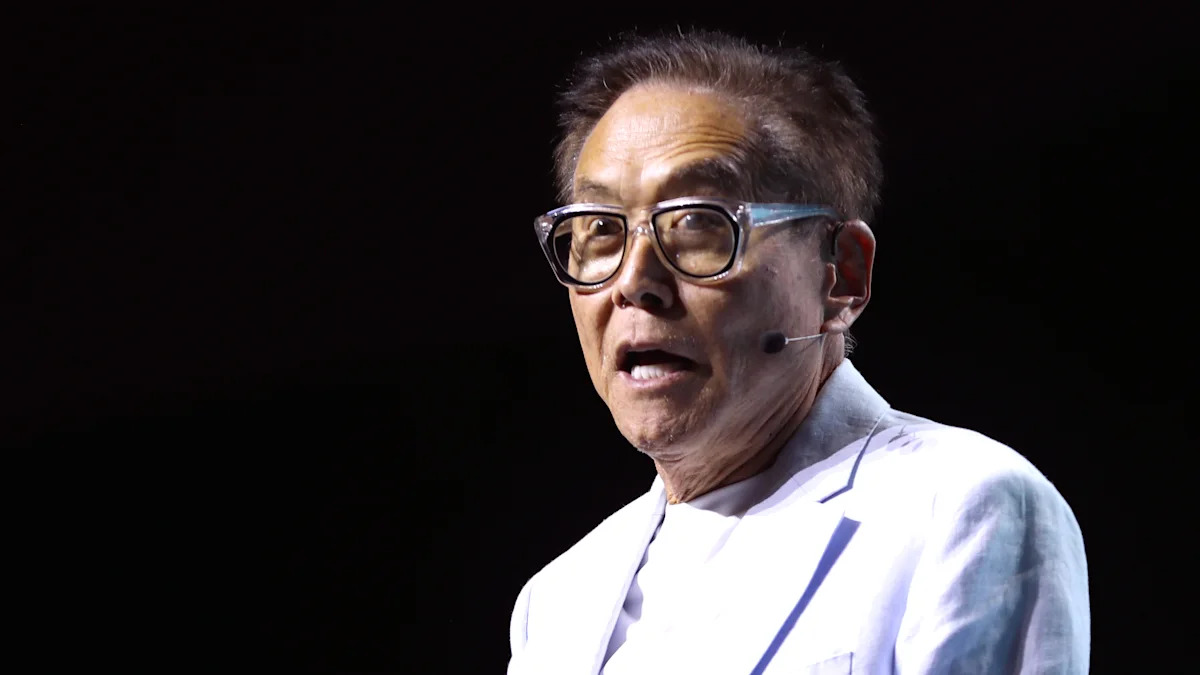
They’re not alone. Robert Kiyosaki, the Rich Dad Poor Dad author and longtime personal finance commentator known for his bold economic claims, cautioned in a December post on X that “the worst crash in history” may be unfolding, and it could start with the stock market (1).
Top Picks
If the market has felt like a roller coaster recently, you’re not imagining it. Headline-grabbing news has sent the S&P 500 and Nasdaq tumbling more than once. Yet, each time, they’ve managed to bounce back — often to new highs.
But Kiyosaki thinks the worst is yet to come.
“Crashes do not happen overnight,” wrote Kiyosaki in the same post on X, adding that they “take decades to occur.”
He recently doubled down on his gloomy predictions in a different X post, writing, “I WARNED EVERYONE (2).”
“In 2002 I released Rich Dad’s Prophecy. In 2026 the predictions in Prophecy are coming true.”
Kiyosaki predicted an “Everything Bubble” will burst and lead to “the greatest depression in world history.”
Kiyosaki claims today’s volatility has been building for more than a century, pointing to the global “economy of debt” and the U.S. as a “debtor nation” as factors that could intensify the effect of a market collapse.
“This crash the world is going through now, possibly the worst crash in history, was started back in 1913, 112 years ago, when the Marxist US Federal Reserve Bank….took over America’s monetary system,” Kiyosaki wrote in December.
Here’s what his prediction means for you and your pocketbook, if and when it comes to pass.
Economic implications
Kiyosaki points to one main culprit behind today’s economic stress: America’s ballooning debt.
“The bigger problem is the national debt of the USA,” Kiyosaki stated in a Feb. 5 post on X (3).
The total U.S. national debt is currently close to $39.5 trillion (4) — a level many experts consider unsustainable.
Moreover, the Iran war has added considerably to the national debt. According to one federal budget expert, the up-front cost of the war is about $200 billion, and the total cost will exceed $1 trillion (5).
Of course, debt isn’t just a government problem.
The average American consumer is saddled with mortgages, student loan debt and credit card debt. Total U.S. household debt reached a record high of $18.8 trillion in the first quarter of 2026 (6).
Meanwhile, Bankrate’s recent credit card debt survey found that in 2025, 61% of Americans with credit card debt reported carrying that debt for at least a year. That’s up from 53% in late 2024 (7).
And this isn’t debt from splurges. One-third of those currently in debt say they relied on their cards to cover everyday essentials like groceries, childcare and utility bills.
Even more troubling? About 20% of borrowers don’t believe they’ll ever pay it off, according to the same survey.
With average interest rates at 23.79% (8), credit cards are now the highest-cost debt many Americans have — making it even harder to break the cycle.
As if that wasn’t enough, Americans are also facing a full-blown affordability crunch.
A survey conducted by The Century Foundation found that nearly 66% of Americans switched to cheaper groceries or bought less food to cut costs. Even more shocking, more than 33% revealed they skipped a meal in the past year to save money (9).
The survey also found that two-thirds of Americans think the economy is not doing well — with 82% expecting the cost of living to rise further in the next two years.
Amid this tumultuous backdrop, you may want to take some steps to not only grow, but also preserve your wealth.
Shockproof your portfolio with gold
With markets rattled and uncertainty piling up, Kiyosaki advises investors to bolster their portfolios with alternative assets rather than sticking to traditional stocks.
“IN THIS COMING CRASH possibly a Great Depression…. Will you be “FU’CD UP or LU’CD UP?” he asked in a recent post on X (10).
Kiyosaki went on to explain that in a crash, recession or depression, “great assets go on sale” and suggested that people can “get richer” by purchasing those low-cost assets.
For those who do take advantage of the opportunity to get rich, the coming crash is actually “good news,” he wrote in a separate post (11).
“Please don’t get FU’CD,” he urged. “Get LU’CD.”
One way to grow your wealth? Investing in gold.
The famed author is known for his love of the yellow metal, which he has famously referred to as “God’s money (12).”
Kiyosaki isn’t the only one who thinks highly of the precious metal. Amid increasing uncertainty, more and more experts are jumping on the gold bandwagon, propping up the yellow metal’s hedging properties.
Ray Dalio, the founder and former CEO of Bridgewater Associates, the largest hedge fund in the world, said “gold is the safest money in this kind of environment,” while speaking at a conference in February (13).
The precious yellow metal has been one of the best-performing assets over the past year, with prices hitting a peak of $5,602 in January (14). Since then, the spot price has dropped somewhat, although gold is still up about 120% over the last five years.
Kiyosaki sees the recent pullback as an opportunity.
“When Walmart has a SALE poor people rush in and buy, buy, buy. Yet when the Financial Asset Market has a sale….a.k.a…..CRASH…the poor sell and run….while the rich rush in….and buy, buy, buy,” Kiyosaki tweeted (15). He specifically mentioned gold, silver and bitcoin as potential buys during a dip.
In another post on X, Kiyosaki said he doesn’t care when the price of gold dips because he knows “the national debt of the US keeps going up and the purchasing power of the US dollar keeps going down (16).”
Open a gold IRA
One way to hedge your portfolio with gold is through a gold IRA, which combines gold’s inflation-resistant qualities with the tax advantages of an IRA.
As one of the metal’s biggest advocates, Kiyosaki predicts gold prices will hit an astronomical $35,000 per ounce in the next five years, according to an X post on June 29 (17). To be clear, gold would have to increase in value by nearly 625% from its high for this prediction to come to pass.
However, other estimates are not quite that bullish. JPMorgan CEO Jamie Dimon suggested late last year that gold could reach $10,000 an ounce (18), while several brokerages expect prices to hit $6,000 by the end of 2026 (19).
One way to invest in gold that also provides significant tax advantages is to open a gold IRA with the help of Priority Gold.
This retirement account can help you stabilize your finances by allowing you to invest directly in precious metals rather than stocks and bonds.
Priority Gold is an industry leader in precious metals, offering physical delivery of gold and silver. They have an A+ rating from the Better Business Bureau, a 5-star rating from Trust Link and the endorsement of Kiyosaki himself.
Another asset Kiyosaki often champions is bitcoin — which he calls “people’s money.”
It’s worth noting that bitcoin has plunged by nearly 45% over the past year (20). But Kiyosaki claims the limited number of coins available makes it a worthwhile investment.
“There will be only 21 million Bitcoins. Fake Government money is unlimited….infinite. That means Bitcoin increases in value as the US dollar goes down in purchasing power,” Kiyosaki wrote on X (21).
For investors who can stomach the volatility, newer platforms have made crypto more accessible.
With platforms like Kraken, buying and trading cryptocurrencies is straightforward, whether you’re on desktop or using the mobile app.
You can invest in 600+ cryptocurrencies,* including Bitcoin, Ethereum, Solana, XRP and more, or set up recurring buys to invest automatically. There’s also the option to add price conditions so your trades only execute when the market hits your target.
Kraken also offers guides on popular coins, helping you understand what you’re buying and how to navigate the process from start to finish. And if you have questions, 24/7 support is available via live chat, phone or email.
For those who want greater control, Kraken PRO offers a more advanced trading experience.
Designed for active traders, it features a highly customizable interface with real-time market data, advanced tools and detailed order types like stop-loss and take-profit to help manage trades more precisely.
You can also trade across spot, margin and derivatives markets, monitor performance in one unified portfolio, and tailor your dashboard with multiple data widgets to suit your strategy.
Opening an account is quick, with a simple sign-up, verification and short investor profile to get started.
*Not investment advice. Crypto trading involves risk of loss. View legal disclosures atkraken.com/legal/disclosures. The views and opinions expressed in this article are those of the author and do not necessarily represent the views or opinions of Kraken or its management.
Diversify like the ultrarich
Investors with capital on hand, or the ultrarich, are well-known for their ability to diversify. And some of them are turning away from the stock market.
As Kiyosaki recently posted, “My question is, ‘If there is a massive crash in 2026, will you become richer or poorer?’ I plan on getting richer (22).”
And he isn’t the only one.
“It’s likely there’ll be a 10% to 20% drawdown in equity markets sometime in the next 12 to 24 months,” Goldman Sachs CEO David Solomon said while speaking at the Global Financial Leaders’ Investment Summit in November (23).
Meanwhile, the Shiller P/E has soared past 40x, a level last seen in 1999, hinting that the decade ahead may bring below-average returns for those tied to the S&P 500 (24). A crash like the one Kiyosaki has been predicting could also cause stocks and bonds to drop in tandem, compromising any portfolio using the classic 60/40 split.
With these warning signs, diversification isn’t just smart — it could be essential.
A globally recognized asset class
Billionaires like Jeff Bezos and Bill Gates continue to invest heavily in stocks, but they also carve out a portion of their portfolios for assets that behave differently from the market.
One such asset has posted positive returns over the last 20 years, highlighting strong long-term investment potential. And with its moderate correlation with the movements of traditional markets, this alternative investment could help protect against inflation, especially amid current geopolitical uncertainty.
That’s perhaps why this asset has long been favored by the ultrawealthy as a resilient and lucrative addition to their portfolios. With an estimated value of over $2.5 trillion — projected to reach nearly $3.5 trillion by 2030 — it represents a massive asset class, according to Deloitte (25).
You might be surprised to find out this asset is fine art.
Until recently, this world was off-limits thanks to a complex network of appraisers, curators and brokers — not to mention the raw capital needed to purchase a piece of exceptional art. Now, with Masterworks, you can buy fractional shares in multimillion-dollar works by icons like Banksy, Picasso and Basquiat. While art can be illiquid and typically requires a long-term hold, it offers unique portfolio diversification.
Masterworks has sold 27 artworks so far, yielding net annualized returns like 14.6%, 17.6% and 17.8%.*
Even better, if you’re interested in art you can skip the waitlist and go straight to investing.
*Past performance is not indicative of future returns. Investing involves risk. See important Regulation A disclosures atMasterworks.com/cd.
— With files from Rebecca Holland
You May Also Like
Join 250,000+ readers and get Moneywise’s best stories and exclusive interviews first — clear insights curated and delivered weekly. Subscribe now.