

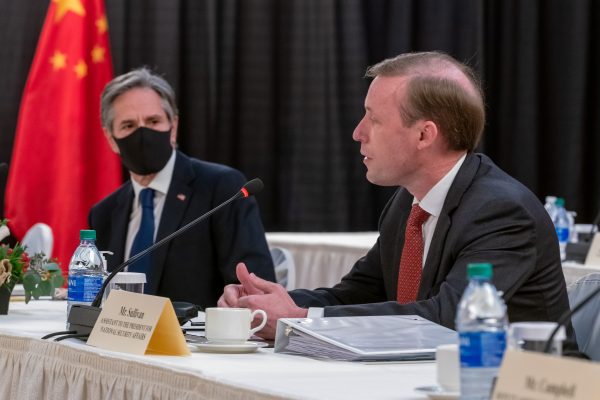
On April 27, U.S. National Security Advisor Jake Sullivan delivered a policy speech on “renewing American economic leadership.” It was, in Sullivan’s words, an attempt to explain the Biden administration’s “broader international economic policy, particularly as it relates to President Biden’s core commitment… to more deeply integrate domestic policy and foreign policy.”
States always have the right and necessity to prioritize their domestic economies. Providing welfare for their citizens is one of the essential roles undertaken by states, and no country is under any obligation to prioritize the health of the international economy, allies, or trading partners over that of their own citizens. In formulating economic policy, the Biden administration wants to put its citizens first, and they’re well within their rights and responsibilities to do so.
That said, Sullivan’s speech was framed as a speech on the U.S. role in the international economy, so those are the merits on which it needs to be judged. On that count, the speech represents a step toward economic unilateralism, like the Bush Doctrine applied to international economics in effect if not intent – the United States will do what it wants, and international cooperation is welcome but only if partners do it on U.S. terms.
The problem is that the logic informing the approach doesn’t work and the shape of what comes next is unclear even to its designers. This isn’t the strategy of an administration with the full set of policy tools available to it, but it’s also the strategy that the Biden administration expects the rest of the world to accommodate.
Some of the specific issues with the speech have been unpacked elsewhere, but importantly, Sullivan’s speech seems to have dismissed the entire logic of the post-World War II economic order. In doing so, he overlooked the reason that order was so successful: it leveraged self-interest in the direction of collective goods.
The order that the United States championed after the end of World War II through the creation of the Bretton Woods Agreements and international institutions like the International Monetary Fund and General Agreement on Tariffs and Trade (now the World Trade Organization) was never entirely about altruism. The institutional network codified U.S. geopolitical primacy and rebuilding Europe and Asia provided a boost to U.S. economic interests, all while helping contain a potential threat from the Soviet Union. At the same time, this system brought real and meaningful benefits to countries within the system, both giving them a stake in a U.S.-led order while also expanding their welfare and giving them input on international governance in ways other international systems had been unable to provide.
As Mona Paulsen, professor of law at the London School of Economics, pointed out, the system was never about free trade as a good unto itself; it was about reciprocity. Everyone’s welfare became linked to that of everyone else’s.
Sullivan’s speech gave significant attention to describing how that system was no longer workable. But it’s not clear what the new logic is. On the surface, what Sullivan is asking for going forward isn’t so radical. Even if the merits of industrial policy can be debated, it’s not novel or without precedent. Partner economies would understand if the United States wants to prioritize their own workers – most economies do. Partner economies would also understand if the United States has concerns about economic security – so do they. Everyone knows that trade policy in the 2020s and 2030s will look different from that in the 1990s.
“Modern trade agreements,” the new direction that’s supposed to supplant the old one, are the Biden administration’s economic policy MacGuffin, something that the Biden administration seems very serious about, yet no one can clearly define or understand why it’s there or why it’s important to the plot. For all of the high-minded and positive ambitions, it’s not clear how this new approach can achieve what the old one can’t. How can reciprocity be achieved without tangible concessions on the table?
Nor is it clear how the United States remains “committed to the WTO” and its values if it doesn’t support the organization’s dispute settlement process and rejects its rulings on steel tariffs. It’s not clear how the United States will achieve agreements on sensitive but important issues like labor and the environment without the leverage that offers of market access can provide.
The United States isn’t alone in terms of a lack of enthusiasm for adhering to rules and practices, but it’s a lot more complicated when Washington has made the maintenance of that system a centerpiece of its case for global leadership. The Biden administration needs to explain how their strategy is multilateral and cooperative without tangible support for the institutions that govern international trade and without a clear framework for inducing meaningful cooperation with partner economies. Until that point, accusations that the Biden administration’s international economic strategy is “America First” are going to stick – and with some justification.
The Biden administration may have decided to eschew “traditional” trade agreements because they might not think such deals are politically viable. But the thing that makes traditional trade agreements politically difficult is the very same thing that gives them value: they’re legally binding. If a deal is not ratified by Congress, there’s no guarantee that it will last beyond the next administration. Without being enacted into law, anything the Biden administration is trying to do, no matter how well intentioned and no matter how certain they are that the world has changed, might not last beyond the end of the administration, whenever that might be.
The United States is apparently “moving beyond traditional trade deals” in favor of “innovative new international economic partnerships.” But the only alternatives to a legally binding trade treaty are narrow agreements that are either nonbinding or afoul of Congress, and possibly in violation of the Constitution. For example, it’s not even clear that the recent agreement between Japan and the United States to cooperate on critical minerals is fully legal without the input of Congress..
Put more bluntly, even in a best-case scenario where Indo-Pacific Economic Framework (IPEF) negotiating partners reach an agreement that achieves every ambition, there’s no reason to assume its provisions will survive the next administration if Biden’s successors choose to go in a different direction. It’s hard to change commercial patterns and shape economic behavior when the time horizon is the next presidential election. It’s hard to extract concessions if negotiating partners may think they can get a better deal with someone else in the White House.
This dynamic is not entirely the Biden administration’s fault – the problems of polarization that have made Congress an unreliable partner go back decades. But it makes ambitious efforts to reshape the international economy much more challenging if policymakers are trying to do that with one hand tied behind their back; in this case, by taking tariffs and market access off the table.
On one hand, dismissing future trade agreements on the basis that tariffs are already low is borderline disingenuous. Trade agreements have discussed issues beyond tariffs rates for decades, covering items like intellectual property, procurement, sanitary standards, and more. On the other hand, Deborah Elms, executive director of the Asia Trade Center in Singapore, suggested a pragmatic motive to Sullivan’s discussion of tariffs: “Declaring that tariffs are the root of all evil is a handy way of avoiding doing anything about them.”
Yet joining ambition with practical constraints could be disastrous. Erik Levitz, a writer for New York Magazine, unintentionally gave a perfect summary of the state of U.S. international economic policy as he lamented the challenge of achieving bipartisan consensus for Biden’s new program: “Strip Global Bidenism down to the provisions for which there is a genuine ‘Washington consensus,’ and you’re left with proposals for reducing U.S. economic dependence on China and constraining that nation’s economic development.” That’s basically where we are now and it’s not a good place to be if the Biden administration wants partner economies to join its program or if it’s sincere about avoiding full conflict with China.
To be fair to the Biden administration, they seem genuine about avoiding a full confrontation and are taking certain steps to avoid that, but it’s not clear if that balance can be sustainable.
Many of the challenges that the Biden administration identified are real issues and have needed to be addressed for years. Reconciling the need for domestic economic revitalization, the U.S. role as the world’s largest economy, and the fact that polarization has limited what’s achievable through Congress is a genuine dilemma. But what’s needed is a strategy that matches the tools with the ambitions and can attract international support. Until then, any vision of U.S. international economic strategy will be incomplete.