

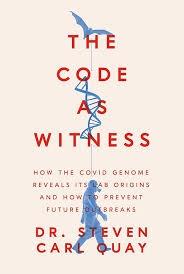
The Code As Witness Authored by Steven C. Quay
Jacket Design by Faceout Studio, Molly Von Borstel
No book about the Covid-19 pandemic has yet succeeded in detailing as impressively and provocatively as The Code as Witness has just done. Written by physician-scientist Steven C. Quay, the 430-page volume is part scientific investigation, part policy strategy, and part warning about the future of biological research. It is a dynamic, Pulitzer worthy work that is easy to read as it weaves a story that keeps any non-researcher’s attention, while not turning away scientists.
The book’s explanatory style is particularly effective when discussing viral evolution, genomic analysis, and bio-safety principles. Readers without formal scientific training can follow the narrative without becoming lost in technical jargon. It opens with an intensely personal introduction that allows readers to vividly imagine themselves in the streets and subways of Wuhan. Quay frames his investigation not simply as a scientific inquiry but as a defense of scientific integrity itself. He writes that he became alarmed not only by the pandemic, but by what he viewed as the suppression of legitimate scientific debate regarding the virus’s origins. His frustration with institutional opacity, disappearing records, politicized journals, and what he describes as narrative enforcement becomes the emotional engine driving the book.
Where The Book Excels:
The book builds a compelling case for its highly consequential conclusion: that SARS-CoV-2 originated through laboratory-related activity. And the tension that this thesis brings to the book is its greatest strength. Quay argues that the evidence he brings reaches a level comparable to proof beyond a reasonable doubt.
This is epitomized in chapter Seven where Quay presents 5 virus “Traits,” not just one smoking gun but 5 smoking guns, supporting one persuasive argument. They comprise:
- The Immaculate Insertion – A description of the Furin Cleavage Site is outlined which is a unique furin cleavage site in the spike protein of SARS-CoV-2. This site is not found in closely related coronaviruses, which is the only natural method of inserting it, leaving laboratory manipulation as its likely source. According to Quay, this genetic feature is most consistent with a laboratory-engineered insertion.
- Human-Optimized ACE2 Receptor-Binding Domain – “The SARS‑CoV‑2 spike protein, in particular, was highly optimized for binding to human ACE2 receptors and infecting human cells.” Evolution is often slow and incremental. Quay argues that nature had little opportunity to improve upon a pathogen that appeared highly optimized for human infection from the outset.
- The ORF8 Gene Insertion – ORF8 is a distinctive SARS-CoV-2 gene associated with immune evasion, suppression of symptoms, and enhanced viral spread. Quay notes that ORF8 differs significantly from comparable genes in related coronaviruses and points to the Wuhan Institute of Virology’s extensive research focus on ORF8 before the pandemic. Based on these observations, he contends that the gene’s unusual characteristics and the prior research interest surrounding it raise important questions about its origins and the broader objectives of the scientific work that preceded it.
- The Application of Restriction Enzymes – Researchers use restriction enzymes such as BsaI and BsmBI to cut coronavirus genomes into manageable pieces, enabling the assembly of synthetic infectious clones by growing separate genome fragments in bacteria and later rejoining them. According to this passage, this process leaves a detectable signature because engineered viruses often lack the randomly distributed restriction enzyme sites found in natural coronaviruses, creating unusually long regions without these sites. Based on these observations, he contends that the gene’s unusual characteristics and the prior research interest surrounding it raise important questions about its origins and the broader objectives of the scientific work that preceded it.
- The “Smoking Gun” Evidence – One consequence of the furin cleavage site was to cause instability for a D amino acid at position 614 in the spike protein, which rapidly mutated to the stable G614 once SARS-CoV-2 began spreading in humans. Analyses of related sarbecoviruses suggest that this D614 form was unstable in the presence of a furin cleavage site, and within weeks of the first known infections, the G614 variant became dominant worldwide. Extensive laboratory testing in multiple potential animal hosts of viruses with the D614 trait showed a rapid mutation to G614. Quay argues that the presence of D614 in the earliest human cases indicates the virus had not been circulating extensively in an intermediate animal host before entering the human population, making this mutation pattern a key piece of evidence in the proof of a lab origin.
These are, of course, analytical summaries of Quay’s arguments, but his meticulous and comprehensive appendix provides a level of documentation that is extraordinary.
The formidable strength of The Code As Witness is its willingness to tackle uncomfortable questions about gain-of-function research and pandemic preparedness. Regardless of where one stands on the origin issue, the broader questions raised by the book are undeniably important. What level of risk is acceptable in biological research? Who decides? What safeguards are sufficient when a single accident could affect billions of people? And what does the answer mean for humanity?
Why This Book Matters Now:
While it might feel nice to put it behind us, as the “rear-view mirror” messaging the Biden administration attempted in 2022, the sad reality was we were emotionally done with Covid-19, but it wasn’t done with us. And the most compelling aspect of The Code as Witness may not be what it says about the past, but what it says about the future.
The Covid-19 pandemic revealed profound weaknesses in global preparedness, public communication, institutional trust, and scientific governance. Quay argues that unless these issues are addressed, future pandemics may prove even more devastating.
The book ultimately becomes a broader examination of accountability in an age when biotechnology is advancing faster than regulatory frameworks can adapt. Synthetic biology, genetic engineering, and increasingly sophisticated laboratory techniques offer enormous benefits, but they also create unprecedented risks. Quay’s message is that society cannot afford to ignore either side of that equation.
Final Assessment:
Covid-19 demonstrated that even a virus with relatively modest mortality of 1% compared with pathogens such as Ebola or Nipah can destabilize economies, overwhelm healthcare systems, and alter geopolitical relationships. Quay repeatedly argues that future pathogens can and will be substantially more dangerous.
The Code as Witness is not a comfortable book, nor is it intended to be. It challenges institutions, questions accepted narratives and asks readers to reconsider assumptions that have shaped public discourse for years. Nor is it a detached scientific monograph; it is, instead, a warning flare. It argues that the true danger lies not merely in what may have happened in Wuhan, but in humanity’s broader willingness to normalize increasingly risky biological experimentation without adequate transparency or accountability. Even readers unconvinced by every aspect of Quay’s case may finish the book agreeing with one conclusion: The world cannot afford another pandemic born from secrecy, complacency, or institutional denial.