

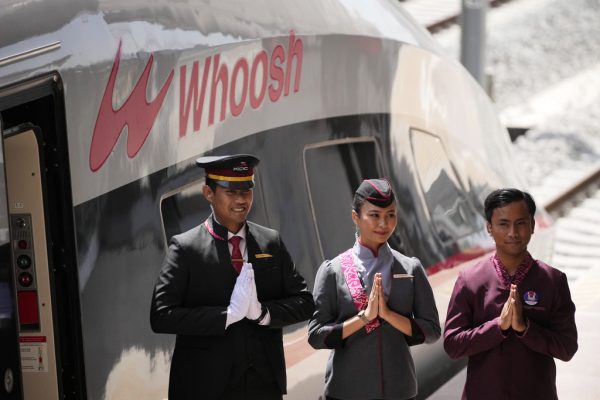
It would be an understatement to say that October was a momentous month for China’s Belt and Road Initiative (BRI). Beijing celebrated the initiative’s 10th anniversary by holding the third Belt and Road Forum; around the same time, its signature high-speed railway (HSR) in Indonesia became operational. The launch of “Whoosh,” the Jakarta-Bandung HSR, on October 2 has been touted as a significant achievement for Indonesia and point of pride for China’s BRI.
During the Belt and Road Forum, Chinese President Xi Jinping and Indonesian President Joko “Jokowi” Widodo applauded the railway line at their bilateral meeting, claiming that it was a success and completed on time. As the first HSR in Southeast Asia, the project holds tremendous potential for Indonesia. In terms of logistics, the railway cuts down travel time between the two cities from three hours to under one hour and addresses congestion that costs the economy billions per year. But perhaps even more significant are the opportunities that the transfer of knowledge and technology can have for Indonesian industry.
Opening just ahead of the initiative’s 10th anniversary, the railway has been hailed as one of the BRI’s flagship projects. The railway has gained wide-ranging media coverage and acclaim, and quite rightly so. However, it’s vitally important to not conflate a successful launch with a successful project. As discussions ramp up for the extension of the line to reach Surabaya, which is roughly 700 kilometers away from Jakarta, it’s critical that lessons learned from the Jakarta-Bandung HSR are taken into account for future infrastructure projects.
While there is certainly no such thing as a “perfect” infrastructure project, the issues that plagued the Jakarta-Bandung HSR stem from a recurring trait in BRI projects: a lack of pre-project preparation and due diligence. This critical phase is where project financiers, developers, and government officials undertake a range of assessments and appraisals of the project from financial sustainability to environmental impacts. When done right, these assessments can provide significant benefits to developers, officials, and communities alike, including direct insight into the local environmental and social context, a structure for project monitoring and reporting, and opportunities to develop and implement plans and mechanisms to address challenges as they arise. Conversely, without the due diligence, things can go wrong and can do so very quickly.
Following the decision to turn down the Japanese proposal in favor of China’s bid in late September 2015, the Jakarta-Bandung HSR project was awarded to an Indonesian-Chinese state-owned business consortium, PT Kereta Cepta Indonesia-China (PT KCIC), in early October. The rush was on to kick-start construction on the project – much to its long-term detriment.
On the same day the HSR was assigned to PT KCIC, Jokowi signed Presidential Regulation No.107/2015 which sought to accelerate the implementation of the railway project. In January 2016, he signed Presidential Regulation No.3/2016, which deemed the HSR a national strategic priority project and allowed for expediting the issuing of government permits. Despite its high priority, however, the project wasn’t even included in the government’s initial Master Plan of National Railway.
Three weeks later on January 21, 2016, Jokowi attended the project’s ground-breaking ceremony in West Java. Despite the ribbon cutting, the Indonesian government had yet to issue the permits to the contractors and the developers to begin construction, causing the project to come to a quick halt. It would take the Indonesian Ministry of Transport an additional two months to process the construction permits for just the first 5 km of the 142.3km railway.
Illustrative of the rush to push the HSR through, critical parts of the pre-project preparation were undertaken with lightening speed. The feasibility study, which usually takes 18 months was finalized in just three months, and the environmental impact assessment (EIA) which should take a year to a year and a half to complete, was done in just seven days. Independent analysts in Indonesia highlighted that the EIA neglected to include key components including the project’s impact on landslides, geological fault lines, and water catchments.
All this due diligence and project preparation falling to the wayside was no small matter to the communities that the railway directly impacted. The lack of a comprehensive, transparent, and a community-engaged EIA process, especially one that was undertaken with such speed, resulted in communities in proximity to the railway line being left almost completely out of the loop on the project’s development and impacts.
Residents of Laksanamekar village in West Bandung were left out of the EIA process. When blasting began on one of the railway’s tunnels, not only were they caught off guard but their homes began to crack and the community loss access to artesian water. This same situation occurred in other residential areas, including West Java’s Tipar Sari Asih housing complex, where tunnel blasting inflicted significant damage on homes. Additionally, due to the rushed and haphazard EIA, changes in land use were not adequately incorporated in the assessment, resulting blocked drainage channels, disrupted waterways, and increased flooding.
Land acquisition and clearance proved to be another significant hurdle in the project’s development. After the issuance of government permits allowing construction to begin, which was initially slated for August 2016, PT KCIC had yet to procure and clear a majority of the land needed for the project. By September 2017, the consortium announced that it had only cleared 55 percent of the land needed for the railway. It would take until roughly mid-2019 – three years after the ground breaking ceremony occurred – for the land acquisition process to be finalized.
As a result of not only the land acquisition challenges but also the impacts of COVID-19 and shoddy project management, the project quickly began to see significant cost overruns. The initial price tag for the railway line was $5.5 billion. That number quickly ballooned in the subsequent years to roughly $7.2 billion. The mounting project costs caused Jokowi in September 2021 to override a previous 2015 decree that prohibited state funds going to the railway through the signing of Presidential Regulation No.93/2021, which paved the way for government funds to be used to finance the railway.
The uncertainties surrounding finances and the project’s sustainability don’t stop there. The announcement in 2019 that Indonesia would shift its capital from Jakarta to a new, but yet to be built city, Nusantara in East Kalimantan province, sparked further concerns over the railway’s long-term viability. When the initial feasibility study was undertaken in 2017, project developers assumed that daily passenger volume would be roughly 61,000 and even then it would take 26 years for the project to break even. With the likely relocation of over 1.5 million government employees and their families from Jakarta to the new capital, PT KCIC adjusted its assumptions, significantly reducing the daily passenger demand to 31,000 – therefore extending the timeline to 40 years to break even.
Further highlighting the precarious state of its financial sustainability, the Indonesian and Chinese governments came to an agreement that they will have to allocate $64.3 million annually to just cover the railway’s operational and maintenance costs. This is no small matter especially as the Indonesian government is increasingly raising the prospect of extending the railway line to Surabaya, which is over 700 km away from Jakarta.
With the Indonesian government announcing on November 1 that it will work with China Railway Group, one of the major shareholders of PT KCIC, to undertake a joint study on the Surabaya extension, it’s critical – especially for local communities and stakeholders –that missteps and lessons learnt from the Jakarta-Bandung HSR aren’t repeated or lost.
In seeking to provide guidance on how best to undertake pre-project planning and due diligence and as a corollary improve project outcomes, the Asia Society Policy Institute developed a Belt and Road Initiative Toolkit to support local communities and companies engaged in the initiative to ensure that projects are developed to be inclusive and environmentally and socially sustainable. Available in English, Mandarin, Bahasa Indonesia, Khmer, and Lao, the toolkit contains key information on best practices on conducting EIAs, how to undertake stakeholder engagement throughout the lifecycle of the infrastructure project, and what Chinese and international laws and policies relevant to the projects.