

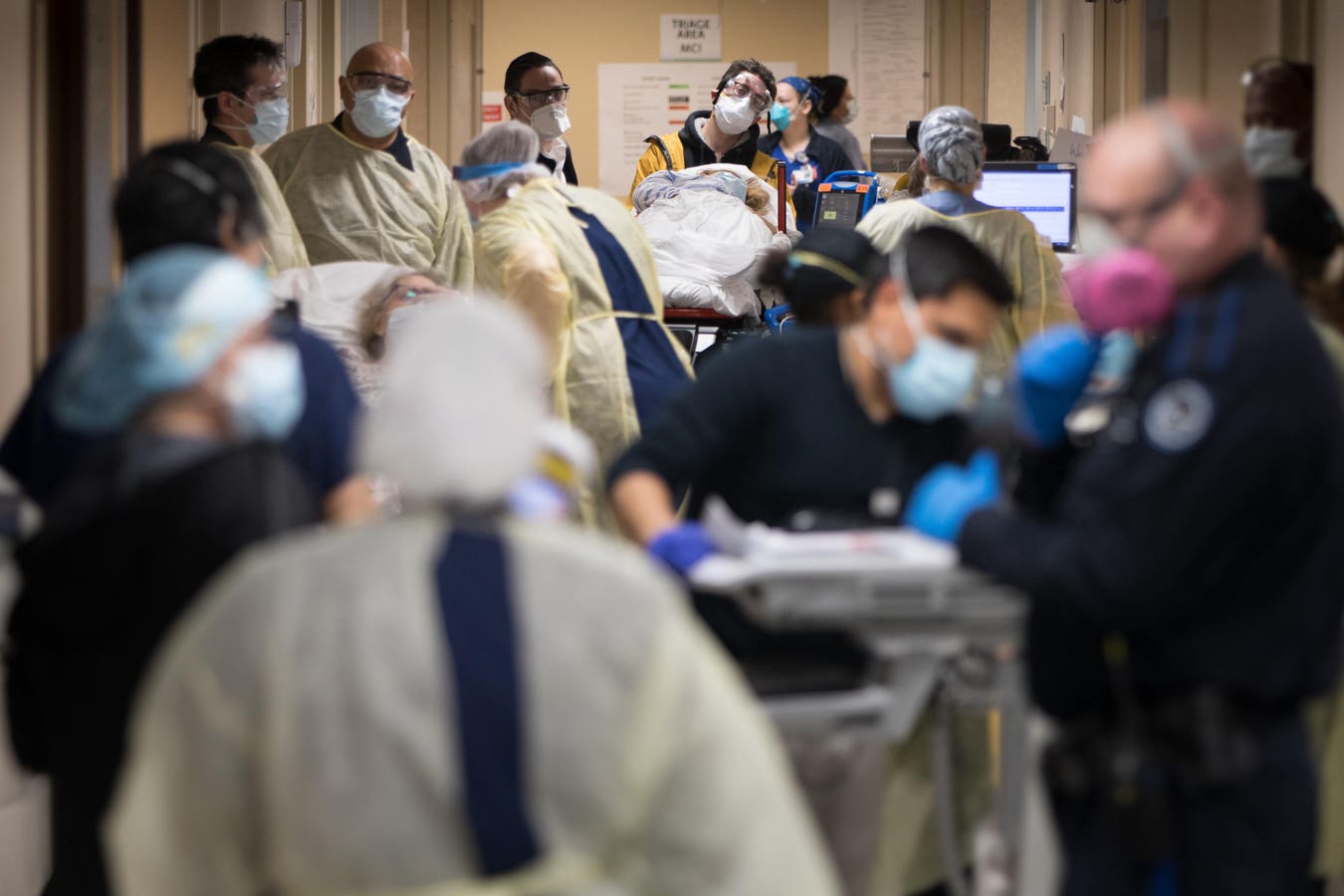
Since 2025, the Trump administration has been progressively shrinking the personnel and activities of the Agency for Healthcare Research and Quality, the only federal agency focused on supporting work and research into improving the safety and quality of healthcare. (Photo by Jeffrey Basinger/Newsday via Getty Images)
Newsday via Getty Images
You probably heard about the Trump administration’s rapid take down in 2025 of the U.S. Agency for International Development after it had been around for 63 years. Well, in 2026, the Trump administration been doing a much quieter take down of another long-standing federal agency—the Agency for Healthcare Research and Quality. The repercussions of this takedown of AHRQ, though, will likely be heard and felt by many, many patients for years and even decades to come.
On July 15 AHRQ Halted At Least 104 Grants
That’s because for 27 years, the AHRQ has been the only federal agency focused on supporting work and research into improving the safety and quality of healthcare—hence the name of the agency. That’s pretty darn important stuff if you happen to have a human head and body and thus require healthcare at some point in your life or at least care about someone who does. An analysis conducted by the agency had estimated that in the 2014 to 2017 period alone, AHRQ-funded studies had saved around 20,500 deaths and $7.7 billion in healthcare costs.
Such studies have included research on preventing and controlling healthcare-associated infections, reducing of medical errors, safely dispensing medications, measuring hospital quality and developing technology that can help improve the safety and experience of patients. An estimated 250,000 to 400,000 people in the U.S. die each year from preventable medical errors. And an estimated 75,000 to 99,000 die each year from healthcare-associated infections.
However, without AHRQ, those interested in researching such areas may struggle to find funding, especially with what the Trump administration along with Elon Musk’s so-called Department of Government Efficiency have done to National Institutes of Health and Centers for Disease Control and Prevention funding. Therefore, a July 15 letter from the AHRQ must have made a lot of healthcare quality and safety researchers around the country go “Argh”—telling them that AHRQ was halting at least 104 of their grants.
AHRQ Had Gone A Year Without Issuing New Grants
That’s after the AHRQ had gone over a year without issuing any new grants and spending less than $15 million of the $345 million allocated by Congress to the agency for the current fiscal year. So unless AHRQ somehow ends up issuing, oh, $330 million in grants from now to September 30, the Trump administration will have basically ignored what Congress had wanted and indicated, which wouldn’t be the first time that’s happened.
Last August, the Society for General Internal Medicine did initiate a lawsuit against AHRQ Director Roger Klein, MD, JD, and U.S. Secretary of Health and Human Services Robert F. Kennedy, Jr., JD over AHRQ’s not issuing new grants. The lawsuit alleges that such actions—or rather inaction—violates a 1974 law that emphasizes that Congress and not the U.S. President and his Executive Brach ultimately determines what federal agencies can spend on what. Of note, the July 15 grant-halting letter from AHRQ did not mention the T-word—meaning “termination”—and instead used the phrase “not awarded continued funding,” which may have ramifications when it comes to what happens to lawsuits like the one initiated by SGIM.
HHS spokesperson Emily Hilliard has indicated that AHRQ has been aiming to establish a new “framework” for grants. However, it’s not been clarified what this framework might be and when it might be revealed. I will continue to reach out to contacts at HHS for more clarification.
AHRQ Has Shed And Lost Three-Quarters Of Its Personnel
In the meantime, if you do try to call or otherwise reach out to AHRQ to ask questions about what’s happening, good luck getting a response. The agency has lost about three-quarters of its personnel since Donald Trump ascended to the U.S. Presidency in January 2025. Those personnel losses have come through a range of different firings, layoffs resignations and other so-called RIFs or reductions in forces. Those who have been at AHRQ told me that by late 2025, the number of empty chairs already far outnumbered the number of people at AHRQ meetings.
Trump Had Already Wanted To Eliminate AHRQ During His First Presidential Term
What’s happening right now with AHRQ should not be a surprise. Back in 2017, I wrote in Forbes about how the proposed budget being put forth by then first term U.S. President Donald Trump and his administration had already tried to effectively eliminate AHRQ. Congress at the time, though, essentially treated this budget proposal like a pair of parachute pants and ignored it, leaving AHRQ with a budget.
The Trump-appointed Director Of AHRQ Has Not Been Spending The Funds That Congress Allocated
However, during Trump’s second term, his administration seems to have more trump cards up its sleeve when it comes to ignoring Congress when Congress ignores the Trump administration’s budget proposals. In 2025, the second coming of the Trump administration once again kept AHRQ out of its proposed budget, as I covered in Forbes. Congress once again ignored such a proposal and budgeted money for AHRQ. This time, though, the Trump administration has apparently circumvented Congress by just keeping AHRQ from spending its Congressional allocated funds.
It remains to be seen whether the Trump administration will even keep AHRQ as a separate agency or dissolve it entirely. Kennedy did announce in March 2025 plans to roll AHRQ and other HHS agencies into a new Office of Strategy. And Klein hasn’t really made public statements to help everyone clearly understand the direction of AHRQ since the Trump administration appointed him in July 2025 to be the new AHRQ director. Klein’s AHRQ website bio does lists him as “a board-certified molecular pathologist and attorney who was formerly Chief Medical Officer of OmniSeq, Inc., a tumor profiling company that was acquired by LabCorp” but doesn’t mention much about his vision for healthcare quality and safety.
Historically, federal agencies have incorporated various advisory committees of external scientific experts to help provide more transparency and oversight of its activities—especially its funding ones. But actions like Trump’s executive orders and the new White House Office of Management and Budget rule that I’ve covered in Forbes have progressively lessened the role of scientific peer review and other such external oversight in guiding federal agency operations such as grantsmaking. That’s concurrently increased the power of the President and his political appointees over what the federal agencies do and where the agencies’ funding goes.
The trouble is healthcare quality and safety work may seem like something you can cut without immediately clear ramifications—sort of like cutting the White House pandemic preparedness and response capabilities in 2017 and the food-borne illness prevention and control programs in 2025. But eventually the ramifications of such cuts will be seen, which is what happened in 2020 with the COVID-19 pandemic and this year with the 12 active food-borne illness outbreaks now occurring. And it’s safe to say that cutting work on healthcare safety and quality will have its ramifications down the road.