

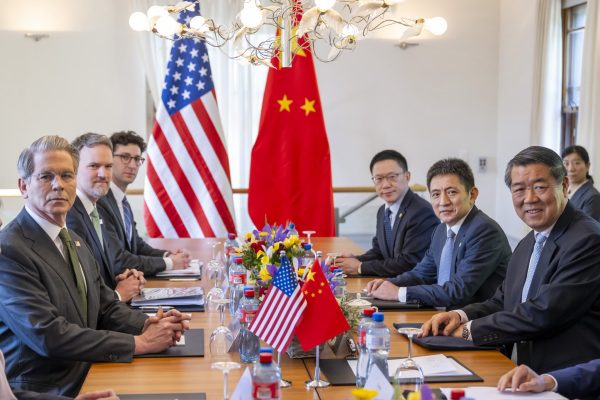
As U.S. President Donald Trump’s planned visit comes into view, Washington and Beijing are discussing a new China-U.S. Board of Trade. U.S. Treasury Secretary Scott Bessent and U.S. Trade Representative Jamieson Greer have suggested a body that would define what the two countries can trade without crossing national security red lines.
That sounds sensible, but it is dangerously incomplete. The real problem is the absence of procedures that keep ordinary commercial disputes from escalating into geopolitical confrontations.
A board that merely blesses some transactions and bans others would quickly become another arena for political theater. Its real purpose should be to keep day-to-day commerce from being pulled into every diplomatic crisis and to prevent minor frictions from triggering tariffs, sanctions, export controls and retaliation.
The difficulty is that while the U.S. and Chinese economies remain tightly intertwined, the rules that govern them rest on fundamentally different assumptions about state power, market discipline, ownership, data control and national security. Those differences surface in disputes over subsidies, state-owned enterprises, industrial policy, regulatory discretion, digital governance and security screening. No trade board will make those differences disappear. Nor should it try. The test is whether two rival systems can create procedures that allow firms, banks, shippers and investors to understand the rules before they act, verify compliance after disputes arise, and adjust course without turning every disagreement into a test of national resolve.
The Manus-Meta dispute shows why that procedural architecture is essential. According to Reuters, Chinese regulators ordered U.S. tech giant Meta to unwind its more than $2 billion acquisition of Manus, a China-founded artificial intelligence company that had moved operations to Singapore after U.S.-led financing. China’s National Development and Reform Commission reportedly required the transaction to be withdrawn under China’s foreign investment security review mechanism.
Manus had reorganized abroad, attracted foreign capital, and become the target of a major U.S. technology acquisition. Yet relocation and foreign incorporation did not settle the jurisdictional question. Regulators treated the company’s links to China in technology, talent, data, prior operations, and strategic industrial capacity as relevant to review.
The lesson is not limited to one transaction. A cross-border deal can be commercially coherent and still fail because the parties do not know in advance which facts will trigger security treatment. Headquarters, ownership structure, founder location, prior operations, cloud systems, data flows, investors, employees, and code can all become relevant after the fact. By then, staff may already have moved, investors may have been paid, and code, data, intellectual property, due diligence records, and engineering knowledge may have entered new systems. A government can order a transaction unwound, but it cannot easily pull back what has already been learned, copied, adapted, or embedded. Deal certainty depends less on incorporation formalities or summit diplomacy than on predictable review before capital, people and knowledge are committed.
Earlier China-U.S. dialogues show the danger of an incomplete structure. The Joint Commission on Commerce and Trade, created in 1983, offered a useful venue for complaints and sectoral bargaining. The China-U.S. Strategic Economic Dialogue, founded in 2006 was rebranded not once but twice: as the China-U.S. Strategic and Economic Dialogue in 2009 and finally the China-U.S. Comprehensive Economic Dialogue, which was announced in 2017 but met just once before being scrapped. These frameworks elevated engagement to the Cabinet level. But consultation is not governance. Without a bounded mandate, fixed timelines, evidentiary standards, escalation rules and preannounced remedies, no forum can stabilize expectations once the political weather turns.
A serious Board of Trade should start with a written charter that defines its jurisdiction. It should specify which sectors are covered, which measures must be notified, what counts as noncompliance, when a matter can move from consultation to adjudication and how a temporary restriction is narrowed or ended. Vague boundaries are not flexibility; they are invitations to rewrite the terms of a deal after firms have already invested.
The board should also separate commercial governance from security oversight without pretending they are unrelated. One track should manage market access, customs, standards, subsidies, state-owned enterprises, payments and supply-chain continuity. Another should address export controls, sanctions-related compliance, technology restrictions, investment review and other security-sensitive measures. Formal notification must connect the two. Otherwise, the security exception will swallow the trade system.
The technical work must be permanent, not improvised before summits. A standing secretariat should monitor implementation, receive complaints, convene regular sectoral reviews and publish reports. Firms should be able to seek clarification without elevating every issue to the Cabinet level.
All this may sound bureaucratic. It is not. Bureaucracy becomes dangerous when it conceals discretion. The goal here is to render discretion visible, comparable, and reviewable. Dispute settlement must be designed before a breach. Panel formation, deadlines, confidentiality rules, standards of review, compliance periods, and permitted countermeasures should be set in advance. Enforcement should escalate in stages, from consultation and formal findings to compliance plans and proportionate countermeasures within agreed limits. If enforcement rules are left until a violation occurs, bargaining will fill the vacuum just when procedure is needed most.
Payments deserve special attention. Lawful trade cannot function if settlement cannot be completed through predictable channels. The board should define approved settlement channels, documentation rules, bank verification duties and fallback routes. Private contract disputes can remain with arbitration or courts. The board should handle systemic failures such as blocked settlement, customs obstruction, discriminatory licensing and measures that make legal trade practically impossible.
Finally, the board must not become a device for legitimizing permanent emergencies. Any restrictive measure should carry a clear trigger, a review date, and an exit path. The aim is to isolate what is sensitive so that the rest of commerce can remain governed by rules.
Both governments have many tools for punishment, but too few for correction. When a dispute arises, companies often do not know which rule applies, which authority can clarify it, what evidence will matter, how long review will take, or what remedy is available short of escalation. In that environment, each side assumes the other is exploiting ambiguity. Precaution becomes retaliation, and retaliation becomes normal practice.
A serious Board of Trade would not eliminate mistrust; it would make mistrust governable. It would require both governments to define obligations before firms invest, make compliance observable after disputes arise, and create a path for revision that does not depend on personal access, political timing, or unilateral pressure. The institutional burden of China-U.S. economic governance today is not reconciliation but disciplined coexistence.
The danger is not simply that the next crisis will interrupt trade. It is that every interruption will be treated as proof that rules no longer matter. If Washington and Beijing create a Board of Trade, they should build one that does more than announce what may be traded. It must keep a dispute from hardening into doctrine, an exception from becoming policy and a crisis from becoming the operating system of the relationship.