

Japanese firms have huge stakes in the policies the incoming Donald Trump administration implements. The United States is Japan’s second largest trade partner, the largest destination for Japanese foreign direct investment (FDI), and a major research and development (R&D) hub for Japanese companies. Japanese businesses are tightly linked to the U.S., too, through their dealings with and FDI in countries such as China and Mexico, which have drawn intense scrutiny, albeit for different reasons, from Trump and his circle.
Oddly, though, while there has been an outpouring of analyses on Trump 2.0 and China, Trump 2.0 and Southeast Asia, and the like, there is an almost complete absence of systematic pieces on Trump 2.0 and Japan, particularly the implications of the new regime for Japanese companies.
It is widely known that Trump remains enamored with trade tariffs. For him, they are a tool to rectify trade imbalances; to incentivize greater FDI in the U.S. and, relatedly, boost U.S. manufacturing; and to bargain for changes in military and political areas. The problem is not just that he intends to raise tariffs globally, but specifically will target China, Mexico, and Vietnam, locales where Japanese companies are heavily invested. In addition, Washington under Trump likely will pressure Japan and Japanese companies to buy more U.S. products and services.
Another challenge for Japanese firms will be that Trump, his Cabinet by and large, and many key advisors are China hawks. They will want Japanese companies to reduce or eliminate FDI in China, join increasingly broad U.S. export controls, restrict technologies transfers, and show solidarity with the U.S. in the face of Chinese retaliation against U.S. tariffs.
In the new Trump era, Japanese companies in the U.S. will face an evolving environment with, on the negative side, the elimination of supportive subsidies and tax credits (e.g., for electric vehicles) and higher tariffs on parts’ imports into the U.S., and on the positive side, potentially reduced regulation and corporate income taxes, wider FDI doors, and new opportunities for collaboration in critical minerals, energy, and technology. Aside from this, it is plausible that the new administration will oppose Japan’s regulation of U.S. high tech companies such as Amazon, Apple, and Google. This, in turn, could darken the operating environment for Japanese businesses competing against or facing pressure from such firms.
The Trump administration may also press Tokyo to open its service or other sectors wider to U.S. companies as well as to show greater openness to U.S. activist investors that want to “reform” Japanese companies, both of which have implications for corporate governance, business operations, and the competitive environment inside Japan.
There is no one on Trump’s top-level team with Japan experience. This said, there are those that have expressed favorable views of Japan or that have more extensive links than other members of Trump’s circle. Mike Waltz, Marco Rubio, and Scott Bessent, Trump’s choices for, respectively, national security adviser, secretary of state, and secretary of the treasury, fall into this camp. There also are those that have policy preferences that directly or indirectly align with the preferences of Japanese companies. For instance, Chris Wright, Trump’s pick to serve as secretary of the Department of Energy, wants greater liquified natural gas (LNG) as well as geothermal and nuclear energy production. Regardless of the above, Trump and his team undoubtedly see Japan as an invaluable security partner, even if they would like Japan to do more, which could make them reluctant to take strong trade actions against Japan.
Japanese companies are moving quickly to curry favor with the incoming administration. Some, for instance, have made “donations” to Trump’s January 20 presidential inauguration as Toyota did. SoftBank Group CEO Masayoshi Son topped this by an order of magnitude, pledging to make a $100 billion investment over four years in the U.S., primarily in high-tech areas, that would create 100,000 jobs, a doubling of his investment pledge to the incoming president eight years ago. Regardless of if the investment comes to fruition, this is an opportune time to make forward-leaning statements about investing in the U.S., especially greenfield investments in areas like critical minerals, fossil fuels, electric batteries, nuclear power, and manufacturing that are privileged by Trump and/or his team.
Acquisitions can be more sensitive, as seen with the U.S. Steel case, but, overall, U.S. national security reviews are likely to continue to view Japanese acquirers favorably, albeit with a keener focus on Japanese corporate ties with China. Increased investment in research and development deserves serious consideration, too, given the multiple benefits it offers to Japanese businesses. It goes without saying Japanese companies should broaden and deepen their government and public relations. Importantly, such efforts should not focus solely on Trump, as important as he is, but his circle, multiple branches of government, and multiple levels of government, particularly Republican-controlled states.
Finally, Japanese business needs to redouble its efforts to de-risk its supply chains to make them more resilient in the event of a full-blown China-U.S. trade war. The United States has recently broached taking action against imports from Chinese-owned factories in Mexico, opening an entirely new area of trade restrictions based on who manufactures a product rather than where it is made. Thus, Japanese firms need to continue moving export production in China to safer bases in Southeast Asia or Mexico and look more closely at manufacturing, licensing or joint ventures they have with U.S. partners that could be vulnerable to Chinese retaliation. They need to press their government to build trade and investment relations with other countries, as they strive to keep ahead of expanding U.S. tariff barriers to other countries such as Vietnam where China is setting up factories at a furious rate to circumvent Trump tariffs.
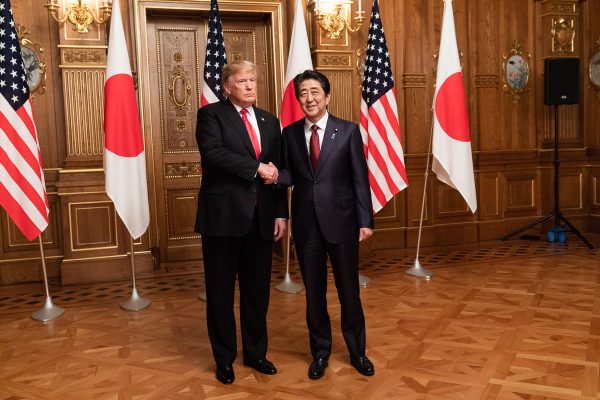
While consequential, Trump 1.0 was not as earthshattering for Japanese companies as many feared. It would be a mistake, though, to assume Trump 2.0 will be the same. First, Trump is not the same as before, already having served one term as president, nor is his circle. Second, the domestic political environment in the United States has changed, with the Republican Party controlling both the U.S. House and Senate and the judiciary and the bureaucracy seemingly pliant, which suggests Trump will have a freer hand to pursue his economic agenda. Third, Japan is politically more unstable – Prime Minister Abe Shinzo had already been Japan’s leader for four years when Trump was elected in 2016, while Prime Minister Ishiba Shigeru is the third Japanese prime minister in four years. Fourth, the regional and international environments are not the same with U.S. hawkishness toward China more intense and international economic and other institutions enervated. Lastly, Japanese companies have a much bigger footprint abroad, which means they are more exposed.
Japanese businesses and their leaderships would be wise to shun mere adjustments and to emphasize rapid adaptation to the new environment.