

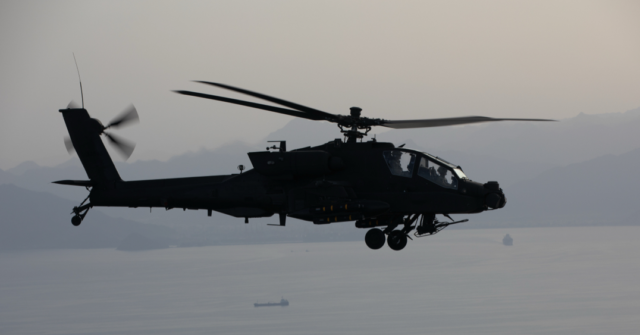
U.S. President Donald Trump confirmed the two crew members of a U.S. Army Apache Helicopter that crashed near the Strait of Hormuz are uninjured and “fine”.
A U.S. Army AH-64 Apache, a helicopter gunship well suited to patrolling waterways and hunting small attack boats, was lost on or near the Strait of Hormuz on Monday. Its two crew members were rescued and it is not immediately clear why the crash happened.
U.S. President Donald Trump made a brief statement on the loss as he boarded Air Force One overnight, stating: “the pilots are fine… nobody injured. We are going to issue a report tomorrow but the pilots are fine”.
UPDATE 0830 — Drone Delivery
A curious ‘the future is now’ element to this story is the revelation, courtesy of Reuters, that the two Apache crewmen were rescued bv a U.S. Navy Drone. Per their report, “A U.S. Navy surface drone found and rescued the two crew”.
The U.S. Navy has had sea drones for years but the capability is relatively little discussed and seen, even though the potential potency of sea drones has been dramatically illustrated by the war in Ukraine in recent years. While we don’t know exactly what sort of drone was used to retrieve the downed pilots yet, the United States Naval Institute has already published on the use of the Common Unmanned Surface Vessel (CUSV), an autonomous speedboat with high speed and endurance.
The institute posited in 2021:
In all search-and-rescue responses, resolution comes only after other ships are able to recover the victims—something that may not be possible in the heat of battle and may not be feasible if there are thousands of stranded sailors. A potential solution is the use of USVs. Autonomous UAVs and USVs would launch simultaneously, search the area, identify and mark stranded sailors using GPS coordinates, and deliver temporary survival equipment. The sailors’ coordinates would be relayed to the surface drone, which would collect the stranded sailors—all while the ships keep fighting.
Because there is no need for a wheelhouse or other superstructure the autonomous boats can be built low to the water, minimising visual and radar signature. Publicly available images of these boats show periscope or scissor mast-deployable sensor suites that can be raised when needed, and retractable mission loadouts including mine countermeasures and missile pods.
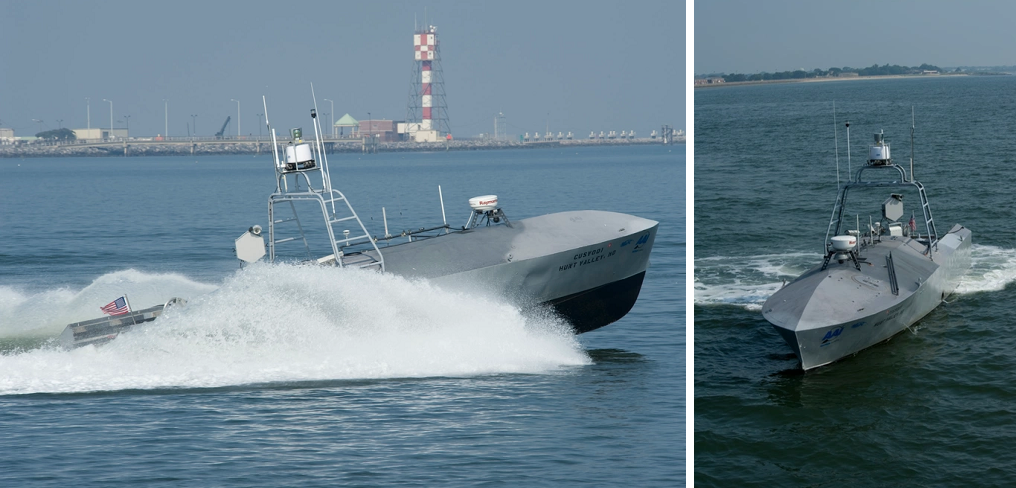
File photo 2011 / U.S. Navy / Seaman Scott Youngblood
UPDATE 0700 ET — CENTCOM statement
Following the comments from President Trump earlier, the promised report from U.S. Central Command has now arrived. They said two crew members from the Apache helicopter were rescued at 19:33 Eastern Time on Monday evening, which would make it the early hours of Tuesday morning local time in the Persian Gulf “after their helicopter went down near the coast of Oman while patrolling regional waters.”
The two crewmembers were “safely rescued” after two hours and are in stable condition, CONTCOM said. An investigation into the crash is now underway.
The original story continues below
President Trump also gave a short update on the state of negotiations with Israel and Iran after the ceasefire was broken in recent days, leading to strikes. Stating that was already over, President Trump said a new agreement was just days away, and said: “we have ongoing negotiations in Iran and with Iran, and that hasn’t stopped. We could have a t least an idea one or two days from now. I think it’s going well. The blockade continues to hold, nothing is getting through out blockade.”
He continued, saying of Israel’s Benjamin Netanyahu and the exchange of fire: “he was hit, and then he hit back, and now they’ve called it quits.
“So they’re going to leave each other alone for another week or so… they’ve both agreed through me to stop and we’re in the final throes of what will be a very good deal that will not allow in any way, shape or form nuclear weapons. And the Strait will pen up right away, it will open immediately upon signing which could be in two or three days.”
The U.S. Army’s AH-64 Apache, the type lost over the Strait on Monday, is a Cold War warrior designed to destroy Soviet tanks in north Germany in the case the conflict turned hot. Conventionally armed with an auto-cannon and Hellfire anti-armour missile, it has recently acquired the Advanced Precision Kill Weapon System (APKWS), one of the new generation of low-cost, medium-effect small guided missiles.
Well suited to shooting down fast, unarmoured, high-threat targets — like drones, such as have dominated the battlefield in Ukraine, or Iran’s fleet of bomb-laden speedboats — the APKWS goes some way to address the often asymmetric nature of modern warfare, which has sometimes seen thousand-dollar drones shot down with million-dollar missiles for want of a better alternative.