

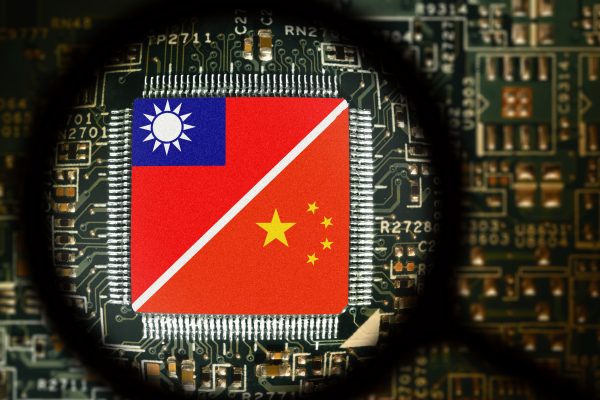
China is aggressively advancing its artificial intelligence (AI) research and production, aiming to achieve greater autonomy in the China-U.S. tech competition through local AI chip design. This ambition makes Chinese AI chip firms prime targets for U.S. technology sanctions. However, China faces a significant challenge: its leading wafer manufacturer, Semiconductor Manufacturing International Corporation (SMIC), can only produce chips of 7 nanometers, which is relatively outdated technology.
To achieve breakthroughs in AI chips and high-performance computing products, China cannot rely solely on its domestic industry and must depend on advanced technology from Taiwan Semiconductor Manufacturing Company (TSMC). But how?
Chip design necessitates close collaboration with manufacturers. From silicon IP verification and trial production to full-scale manufacturing, the process must ensure that production technology meets design specifications. If Chinese AI chip designers collaborate with TSMC to develop new AI chips, switching to alternative chipmakers quickly becomes unfeasible. This dependency underscores the business mechanisms within TSMC-China chip design partnerships and illustrates how Taiwan and China’s semiconductor supply chains are potentially intertwined amid the China-U.S. tech war.
The Remote-Poaching Model: The Case Study of Bitmain
Bitmain serves as a key case study in understanding the relationship between China and Taiwan in AI chip development. Originally focused on designing cryptocurrency mining machines, this leading Chinese IC design firm shifted to developing edge AI chips with the assistance of Taiwanese engineers.
This business approach, known as the remote-poaching model, involves Taiwanese engineering teams designing chips for Chinese firms, managing local wafer production with TSMC, and overseeing the entire packaging and testing process. Importantly, no Taiwanese engineers relocate to China, yet China’s AI chip industry continues to advance.
As shown in the Bitmain case, establishing cross-strait business mechanisms is crucial for the remote-poaching model to operate effectively. Beijing Jingshi – a company spun off from Bitmain in 2019 – played a pivotal role in this cooperation. From Bitmain’s perspective, Beijing Jingshi is a subsidiary funded by the parent company and incorporates technology investments from Taiwanese engineers.
The Chinese side provides funding, while the Taiwanese side contributes technology. Through this joint venture, both partners effectively tap into the promising Chinese market, where the local government utilizes these AI tools to power surveillance systems in smart cities. Moreover, this collaboration has attracted substantial financial investments from other Chinese entities, including Beijing E-hualu and Xiaomi Group.
However, such a business model is not legally acceptable in Taiwan.
Taiwan’s Response: Investigative Actions and Investment Screening
To prevent Taiwan’s semiconductor industry from becoming a tool for China’s AI advancements, the Taiwanese government has taken decisive actions since 2021. Through investigative raids, authorities successfully blocked Bitmain from remotely poaching Taiwanese teams. Over the past three years, authorities have uncovered dozens of similar cases.
These legal actions stem from Taiwan’s stringent legal framework for China-related business dealings. Under these regulations, all Chinese entities must obtain prior government approval to operate in Taiwan. Most chip design companies targeted by raids failed to secure this approval yet attempted to recruit chip talent and conduct R&D within Taiwan’s semiconductor clusters. In another example, WiseCore Tech, one of Bitmain’s Taiwan-based subsidiaries, assumed its parent company’s role in securing TSMC’s capacity and managing manufacturing processes.
Taiwan’s official investigations into these business connections not only align with efforts by like-minded countries to strengthen economic security but also aim to regulate the flow of semiconductor technology. This regulation is essential to prevent technology from flowing to China and undermining Taiwan’s industry competitiveness. Similar to many countries, Taiwan has established investment review systems, including inbound screening, which is common, and outbound screening, which is rare. Even the United States only introduced outbound measures this year to regulate U.S. investments in China’s semiconductor, AI, and quantum computing sectors.
However, Taiwan’s investment review system fails to effectively counter the remote-poaching model. Bitmain did not use formal investment channels to send money to Taiwan. Moreover, the company’s primary operational funds for developing AI chips remained in China, with most financing completed through Beijing Jingshi. Consequently, Taiwan’s inbound investment review mechanisms were not triggered.
Additionally, outbound screening regulations could not effectively detect their illegal business practices. The Taiwanese engineering team assisting Bitmain in chip development first set up a company in Hong Kong. Under this Hong Kong company’s name, they acquired technical shares of Beijing Jingshi. According to Hong Kong’s Companies Registry, the company’s capital was only the minimum required to establish it, far below the threshold needed to trigger Taiwan’s outbound screening mechanisms.
Taiwan’s investigative actions serve as a supplementary mechanism to its investment review system. Through these investigations, the Taiwanese government compensates for the investment screening process’ limitations in effectively blocking the remote-poaching model. This case clearly demonstrates that modern economic security frameworks must continuously adapt to the evolving nature of global supply chains to remain effective.
Slowing Down China’s Strides in AI
Taiwan’s experience with the remote-poaching model also provides the international community with an analytical framework to examine similar business activities by China in other countries and assess potential threats to economic security. There is a common argument that current U.S.-led export control measures have inadvertently accelerated the localization of China’s chip technology. Due to restricted channels for importing products, domestic market demand in China remains strong, forcing Chinese companies to invest resources in local technology research and development, thereby speeding up technological advancements.
However, in the Bitmain case, Taiwan exports more than just chip products. Taiwanese engineering teams collaboratively advanced the technical capabilities of Chinese chip designers. Halting these business activities should be viewed as an effective measure to slow down the development of China’s AI technology.
Bitmain has recently regained significant attention within Taiwan’s semiconductor sector. In the second quarter of 2024, Bitmain allegedly became a major source of demand for TSMC’s 3 nm chips. In the third quarter of 2020, TSMC halted shipments to Huawei, causing a sharp decline in its revenue from China. However, recent figures have rebounded to pre-sanction levels, indicating that Chinese companies beyond Huawei continue to maintain strong demand for TSMC’s technology.
In 2018, Bitmain’s founder made bold claims, vowing to challenge the AI chip market dominance of Intel, Nvidia, and AMD. Currently, Bitmain’s orders for high-performance computing products from TSMC are not subject to U.S. export controls, and TSMC complies only with U.S. extraterritorial regulations. However, from the perspective of slowing authoritarian states’ strides in the global AI race, are current international economic security measures sufficient? Even if the chips sold are not the most advanced, could these business activities still be advancing China’s AI chip technology?
Given the high complexity of the semiconductor supply chain, simplistic assumptions may fail to clearly identify the effects of technological sanctions on China’s emerging technological development. The remote-poaching model provides a nuanced analytical perspective, allowing us to assess the effectiveness of economic security policies.