

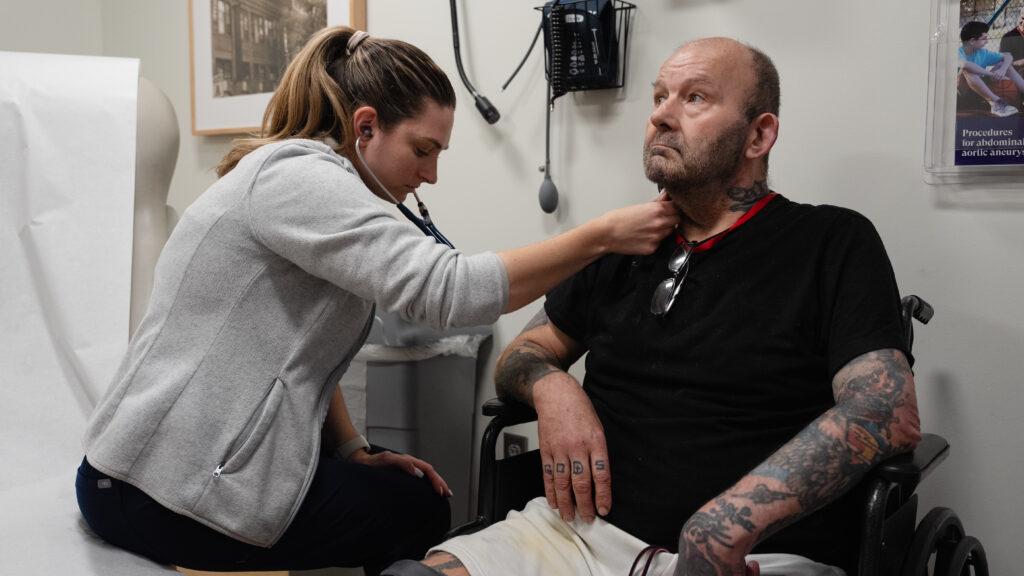
BOSTON — Carlton Haynes hugged his left knee, pulling it toward his shoulder as hard as he could. He was desperate to blunt the pain shooting from an open, oozing wound on his right shin. Anahita Dua, a vascular surgeon leading an unusual clinic created by Massachusetts General Hospital that Saturday, told him he was going to the ER and then the OR, where she would remove damaged skin and treat the wound.
Without this stopgap measure, she warned him, he’d almost certainly need amputation. OK, he said, but first he wanted a smoke.
So vascular surgery resident Sujin Lee rolled Haynes, 56, in a wheelchair into the elevator down four flights to the street, wondering how far they would need to go in the spitting rain to leave the hospital’s no-smoking zone. In anticipation, Haynes pulled a cigarette from his pack of Winstons.
“Do you have a lighter?” he asked.
No, she didn’t. Passersby and drivers in parked cars were no help either, as Lee dashed down the street. Then she told Haynes they should head back inside the hospital.
That last smoke proved elusive, but not for want of trying. Faithful to their ethos of meeting patients where they are, the Mass General team helps bring in people like Haynes — arranging Uber rides or sending shuttle vans — so they can see the series of specialists they need in one seamless visit on the hospital campus.
Every three months about 30 patients referred by primary care clinics move from a busy waiting room to a triage desk, then down a hallway of exam rooms labeled for the day to render wound care, imaging tests, evaluations, and compression sock fittings. Patients come in with what could be blocked carotid arteries, peripheral artery disease, abdominal aortic aneurysms, or infected sores that could seed sepsis, the overwhelming full-body infection.
“Because there’s lack of flow to the foot, for example, they’ll get a black toe and they’ll go to the ER,” Dua said about a more typical health care scenario. “In the American health care system, the model unfortunately is such that there’s a lot of firefighting, but in general, we’re not huge on prevention. So these patients will turn up, and of course they’ll have had no care anywhere previously and certainly no records.”

Working with Boston Health Care for the Homeless Program, the Mass General clinic, believed to be the first and only one of its kind, turns the ER-first model on its head. Primary care professionals at Boston Health Care for the Homeless identify people who could benefit from the hospital’s effort, founded three years ago to treat vascular conditions that threaten life and limbs. The clinic, run by the vascular medicine and surgery group within the Mass General Brigham Heart and Vascular Institute, was created a year after the hospital established the Limb Evaluation and Preservation Program, which Dua co-directs and whose mission is to help patients avoid amputation after peripheral artery disease.
People can get good care at shelters or clinics for the unhoused, but the middle part between primary care and the emergency department was missing, Dua said. While she and her colleagues do see urgent cases in the quarterly sessions, their hope is to prevent emergencies and overcome reluctance to seek intermediate care. The vascular surgery clinic can be the bridge, Dua said.
“You do the primary care, you find out someone has an aneurysm in their aorta, and then you say go to the ER? This person’s not going to go to ER, so they die,” she said about patients’ reactions. “That’s where this idea was born that we would create a clinic where we could do the next step: Send them to us.”
David Munson, a primary care physician at Mass General and medical director for Boston Health Care for the Homeless, said building trust has to happen first. He estimates that 125 to 150 people have received care since the clinic began in 2023.
“I think a lot of that is done upstream, where people have done work to either engage people on the street or engage people in shelters or in our respite program, and they have a relationship with a provider,” he said.
There is no typical Saturday at the vascular surgery clinic at Mass General, but the mainstays are doctors, nurse practitioners, nurses, and ultrasound technicians assisted by medical students and medical residents. Doctors and trainees like Lee volunteer their time to guide patients through up to five steps that could otherwise require separate appointments on separate days.
Four patients, including Haynes, agreed to share their stories with STAT. Most of their care started with Health Care for the Homeless in its Barbara McInnis House, near Boston Medical Center. Many referrals start with a wound that does not heal, a warning signal of an underlying vascular problem.

‘I’m trying’
Before Haynes bargained with vascular surgeon Dua to have a smoke, Mark Picard, 53, was telling his story to podiatric surgeon Sara Rose-Sauld. Dressed in a black T-shirt and shorts with a New England Patriots hat on his head and shower slippers on his feet, he said he wanted to understand why the sore on his lower left leg wouldn’t heal, eight years after getting a gash from a bike pedal.
First Rose-Sauld asked if he’d like to have his long toenails clipped. Yes, he said. Pain from his right hip kept him from doing that himself, and also from putting on socks. He’s due for a hip replacement, but if his leg wound gets infected, that would be a deal-breaker.
“I’ve been a drug addict for 30 years, too, so I used to think that that was the reason,” he said about former heroin use and his wound’s failure to heal. “I’ve got a pretty good grip on that now. I’ve gotten some time under my belt and finally, you know, after a lot of years of hard work, I’m trying.”
Finding timely health care has been hard, aggravated by a lack of transportation. This day Picard arrived at the vascular clinic with six other patients via a van from the Barbara McInnis House, where he has received daily dressing changes for his leg. Rose-Sauld cleared the edges, applied a wound-care salve, and emphasized the importance of changing the dressing frequently and elevating the leg when he could.
“Once I get my hip taken care of, then I can get back to doing the things I used to do that I enjoy,” he said. “I love golf. I’ve got nieces and nephews that are golfing. I can’t wait to be able to play with them.”

‘They said I’d be dead’
Waiting his turn for an ultrasound exam, Kenneth Bolster, 63, recounted his brushes with death. There was the time in San Antonio, Texas, when a person addicted to meth slammed a steel pipe onto his head, he recalled, causing brain damage that weakened his left side and left his left arm limp. That injury ended his 35-year career as a tattoo artist. He needed that left hand to stretch skin where his right hand would perform his art.
“I raised nine kids on it — everyone went to college, and I had three new homes,” he said about his tattoo work.
Ten years ago a tree fell on his right leg, requiring an amputation. He’s also had a quadruple heart bypass, a stomach blockage that required surgery, and a spinal fusion. “They said I’d be dead in a year and that was six years ago, so I’m not going anywhere,” Bolster said.
This time he was referred to the vascular clinic by the New England Center and Home for Veterans to follow up on CT scan results. He’d had dizzying low blood pressure due to blocked carotid arteries, the large blood vessels on each side of the neck. He felt like he was choking.
Because his right carotid is completely closed, his left one has to work harder to compensate, vascular technologist Lindsey Ferraro explained to him. As the ultrasound swooshed with each pulse and red blobs animated the screen (a good sign), there was no indication he’d need urgent care, unlike fellow patient Haynes, who was heading to the operating room before the clinic’s end at 2 p.m.
Instead, Bolster traveled to the cafeteria with a $15 voucher and a volunteer escort, part of every patient’s visit should they so choose.

‘I used to be afraid of doctors’
Meanwhile, Emma Chase, a medical assistant in vascular surgery, was helping Francia Echevarria, age 67, stay as comfortable as she could while her two legs were examined for pain that she says keeps her from moving forward. Unlike the open wounds others showed, there were no obvious signs of vascular trouble, but movement hurt due to peripheral artery disease. Turning to the right on the exam table was more difficult than to the left. She sighed a little more loudly, nodding when Chase asked if it felt worse.
Originally from Santo Domingo in the Dominican Republic, she now lives with her two daughters in South Boston.
“I take care of two autistic grandchildren. One is 11 years old and the other is 8 years old,” she said through a hospital medical interpreter. “They were born in my hands.”
While decisions on further steps were being made, the nurse offered knee- and thigh-high compression stockings to ease the pain and improve blood flow to and from the legs.
Chase used what looked like a partial plastic brace to widen the stocking to push them up the legs. Kneeling on the floor, Chase brought Echevarria’s ankles to rest on her shoulder so she could bring the stockings up to the hip.
Then Chase demonstrated how this might be done at home. “Make a sock puppet” was the first step.
This was Echevarria’s second visit to the clinic for leg pain. She was smiling behind her mask, which she pulled down at the end.
“I used to be afraid of doctors, but when I come here, I feel so confident that I have no fear,” she said. “Not anymore. Here, people are treated wonderfully.”

Avoiding us versus them
Moments later, Dua, the vascular surgeon who would see Haynes in the OR, heard that he was intubated and would be ready for her soon. Her plan was to clear dead skin from the edges of his wound and then apply a specific treatment: the scaly skin of a fish from Iceland that would promote healing and stave off the need for amputation. Called Kerecis, it’s considered superior to tilapia skin, which is used to bandage burns.
Another treatment called Stravix, made from human amniotic tissue, works well but it looks so much like dead skin that well-meaning people might brush it off.
Haynes’ heading into that operating room was a victory for Dua. When she first proposed the procedure, he said no, not if he couldn’t smoke while admitted to the hospital.
Dua knows there’s a direct link between his cigarette smoking, vascular damage, and the wound right on his bone that wouldn’t close, but she decided that letting him smoke was a choice that got the job done.
“The minute you make it an us-and-them thing, the patient will immediately reject you,” she said, adding: “This one cigarette allows him to get the care he needs now. I achieved what I needed to achieve.”
Peripheral artery disease, when narrowed arteries reduce blood flow to the arms or legs, affects up to 12 million Americans. It’s more common among Black Americans, who are three times as likely as other Americans to have their limbs amputated.
It doesn’t have to be that way, Dua said. Screening can begin in primary care with shoes-off exams, when damage from diabetes could be visible; ankle measurements to ascertain swelling, or ultrasounds if warranted. Federal legislation introduced in 2020 is intended to increase awareness and reduce disparities, but Dua is not hopeful about its passage.

With no more patients in the waiting room, Dua excuses herself to see Haynes in the OR, where medical resident Lee has begun the procedure. Dua will return to meet the team for a debriefing on all the patients seen before the clinic’s close at 2 p.m. Their medical charts will be updated to reflect the day’s treatments and decisions.
Staff and volunteers — critical to the program’s success — first gather over Indian food. Second-year medical student Shiv Patel arranges Uber rides for patients and he orchestrates takeout for the team’s lunch.
Dua said volunteering reflects the same urge that got them all into medicine. “It’s just you and that patient,” she said. “They get to take ownership of the patient fully.”
And go outside with them for a cigarette, if that’s what it takes.
STAT’s coverage of chronic health issues is supported by a grant from Bloomberg Philanthropies. Our financial supporters are not involved in any decisions about our journalism.