

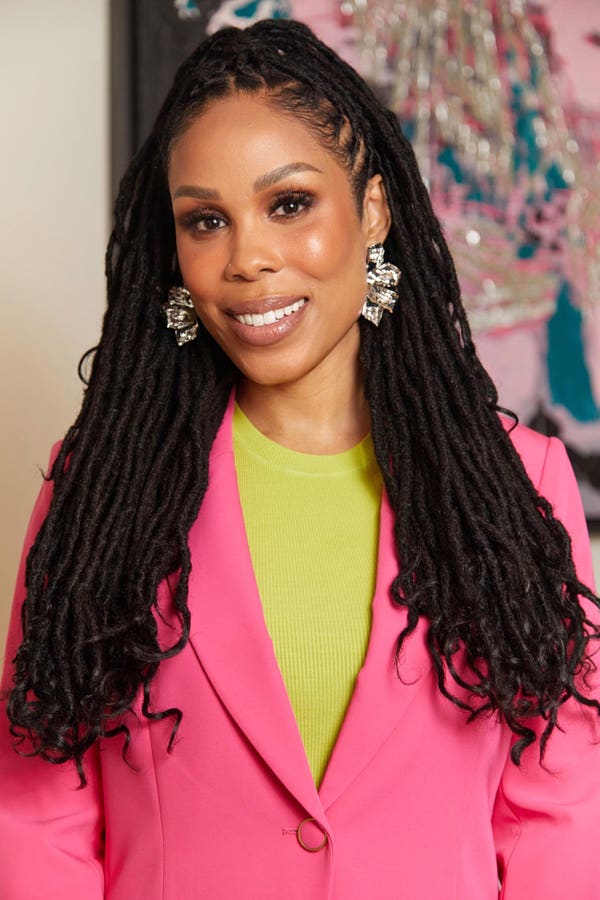
Uche Blackstock has been a leading proponent of health equity. She’s been very reflective about what’s gone right and what’s gone wrong in the last decade.
Uche Blackstock
Uché Blackstock was a year ahead of me in medical school. Over the past two decades, she has become one of the country’s leading voices on health equity, writing, speaking, and challenging healthcare institutions to confront inequities that many had grown comfortable ignoring. Her memoir, Legacy: A Black Physician Reckons with Racism in Medicine, chronicles not only the history that shaped her work, but also the personal and professional costs of pursuing change before most institutions were ready to embrace it.
When I sat down to interview her recently, I expected to spend our time talking about the rise and apparent retreat of the health equity movement. Instead, our conversation became something broader: a discussion about leadership, institutional courage, and how organizations distinguish between values they genuinely hold and values they merely borrow during moments of cultural consensus.
It also made me rethink an idea I’ve written about before: rented values.
Five years ago, in the aftermath of George Floyd’s murder and amid a pandemic that laid bare longstanding inequities in American healthcare, health equity became one of the defining priorities of nearly every major health system. Boards discussed it. CEOs elevated it. Chief Health Equity Officers were appointed. Strategic plans were rewritten. Conferences multiplied. Mission statements evolved. It seemed, for a moment, as though healthcare had reached a new consensus.
Today, the landscape looks very different. Budgets have shrunk. Some dedicated leadership roles have disappeared. The political environment has shifted dramatically. Organizations that once spoke confidently about health equity now speak more cautiously about population health, community health, quality, or trust.
It would be easy to interpret this as evidence that the movement failed.
I think the more interesting question is whether our institutions ever fully believed what they said.
When I asked Blackstock what she would do differently if she could replay the past decade, her answer surprised me.
“We didn’t do our best in terms of strategy around talking about what health equity really is,” she said. “We often relied on the moral argument. We never really talked about the return on investment.”
Coming from one of the nation’s most prominent advocates, this was not an abandonment of the moral case. It was an acknowledgment that morality alone rarely sustains institutional change. Organizations are built to solve operational problems. They invest when they understand how an idea improves outcomes, strengthens performance, and creates lasting value.
For Blackstock, the return on investment extends well beyond financial performance.
“It’s about having a system that prioritizes quality for all patients,” she explained. “It’s about having the best outcomes for all patients. It’s about thinking about what the workforce looks like. Burnout, workforce attrition, poor patient outcomes—they all translate into real costs.”
That observation stayed with me because it reframed health equity not as a specialized initiative, but as a blueprint for building a better healthcare system. Better transitions of care. Fewer avoidable readmissions. Higher-quality maternal care. Stronger patient trust. Lower clinician burnout. These are not niche objectives. They are the hallmarks of high-performing healthcare.
Our conversation also forced me to confront something that has long troubled me about the public debate surrounding health equity.
America does not simply have inequitable healthcare.
America has underperforming healthcare.
Compared with other high-income nations, our life expectancy is shorter. Maternal mortality remains unacceptably high. Chronic disease is pervasive. Patients often wait months to see specialists while clinicians struggle under extraordinary administrative burdens. Burnout has become commonplace rather than exceptional.
None of those failures are confined to one demographic group.
What is true—and profoundly important—is that Black Americans, Indigenous communities, and other historically marginalized populations often experience these failures earlier, more frequently, and with more devastating consequences. Their experience reveals where the healthcare system is weakest. They are the canaries in the coal mine, not because everyone else is flourishing, but because the underlying structural failures become visible there first.
Blackstock made this point in a way that I found both practical and compelling.
“When we talk about health equity only impacting certain populations,” she told me, “people tune out.”
She was not arguing that racial inequities should receive less attention. Quite the opposite. She was observing that too many Americans mistakenly concluded that health equity was someone else’s issue rather than recognizing that it represented an effort to improve a healthcare system that is underperforming for nearly everyone.
That distinction matters.
If the movement was perceived primarily as helping one group, it became politically vulnerable. If it is understood as improving the quality, safety, accessibility, and trustworthiness of healthcare for everyone—while paying particular attention to those communities that have historically been left behind—it becomes much harder to dismiss.
I found myself asking her whether health equity should even remain its own discipline.
Her answer reflected a refreshing lack of attachment to labels.
“I don’t care what it’s named,” she said. “We could call it health equity. We could call it population health. We could call it community health. I just care that the work gets done.”
Healthcare has an unfortunate tendency to confuse organizational structure with progress. We establish offices, appoint executives, rename departments, and launch initiatives, sometimes believing that the existence of those structures is itself evidence of change.
Patients experience none of that.
They experience whether they can obtain an appointment without waiting months. They experience whether their physician has enough time to answer their questions. They experience whether discharge instructions make sense, whether medications are affordable, whether someone calls after they leave the hospital, and whether they trust the advice they receive.
If those experiences improve, it matters little what the initiative was called.
That part of our conversation brought me back to rented values.
I’ve become increasingly convinced that many organizations don’t actually possess values so much as they lease them. During moments of cultural consensus, institutions enthusiastically adopt whatever values society is rewarding. They publish statements. They redesign websites. They launch initiatives. They create executive positions.
The difficult question comes later.
What happens when the headlines disappear?
What happens when political winds change?
What happens when defending the value becomes inconvenient?
That is when organizations discover whether their values were owned or merely rented.
Health equity has become one of the clearest examples of this phenomenon.
Some organizations undoubtedly treated it as a performative exercise. They wanted to be seen embracing the issue while public attention remained fixed upon it. Others were sincere but found themselves navigating an increasingly uncertain legal and political environment. Still others quietly continued the work, changing little beyond the terminology they used publicly.
Blackstock sees that distinction firsthand.
“The organizations that are still doing this,” she said, “have integrated those same goals into every aspect of the organization.”
She described health systems that have embedded these principles into quality improvement, workforce development, community engagement, patient experience, research, and operations rather than isolating them within a single department.
That observation struck me because truly durable values rarely exist as standalone initiatives.
Patient safety isn’t a department.
Quality isn’t a department.
Ethics shouldn’t be a department.
They become part of how organizations make decisions.
Perhaps health equity was always meant to evolve in the same way—not disappearing, but becoming inseparable from excellent healthcare itself.
Toward the end of our conversation, Blackstock offered what may have been the most memorable insight of the afternoon.
“I think of trust as infrastructure.”
It is an elegant phrase because it reframes trust as something far more substantial than branding or communications.
Patients are increasingly turning to artificial intelligence, social media, and online communities for medical advice. It is tempting for healthcare leaders to dismiss this trend as misinformation or misplaced skepticism.
Blackstock sees something different.
She sees people attempting to fill gaps that healthcare itself has left behind. They are looking for answers while waiting months for appointments. They are searching for communities that understand chronic illness. They are seeking explanations they didn’t receive during a hurried office visit.
Remarkably, despite all of this, Americans continue to trust their own clinicians more than almost anyone else in healthcare.
The problem is not that physicians have lost the public’s confidence.
The problem is that healthcare organizations often make it extraordinarily difficult for physicians to earn and sustain that trust.
As we ended our conversation, Blackstock expressed confidence that the pendulum would eventually swing again. Political environments change. Priorities evolve. The need for this work, she believes, will remain.
I suspect she’s right.
But I also think the next chapter should look different from the last one.
If health equity depends upon a particular political moment, it will always remain vulnerable to the next political moment.
If, instead, it becomes synonymous with building safer, higher-quality, more trustworthy healthcare organizations—organizations that recognize disparities because they are committed to excellence rather than because they are responding to social pressure—then its future becomes much more secure.
Leadership is ultimately revealed not by the values we proclaim when everyone is watching, but by the values we continue to practice after the spotlight moves elsewhere.
The healthcare organizations that will matter most over the next decade will not be those that issued the strongest statements in 2020. They will be the ones that quietly kept doing the work in 2026.
That is the difference between rented values and real ones.