

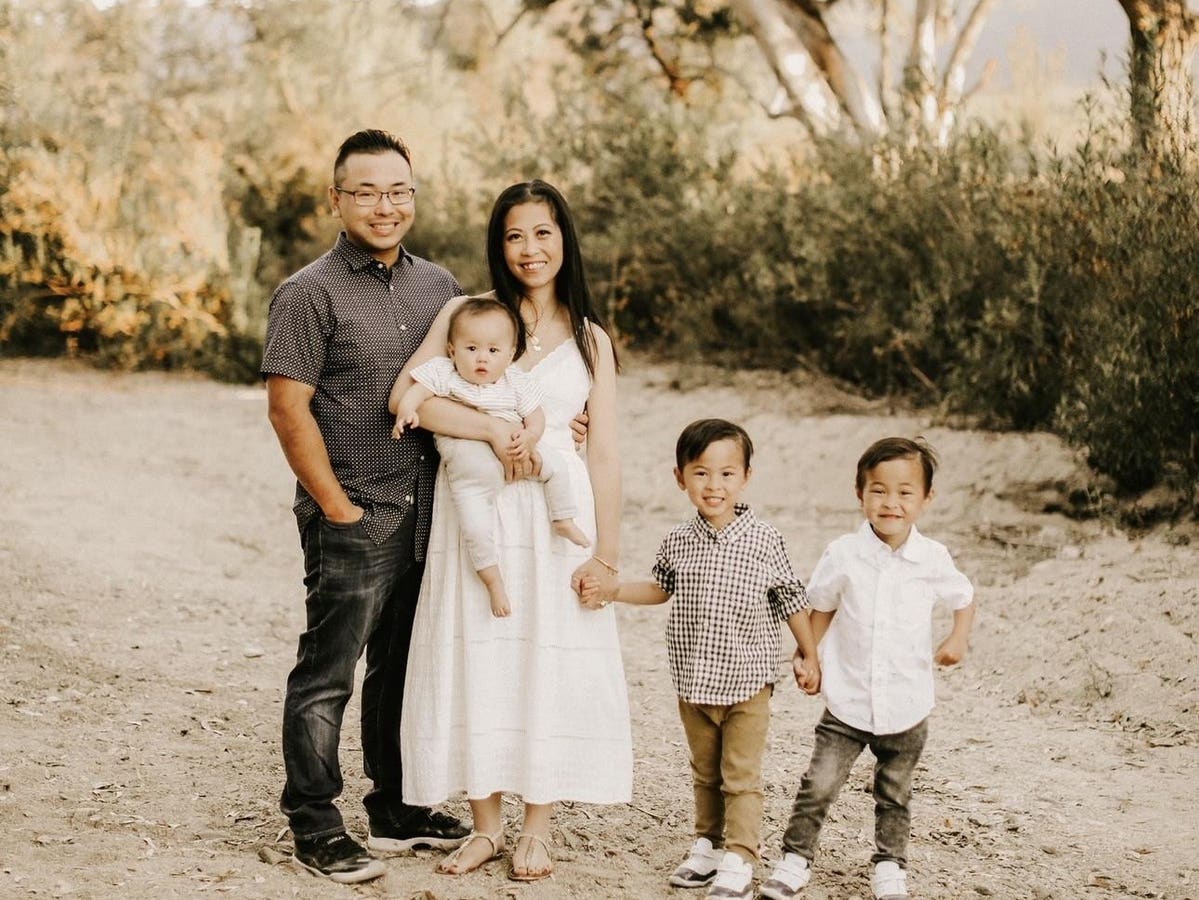
Nguyen-Wong Family
Cici Nguyen-Wong
Steve Wong was 41 years old, athletic, and healthy. “He was the last person you’d think would get sick,” his wife, Cici Nguyen-Wong, told me. However, in 2024 he started to have acid reflux which progressed to discomfort with swallowing. Within 11 weeks of his symptom onset, Steve died from gastric cancer. Cici was left to raise their three young boys, a part of motherhood she had never readied herself to take on.
Over the past two years as a physician and writer, I have interviewed dozens of cancer patients about their journey with diagnosis, treatment, and remission. Each story – on colorectal cancer, lung cancer and breast cancer, ovarian cancer – highlights my concern of the growing incidence of various young adult onset cancers and the destruction this disease leaves behind. What I have recognized most is that a patient is not just a diagnosis, they have full life, where friendships, marriages, children, careers, and communities also absorb the impact.
To better understand the journey after a young adult dies from cancer, I spoke with Nguyen-Wong about her abrupt transition from wife, to caregiver, to widow.
How Cancer Produces Sudden Life Changes
Steve’s path towards diagnosis is reminiscent of many patients who are ultimately diagnosed with cancer. He had vague abdominal symptoms that were not immediately diagnosed or raised a red flag that triggered expedited workup. He was seen by different specialists for back pain, and had screening imaging studies that were reassuring. His delay in diagnosis could be explained by the fact that Steve didn’t fit the typical patient profile for cancer.
For gastric cancer, the average age at diagnosis is 68, with roughly 6 in 10 patients being 65 or older. “Gastric cancer is one of those cancers that isn’t glamorous. It doesn’t get the press,” said Nguyen-Wong. Lack of national spotlight on a disease may lead to lack of awareness at the bedside. There are only about 31,000 new cases of stomach cancer each year, accounting for 1.5% of all new cancers in the US each year. And in recent decades fewer patients are being diagnosed due to technology and medical intervention. For instance, refrigeration for food storage has led people to eating fewer salted and smoked foods, a known risk factor. As well, there are fewer cases of untreated Helicobacter pylori (H pylori) bacteria, another known cause.
Cici Nguyen-Wong and Steve Wong
Cici Nguyen-Wong
As Steve took medications at home, his symptoms hit a breaking point and he was sent to the ER where doctors found, “a large tumor in his stomach that was covering his esophagus,” said Nguyen-Wong. She immediately recognized the gravity of his diagnosis. In a meeting with the surgical oncologist, she learned the mass could not be resected. “I knew that he was going to die. I’m a very logical person and I knew almost instantly,” she recalled.
He was hospitalized and overcame multiple medical complications, a testament to his will to live. However, eleven weeks after diagnosis, Steve died from gastric cancer.
Caregiver Spouses Often Don’t Grieve Until After Death
“I wasn’t scared because I was so busy. I was literally just in it,” Nguyen-Wong told me. During those 11 weeks her only goal was keeping Steve comfortable emotionally and physically.
Studies on spousal caregivers consistently find that grief is often suppressed during the caregiving period itself as the operational demands of the role leave little room for processing the shock and trauma. For many caregiver spouses, symptoms of depression and grief actually decline after the death of a loved one and return to near-normal levels within a year. But for 20% of bereaved caregivers, the grief that was deferred during caregiving resurfaces as persistent psychiatric symptoms including depression and complicated grief. At times caregivers can have high levels of distress that impair daily functioning. Nguyen-Wong is candid that she doesn’t know yet which category she’ll fall into. The fear, she says, came after his death and is still arriving, “I’m scared now, when I should have been scared almost then.”
She does have advice for families who are facing illness or death and have some advance notice: “get the will in order and sort the finances” she said. She warns others that the emotional disruption is enormous in itself. Adding on sorting through finances would have been catastrophic. According to a 2018 Merrill Lynch/Age Wave survey of more than 2,600 widows, 69% of widows say the hardest financial challenge of widowhood is suddenly becoming the sole financial decision maker, a role most never prepared for. “That is the last thing you want to worry about,” she said. Financial preparation gave her room to grieve. “I could just focus on being sad,” she said.
She also treasures the hard conversations she and Steve managed to have before his death — about dying, funeral wishes, and the philosophy of what comes after. But the question that mattered most to her was more personal: “How do you want me to raise our sons in your absence?” She knew how to be their mother. “But I don’t know how to be the dad.” Having clarity on Steve’s fatherhood values and perspectives before his death was crucial for Nguyen-Wong.
Raising children after spousal death from cancer
“Being a caretaker, I had a purpose,” she said, “I was taking care of him.” She spent time managing all mechanical tasks you have to manage when someone you love is dying. After his death, however, there was no intuition or blueprint for her on navigating widowhood.
Widowhood, Nguyen-Wong says, is disorienting in a way she couldn’t have anticipated. “You function as a unit, and then it’s like a limb got cut off. I now have to learn how to live without this other right hand.” The bed is empty. The parenting is suddenly solo. “He was my person. He would be my forever person. And suddenly I don’t have that forever person anymore.”
The hardest thing she’s faced isn’t loneliness — it’s parenting her grieving boys while grieving herself. Still she moved fast: all three boys were provided separate therapy immediately, their routines were kept fairly consistent, and she gave them space to exist freely. “When they feel sad, I let them be sad. I don’t try to fix it.” Her motivator every morning was simple: “I want to keep these three boys functioning.”
The support caregiving spouses need from others
Cici Nguyen-Wong smiling
Cici Nguyen-Wong
Nguyen-Wong is clear that she hasn’t navigated this alone — she has a strong network of friends, family, and a social media community that has rallied around her. What has helped most, she says, is simple: don’t minimize the grief, and don’t stop saying his name. “Don’t shy away from his death. Don’t make me feel like I can’t talk about him.” She loves when her community talks about Steve as if he’s just out of town.
A 2025 University of Saskatchewan study of young widowed Canadians found that grief after spousal loss isn’t something people distance themselves from. Instead many widows decide to move forward with the grief, integrating their lost partner into their ongoing lives rather than leaving their memories behind.
Two years since Steve’s death, Nguyen-Wong keeps telling his story so others will listen to their bodies, ask harder questions, and have the meaningful conversations they’ve been putting off. Most importantly she encourages maintaining a sense of connectedness.
“Grieving Steve is not a solo experience,” she told me. “Grieving Steve belongs to all of us.”