

Barely anyone uses cooling centers. Here’s how to change that.
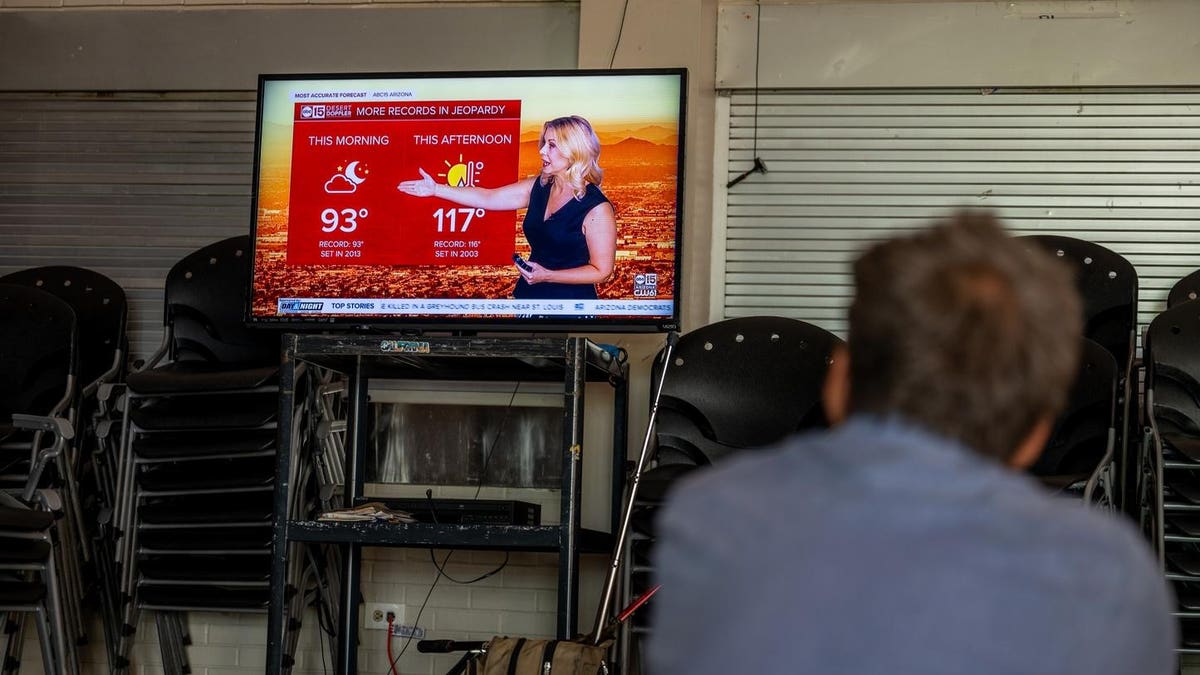
A person in a church cooling center watches the weather forecast in Phoenix. (Photo by Brandon Bell)
By now, heatwaves of record-setting peaks, duration, and timing are grimly familiar.
One response has been to turn public spaces into cooling centers, or temperature-controlled facilities where people can cool off for free. This is just one of a basket of measures that will be needed to adapt to higher temperatures caused by climate change.
An emergency medicine spokesperson in Oklahoma has said there’s no excuse not to take advantage of cooling centers. Yet by and large, cooling centers remain little-used, even in the most oppressively hot areas.
There are a number of reasons for this underuse. More positively, there are ways to overcome the barriers.
1) Make them more pleasant.
This is the most overlooked aspect of designing cooling centers. Yes, extreme heat is a matter of life and death. But even in stark circumstances, people need to feel welcome in order to make the effort of getting to a cooling center. Stigma means that homeless and lower-income people may feel judged in a cooling center, or that wealthier and younger people may feel that such a space isn’t intended for them.
As Heather Hughes, a resident of Blythe, California, told reporters Ruben Vives and Akiya Dillon of the Los Angeles Times, “she felt ashamed being a homeless person inside a church. She also assumed she couldn’t bring her pit bull.”
It won’t be easy to make cooling centers more inviting. Part of that comes down to do with making them more enjoyable.
As Jake Bittle has reported for Grist’s Record High newsletter, in Seattle, “Perhaps the most common objection city officials heard was that being at a cooling center sounded boring. If a government building didn’t have food, or internet access, or activities of any kind, it was hard for many people to imagine spending hours there at a time, regardless of how excruciatingly hot it got outside.”
It remains much more common for those who need a break from the heat to go to commercial spaces. In L.A., for instance, people mainly use shopping malls or movie theaters for this purpose, not cooling centers.
So local governments could think about formalizing these kinds of popular spaces as cooling centers – where everyone is welcomed and able to do basic things like charge their devices, whether they intend to make purchases or not. And it’s not just malls and theaters: cafes, fast food joints, gyms, buses, and other places where people are already happy to spend hours could find double purpose as cooling centers.
This might require subsidies or other encouragements to private businesses, which may worry about increasing numbers of people with complex needs. It would certainly require a shift in mindset. But such shifts are badly needed in a quickly heating world.
Playing games at a cooling center in Los Angeles. (Photo by Frederic J. Brown)
2) Make them more abundant.
It’s clear that there simply aren’t enough cooling centers for the need. There are just 12 listed for all of Arkansas, for instance. A major increase in cooling centers is needed before the next heat season.
A cooling audit, in which residents have input into which areas need cooling centers the most, can help to ensure that the siting of cooling centers fits community needs, so that they’re placed where they’re more likely to be used.
A similar argument has been made for community resilience centers, which would address more needs than cooling alone. As nonprofit program coordinator Joey Sanchez told Erin Stone of the publication LAist, “ While a building retrofitted with solar panels and battery storage provides physical resilience, the space’s community building of the space is at the core of its ability to be a resilience hub.”
3) Make them more accessible.
In California’s Riverside County, the five to ten users of heat centers each day are generally people whose cars have broken down.
But overall, transport – or rather the lack of transport – is often given as a reason for not frequenting a cooling center. In the US, very few people are within walking distance of a cooling center; and “walking distance” is in any case a subjective measure for people with mobility issues. More people might consider going if free transport were provided.
One way to bring cooling centers closer to home is to literally place them within the home. Following the deaths of three women in their apartment building during a Chicago heatwave, Chicago has mandated that buildings housing seniors set up common cooling spaces.
Another way to bring cooling centers to where people are is to make them mobile. The Red Cross has used cooling buses in Hanoi, in areas where street vendors and motorcycle riders congregate.
Physical distance is just one part of being able to access a cooling center. Another is consideration of different needs. One study of cooling centers in New York City, almost half of which were senior centers, found that 22% lacked wheelchair access. Disability access is an important yet sometimes overlooked factor for cooling centers, especially as people with disabilities are more likely to have heat-related vulnerabilities.
A sign on a cooling center in Portland. (Photo by Michael Hanson)
4) Extend opening hours.
Heat doesn’t respect human schedules. Yet to give just one example, one library in California’s San Fernando Valley closes at noon on Fridays. In a study of New York City, 83% of cooling centers were listed as closed on Sundays, even during heat emergencies. Keeping cooling centers open only during typical working hours means that many outdoor workers won’t be able to benefit from them.
With limited budgets come limited opening hours. Heatwave forecasts typically trigger the opening of cooling centers, which might seem reasonable. Yet restricting these facilities to just heatwave periods doesn’t address the problem of seesawing temperatures, which can be harder for the body to adjust to than a single peak. Keeping cooling centers open for longer periods of the year could help to counter these swings in temperature (as well as to normalize the existence of these facilities).
And during periods of sustained heat, extending opening hours into the evening would be a way to respond to the accumulated strain on bodies. Heat is most dangerous when it sticks around at night, so that people can’t recover from daytime peaks.
To return to the idea of turning more businesses into official cooling centers, 24-hour businesses could be especially valuable. Quick stints in cooling centers can benefit health, but only temporarily, so sustained periods of cooling – where people feel comfortable and entertained – are important. Lingering in an all-night diner, as simple as it sounds, could be a way to protect the organs during long-lasting heat.
5) Publicize them more.
I once entered a cooling corner of a public library in Kumagaya, a notoriously hot city in Japan. The (optional) check-in book was nearly blank, and the only other person I encountered there was a jogger who had stopped to use the drinking fountain, who didn’t even though this area had been designated as a cooling center.
This isn’t an aberration. In other sweltering cities, including Phoenix, people regularly report not knowing about cooling centers.
Often, information is available mainly online, which may have a lower chance of reaching older people and people living on the street. Language barriers are an issue as well, though community organizations can help with translation and information sharing. These are crucial partners, as they’ve built up trust and local knowledge well before any emergency.
Even online sources of information can be inadequate. The online maps of cooling centers for California and L.A. County, were down during some of the hottest parts of this summer. We can’t afford such lapses in basic infrastructure during emergencies.
This reliance on online messaging also needs to be complemented by broader forms of communication, so that everyone is aware of the nearest cooling center. Each community would need to decide on the combination of communication methods most appropriate for its underserved groups, whether that’s local TV news, radio billboards, flyers, or door knocking to reach those who rarely leave their homes.
A church cooling center in Phoenix. (Photo by Brandon Bell)
All told, these kinds of adjustments are straightforward. That doesn’t mean they’ll be easy.
Cash-strapped local governments would of course need to find the money for all these types of improvements. This will be challenging amid wider cuts to public services as well as rising electricity prices. In L.A. in 2022, it was estimated to cost $292.79 an hour to run a cooling center at a Recreation and Parks site (but no additional cost at a library).
Yet these would be additional investments to ensure that all this work on cooling centers hasn’t been a waste. If people aren’t actually using cooling centers, what’s the point?
There’s also an opportunity here to put more oomph into the longer-term transition toward cheap renewable energy and thoughtful design of the built environment, which would eventually lower cooling costs. For New York City, heat pumps and building retrofits have been recommended to move to more sustainable cooling systems.
Cooling centers are very far from perfect, but they’re at least a known tool in the arsenal of climate adaptation. What’s critical now is to get smarter about operating them, to reduce what are essentially preventable deaths.