

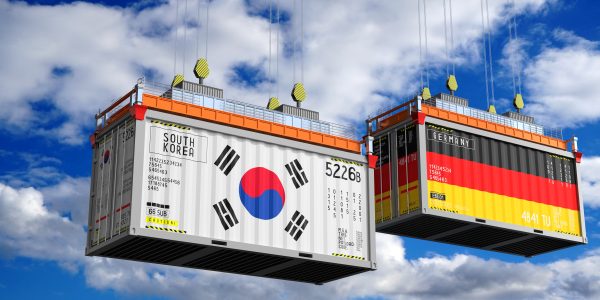
Middle powers such as South Korea and Germany are at risk of becoming victims of great power politics in light of growing China-U.S. frictions. Faced with similar challenges from trade protectionism, export controls, and rising Chinese competition in key industries, identifying commonalities and differences between both countries provides a starting point for analyzing their economic statecraft, while also helping to explore possibilities for bilateral cooperation that leverages their respective industrial strengths.
The ratios of manufacturing share to GDP in South Korea and Germany are some of the highest among major industrialized countries, at 25.6 percent and 18.4 percent respectively in 2022. South Korea’s and Germany’s industrial strength has enabled both countries to continue to occupy vital hub positions in regional value chains in Europe and Asia. Their companies supply other economies with critical inputs such as machinery, chemicals, or electronics and other high value equipment, particularly vehicles and transportation equipment.
In response to recently unfolding geopolitical risks that are reshaping globalization, governments are scrambling to make appropriate policy adjustments. But implementing these changes is easier said than done as it may raise tensions between governments and companies. Striking the right balance between respective security and economic interest is a delicate task, as formulating policy responses may run the risk of over-securitization.
In South Korea and Germany, the evolving policy responses place high priority on mitigating structural vulnerabilities, especially those related to China. In Germany and Europe, policy responses run under the label of “de-risking” while in South Korea the approach has shifted to the concept of “continuity and change.” While the names might be different, the main building blocks share very similar features: reducing dependencies on a single country, enhancing supply chain resilience, and strengthening tech sovereignty.
But there are substantial differences in the details and drivers for the ongoing policy changes. China-related vulnerabilities, including the importance of the Chinese market, are equally seen as risks in both countries. But unlike South Korea Germany has avoided the fate of being directly targeted by Chinese economic coercion. Potentially emerging economic vulnerabilities were only a vague concern until the mid-2010s in the wake of China’s economic coercion against South Korea.
In 2016, the Chinese government responded to South Korea’s decision to deploy Terminal High Altitude Area Defense (THAAD), a U.S. missile defense system, with de facto economic sanctions affecting a wide range of sectors, including retail, entertainment, tourism, and content services. Even more problematic were the indirect effects of Chinese measures on South Korean companies’ businesses in China. The automotive, smartphone, and display industries, which were not directly targeted by the sanctions, saw their market share in China decline sharply after 2017.
This bitter experience has been a decisive factor in shaping South Korea’s economic statecraft, both to reduce overdependence on China but also improve overall resilience. In response companies and the government are working in sync in South Korea’s national interest with the aim of strengthening industrial competitiveness and reducing structural vulnerabilities.
But the issue of economic coercion is not only a factor related to China. For example, in August 2019, tensions with Japan escalated after a South Korean court ordered Japanese companies to pay compensation for wartime forced labor. In response, Japan’s government removed South Korea from the whitelist to control the export of key materials essential for semiconductor and display manufacturing, again highlighting South Korea’s economic vulnerabilities. Although Japan lifted the export controls in March 2023, the case aroused widespread recognition in South Korea that a strategy focused on strengthening the supply chain resilience of key industries was needed.
Realizing that economic opportunities can be turned into a risk, South Korea needed to achieve a more nuanced approach that balances diversification with self-sufficiency in high technologies. This approach, which can be termed “techno-economic statecraft,” leverages South Korea’s manufacturing prowess in key high-tech industries. High technology becomes a tool for deterring economic coercion and fostering international cooperation.
For instance, in July 2020, the South Korean government implemented the “Materials, Parts, and Equipment Strategy 2.0.” This initiative fosters a collaborative domestic ecosystem, aiming to transform Korean companies into central hubs and vital partners within global supply chains. This enabled South Korea to mitigate structural vulnerabilities in general – not only China related ones – while expanding international cooperation with the United States, Europe, and Southeast Asia.
South Korea managed to limit the impact of economic coercion on the competitiveness of its key high-tech industries. For example, even though Samsung’s smartphone sales disintegrated in China, the company maintained or even increased its position in global markets due to its competitiveness. Rather than getting caught up in excessive fear of economic coercion or trouble in the Chinese market, this example shows it is effective to carry out proactive economic statecraft and international cooperation with like-minded countries.
Both South Korea and Germany are faced with a complex situation requiring policy adjustments to balance economic security and opportunities. Despite the growing risks, it is not desirable to exaggerate the fears, as it is likely to lead to costly overreaction. In order to deepen and expand economic security cooperation, South Korea and Germany should start by cultivating mutual understanding of their respective economic security strategies and sharing experiences in addressing strategic challenges.
First, South Korea and Germany should share best practices and lessons learned in order to maximize the synergies of cooperation based on their complementarities. This initiative would foster the exchange of best practices and insights gleaned from navigating strategic challenges such as the China-U.S. strategic competition, the COVID-19 pandemic, and recent supply chain disruptions affecting shipping.
Second, South Korea and Germany should pursue strategic cooperation that goes beyond individual industries and aligns with their broader national strategies. Both should expand traditional S&T cooperation to high-tech industries such as semiconductors, batteries, automobiles, and artificial intelligence (AI). For example, South Korean giants such as Samsung Electronics and SK Hynix possess leading AI chip production capabilities, which creates natural synergies for collaboration with German companies.
Third, South Korea and Germany can use bilateral cooperation as a platform to promote regional cooperation between Asia and Europe. The transnational nature of economic security challenges requires a global response. Jointly promoting regional cooperation in Asia can facilitate diversification by coordinating on developing alternative industrial clusters in highly exposed areas which were identified by its companies.
Expanding cooperation with South Korea can help foster policy change in Germany by focusing less on regulation and restrictions on companies as a hallmark of economic security and instead provide new opportunities for companies. There is a realization in Germany that change is needed, but policy implementation is still rather slow and too often driven by fear of Chinese retaliation. De-risking remains mainly a concept that focuses on defensive measures and its effectiveness is restrained by tensions between government and companies.
South Korea, with a far larger exposure to the Chinese economy, provides some pragmatic lessons in finding a policy response that is centered around economic competitiveness as a key feature for improved economic security. Stronger Germany-South Korea cooperation in economic security could help foster stronger competitiveness of both countries’ companies and help resist policies that risk over-securitization.