

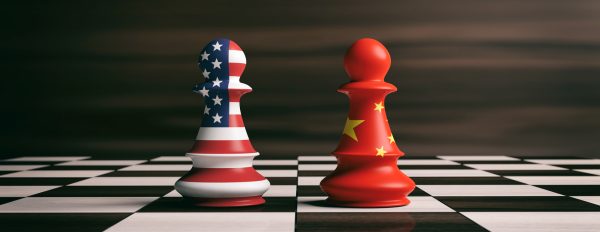
Promoting free trade, particularly through the reduction of tariffs, was a big part of U.S. international leadership after World War II. Now, however, both major candidates for the U.S. presidential election in November seem to be competing with each other to impose U.S. tariffs against China.
As U.S. president, Donald Trump famously set off a “trade war” with China starting in 2018 by levying tariffs of up to 25 percent on hundreds of types of Chinese imports. His successor, Joe Biden, kept Trump’s tariffs in place. In February, Trump said that if re-elected, he would charge a tariff of 60 percent or more on all Chinese imports. In May, Biden announced a 100 percent tariff on Chinese-made electric vehicles.
Economists have raised numerous objections to these tariffs. Americans, they point out, will pay higher prices for the many commonly-used goods imported from China. The Chinese will retaliate against U.S. exports, resulting in lower profits for U.S. companies. Tariffs will likely increase inflation. They will undermine U.S. progress toward greater reliance on clean energy, as China is a world leader in the production of electric cars and solar panels. Most economists believe the Trump administration’s previous tariffs against China hurt Americans on balance.
But the discussion of tariffs as a strictly economic issue – how they are likely to affect American incomes and living costs – indicates a failure to come to grips with a national emergency. The United States is dangerously economically over-dependent on its most serious potential adversary. Substantial, perhaps drastic, action is needed to address this situation. Tariffs could be part of the solution.
With both Trump and Biden, the rationale for tariffs against China is garbled. Most of the emphasis is on giving U.S. businesses a fair chance to compete, not national security. Trump said his 2018 tariffs were a response to “unfair trade practices” by China that “make it impossible for many United States firms to compete on a level playing field.” The White House’s official announcement of the tariffs imposed against China in May is titled “President Biden Takes Action to Protect American Workers and Businesses from China’s Unfair Trade Practices.” The text of the announcement mentions national security, but less prominently than protectionism.
The Biden administration’s vision of a “small yard, high fence” is inadequate. The stated intent is to restrict China’s access to a few strategically vital emerging technologies in the interest of U.S. national security, while leaving the vast majority of bilateral trade and investment unhindered. But to effectively uphold national security, the yard must be bigger.
The tariffs Biden imposed in May cover Chinese steel and aluminum, semiconductors, electric vehicles and their batteries, certain minerals, solar power cells, medical products, and port cranes. The list reflects a mishmash of concerns: transferring high technology that could strengthen the Chinese military, protecting U.S. industries from bankruptcy due to Chinese competition, Chinese cyber warfare, and the possibility of China withholding the supply of important goods. All of these concerns are valid, and the list of items that raise one or more of these concerns will grow yearly. The “fenced” area can and must grow.
The United States doesn’t need total economic decoupling from China, but it needs to restore its own capacity to manufacture supplies vital to national well-being. This goes well beyond just a handful of emerging technologies.
Maximizing economic efficiency, the goal of most critics of tariffs, will not deliver national security. Rather, acquiescing to David Ricardo’s principle of comparative advantage would lead to a dystopian world in which the United States focuses on producing soybeans for export while Americans buy their cars, trains, ships and maybe eventually airliners from China.
A deindustrialized United States cannot be a superpower. The combination of high technology and manufacturing capacity is the substance of national strength. The U.S. defense industrial base, however, has been hollowed out to the extent that it cannot build equipment or munitions quickly enough to sustain a major war. Even American military forces rely on Chinese suppliers of key components.
Historically, when a declining major power enjoys a level of international influence and privileges that is no longer commensurate with its capabilities – what Chinese would call a “paper tiger” – that country typically gets tested by a rising challenger country that features the opposite characteristics. That China is thinking in these terms was evident in 2021, when senior Chinese official Yang Jiechi chided his American counterparts, “the U.S. is not qualified to say it wants to speak to China from a position of strength.”
A country that is economically dependent on China is not even fully in control of its own affairs. Beijing routinely exploits China’s economic leverage to extract political concessions from other governments or punish them for refusing to support the PRC position on a political issue. These cases commonly involve Taiwan or Tibet, but also augment China’s attempts at territorial expansion into the East China Sea, the South China Sea, and across the Taiwan Strait.
The COVID-19 pandemic provided some additional illustrative examples of the cost of economic vulnerability to China. Soon after the world discovered China was the epicenter of the outbreak, Beijing pressured other governments to not restrict travelers from China – even though this would put their own people in danger – to avoid embarrassing the Chinese government. Some countries highly economically dependent on China complied. Other countries suddenly discovered the downsides of depending on China to supply medical equipment. The PRC government confiscated supplies of masks intended for export, leading to shortages abroad. Chinese officials demanded that foreign governments make public statements praising China as payment for medical gear. When Australia asked for an international investigation into the cause of the COVID-19 outbreak, the PRC blocked imports of several Australian products. Chinese government-sponsored media raised the possibility of cutting off medical supplies to America as punishment for U.S. criticism of Beijing.
The PRC is consciously preparing its conventional, nuclear, and cyber forces for war against the United States. The Chinese government is currently conducting hostile gray-zone activities against the U.S. military while attempting to seize territory in the East China Sea, South China Sea, and across the Taiwan Strait.
The message both major U.S. political parties should be hammering home is that it’s unacceptable for Xi Jinping’s China to hold excessive economic leverage over the United States.
National security demands that the United States strives not only to ensure superiority in crucial emerging technologies. The U.S. also needs to rebuild its manufacturing prowess to avoid dependence on China or other cold adversaries for all supplies important to the nation’s well-being. Total economic decoupling from China is not realistic or even desirable. But national economic policy does demand extensive “de-risking” that is driven by security considerations, not just calculations about profits and cost of living.
Smart tariffs should be part of the effort. Simply dismissing them as poor economic policy is strategically blinkered thinking. Using tariffs to create a temporary breathing space for U.S. industries that are trying to build themselves into major players, such as electric vehicles or semiconductor fabrication, is justifiable. This was commonplace early in U.S. history, and helped America become a manufacturing powerhouse by the beginning of the 20th century. Tariffs should not become a permanent crutch that disincentivizes U.S. firms from achieving their maximum competitiveness.
Although tariffs entail a cost to society, this is necessary to avoid higher future costs to the United States’ ability to prosper and to protect itself.