

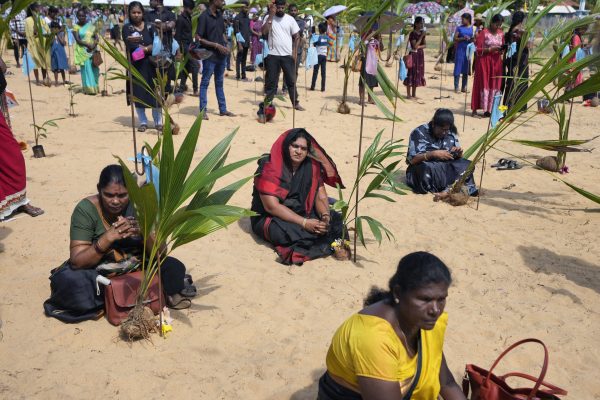
This year marks 15 years since the end of the Civil War in Sri Lanka. The armed forces carried out an avalanche of atrocities during the conflict: they bombed No Fire Zones, shelled hospitals, fired on Liberation Tigers of Tamil Eelam (LTTE) combatants that surrendered, carried out enforced disappearances, and denied humanitarian aid such as food and medicine to civilians in camps. An International Crisis Group report in 2010 noted that the “the Sri Lankan option” set a precedent for the elimination of dissent. In fact, close parallels can be seen in Gaza today.
Fifteen years later, the Tamil people have not received a solution to the National Question, be it a political solution – such as the complete devolution of authority from a centralized state to the provincial councils, a solid accountability mechanism, or personalized reparations – or an economic solution.
Research has revealed a number of obstacles to economic development in the North-East: militarization, unsustainable infrastructure projects, a lack of viable livelihoods in the area, the lack of a macro-economic vision that prioritizes local people’s autonomy over land, and the absence of ports.
The diminished civic space and lack of economic development are closely connected. This can be seen in the state-sponsored colonization that has restricted people’s access to their land and resources, and militarized capitalism, that has acutely reinforced the military’s ability to act as a capitalist hand.
State-sponsored Colonization
“It is only the armed conflict that is over. The civil conflict is very much alive,” said Shanakiyan Rasamanickam, an MP and member of Illankai Tamil Arasu Kachchi (ITAK). “The oppression still exists and the land issues are the topmost issue.”
In Sri Lanka, the majority of land is under the state’s control. Land is distributed under various ordinances to farmers as annual or extended permits. Grants exist but they have specific stipulations. In the North-East, most citizens had access to private lands. Faced by violence from the armed forces, the Indian Peace Keeping Forces, and other paramilitary troops, many people had to leave their lands and in the process lost their deeds. At the end of the Civil War, the army released the majority of land but the state used various departments to reoccupy them.
The state has three primary motivations for this. First, the extensively centralized state is paranoid that the complete devolution of authority to the provincial councils could loosen their control over the land. Second, colonization shapes the ethnic makeup of an area. With land occupation, the number of Sinhala voters increases and there is a greater likelihood of a Sinhala representative elected into Parliament. Finally, when the state occupies land, they could use it to complete their political project, be it Sinhalization or neoliberalization.
“Land is power. The state needs to control land to implement its political project,” said Sandun Thudugala, a member of People’s Alliance for Right to Land. This can be seen in former President Gotabaya Rajapaksa’s allocation of land to the military and current President Ranil Wickremesinghe’s allocation of land for market liberalization (i.e. private investment).
Methods
Under British rule, the state occupied land for tea plantations. These schemes displaced Sinhala peasants and confined them to the periphery of these areas. In the post-independence period, many politicians had to meet the demands of these constituencies and expanded colonization schemes into the Dry Zone. D. S. Senanayake, the first prime minister of Sri Lanka (then known as Ceylon), set up the Gal Oya project for rural development during 1948-1952. The project built a dam in the Gal Oya Basin and used it to cultivate paddy, chilies, and potatoes. The need for labor led to the violent displacement of Tamil and Muslim farmers to make space for Sinhala settlements. The Gal Oya riots in 1956 exploded as a result of these schemes.
Water diversification for Sinhala farmers was the primary aim of the Accelerated Mahaweli Development Program in the 1970s. In the next decades, Sinhala farmers did not have a base in the North-East, so the state continued the project. These development projects led to tensions in rural areas like Batticaloa’s Mayilathamaduva. Tamil cattle farmers were threatened by Sinhala paddy farmers and many times their livestocks were harmed or killed.
In the Civil War, the military occupied land for security reasons and maintained its establishments. No one could enter these areas except for military personnel. After the conflict ended, the military released most of the land, but certain lands such as Mullikullam in Manner are still occupied. The military also runs tourism sites such as the Thalsevana Holiday Resort and Restaurant in Valikamam. Some families were provided alternate lands, but other families continue to protest for their private land. Despite pressure from the international community, some of these lands have been reoccupied by other departments.
The Department of Archeology (DOA)’s main mandate is the restoration and preservation of Sinhala Buddhist culture, but they use this to colonize lands in the Tamil homeland. When the DOA identifies ruins (i.e. ancient stones or broken statues), they demarcate the land under their department. The entrance is closed and all productive activities are ceased. A Buddhist monk enters the area and a temple is built around him. He opens the space up to devotees, usually family members from the South, to clean the premises and cook. Once a number of families have been settled, the area becomes a Sinhala-Buddhist community. Kurunthurmalai temple is an example of a temple’s construction under the premise of archaeological restoration, despite the presence of a court order.
The DOA’s narrative only promotes Sinhala Buddhism. So only Sinhala people can enter these areas and pray. Tamil historians have pointed to the presence of Tamil Buddhists in the North but these nuanced identities are unable to fit into the state’s definition of a fixed Sinhala Buddhist identity. Land colonization by the DOA, as a result, upends and fractures the complexity of identity in the island.
Similarly, the Department of Wildlife Conservation (DWC) declares land to be under its authority for conservation purposes. Once land is allocated to the DWC, people cannot enter unless they have permission. Land allocated under the DWC in the Civil War naturally turned into forests. When the state mapped the area, they demarcated occupied private land as forest cover.
“We have certain places where the house is owned by a private individual and the toilet is owned by the DWC,” Sandun said. “Conservation is important but this is an arbitrary declaration of zones. We have asked for a proper mapping of the area for environmental conservation and private lands. This can help the release of lands to citizens.”
Despite their mandate for conservation, DWC-held land has also been used to set up cultivation projects. In 2015, the president claimed demilitarized land to be forest cover. The DWC set up elephant fences as borders, initiated reforestation projects, and the Civil Defense Forces (CDF) occupied these areas. In 2021, former Wildlife Conservation Minister Wimalaweera Dissanayake asked 600 CDF members to cultivate nut trees in the 300 acres allocated to each of them. Subsequently, the CDF members erected fences and claimed to be involved in a reforestation scheme, despite it being a cultivation scheme.
Another example is the occupation of the coastal belt. Coastal land in Sri Lanka is common land and in the past fishermen used this land to host their shelters, boats, and nets. After the tsunami in 2004, the state prevented construction in a 100 meter area that separated coast and land. When the Civil War ended in 2009, the state decided to allocate this land for tourism. In the Eastern Province, in particular, land has been sold to hotels.
The occupation of land by various state departments denies people access to the land, natural resources, and local infrastructure. Land that could potentially be used to stimulate the local economy is held by the state. The state is able to occupy, appropriate, and extract the lands for its benefit at the expense of the people it belongs to.
“If land is not prioritized, who are the beneficiaries of a political solution?” Rasamanickam asked.
The release of private land is just a start. There are a number of people that relocated from the plantations to the North and members of oppressed castes that never had land.
“There is a large section of society in the North that is landless. They never had land to start. This requires a much broader scheme for land alienation and land redistribution,” said Ahilan Kardirgamar, a lecturer at the University of Jaffna.
Militarized Capitalism
A study published in 2017 touched on the concept of militarized capitalism in the North-East. The idea is that militarization intersected with capitalism, in the form of apparel factories set up in former LTTE-occupied areas. The military helped these factories secure property, production sites, and a labor force in 2009. They also built infrastructure such as roads to increase connectivity. The factories set up training centers to indoctrinate the labor force into the rules of capitalism, namely technical skills, presentation and interpersonal skills. At this point, civilians still employed the labor force.
Over time, the intersection of capitalism and militarization coalesced into one form: militarized capitalism. In Mullaitivu alone, there are a number of military-run businesses (i.e. farms, hotels, and factories), recruitment of civilians into the military-run Civil Security Department (CSD) and interference by the military in the private sector. People are stuck in a cycle of control, dependence, and debt. As a result, the military, as a hand of capitalism, has a monopoly over the local economy and local political activity.
“The local people cannot access their land, natural resources, and markets. They are denied opportunities,” Sandun said. “Smallholder businesses and SMEs are supposed to compete. This is not a fair or equal competition. This bodes badly for the entire economy. It provides control of the economy to a limited group of people.
“Look at Myanmar and Pakistan. The authority of the military has been built through economic exercises. In those countries, the military controls the economy,” he continued.
The structural dependence of local livelihoods on the military means that they are instrumentalized for political purposes. CSD employees were used to campaign for former President Mahinda Rajapaksa’s re-election in 2015. Workers had been told to protest the transfer of the CSD to civilian authorities in 2017.
Impact
With the end of the Civil War, repression became normalized in Sri Lanka’s North-East. In 2017, the district of Mullaitivu had 60,000 troops – 25 percent of the approximately 243,000 active military personnel in the entire country. For every two citizens, there was one soldier.
In 2024, over a decade since the war ended, Tamil people are haunted by surveillance, harassment, and intimidation. Women, in particular, have not received justice for the sexual violence they experienced in 2009. They encounter armed men in mundane situations: as they purchase food, enter schools, and access resources. Female-headed households are particularly culpable to violence. Those who protest have received visits from armed men at late hours, sources have disclosed.
Research from 2020 mapped out diminished civic space for minorities across Sri Lanka. While this space briefly opened up in the 2022 protests in the South, activists have encountered a climate of repression in events that remember Tamil people, such as the Mullivaikkal remembrance event in 2023 in Borella Cemetery and 2024 in Wellawatte Beach. Similarly, protests for Palestine are accompanied by a police force and water cannons.
“Tamils in the North-East have fought for the right to commemorate for many years prior, facing severe repression from the state. While commemoration events marking the Tamil Genocide Remembrance Day and Maaveerar Naal happen, the participants and organizers continue to face harassment from the state,” said Mario Arulthas, a Ph.D. candidate at SOAS, University of London. “The people organizing Tamil remembrance events in Colombo only started in recent years and are in a space that the state is not used to and therefore faced some backlash. Tamils have shown that these spaces, while contested, must be fought for.”
The deprivation of economic and civic rights has left the North-East vulnerable to external shocks. Sri Lanka’s poverty rate increased from 4 to 7 million during 2019-2023. While the economic crisis hit the entire island, the impact is compounded in the Tamil homeland. Research from 2019 revealed that multidimensional poverty had declined from 2007-2013, but existed in pockets in the North-East. In 2023, a UNDP report identified 55.7 percent of the country to be multidimensionally vulnerable, mostly from areas in the North, North-Central, and Eastern provinces. Many people have been forced into debt to secure basic necessities such as food and medicine. Reports by the World Food Program and U.N. Food and Agricultural Organization in 2023 exposed the acute food insecurity in districts in the North-East.
Tamil Vote
The Tamil people’s choice is crucial for the upcoming presidential election because no party is likely to secure a majority in the first round. Data from 2019 revealed that the North-East has exceptional voter turnout. These votes helped Sajith Premadasa and his party become a contender in the 2019 presidential election. The upcoming election is a three-horse race run by three candidates. As the Sinhala vote is likely to be split into three, the minority Tamil votes are essential for a party to secure a victory.
Tamil nationalist parties have announced a number of options: a boycott of the elections, support for a candidate in the South, or a common candidate for the Tamil vote. While some feel that the common candidate is an opportune moment to further Tamil demands, others are critical of it.
“The common candidate is a distraction. The Tamil nationalist parties have distorted the entire project. They remain on this one-track, polarizing ethnic project but this does not help the Tamil people,” Kardirgamar observed.
In a local paper, leader of ITAK, M. A. Sumanthiran said that presidential elections are not the time to make statements about Tamil demands.
“No party or a candidate is likely to receive 50 percent in the first count. So the president is likely to focus on the second preference. He could rely on SLPP members for the Southern votes and CWC for the Hill Country Tamil votes,” said Shreen Saroor, an activist and member of the Women’s Action Network.
“The Cabinet recently issued a statement about burial rites and an apology for forced cremation done during the pandemic, probably for the Muslim votes. It is also speculated that the president and the Tamil common candidate have a deal to further split the Tamil votes.”
Despite the importance of the Tamil vote, apart from lip service about the provincial councils, none of the candidates has proposed a radical solution to either the national question or the economic crisis. In the North-East, they manifest as one crisis.