

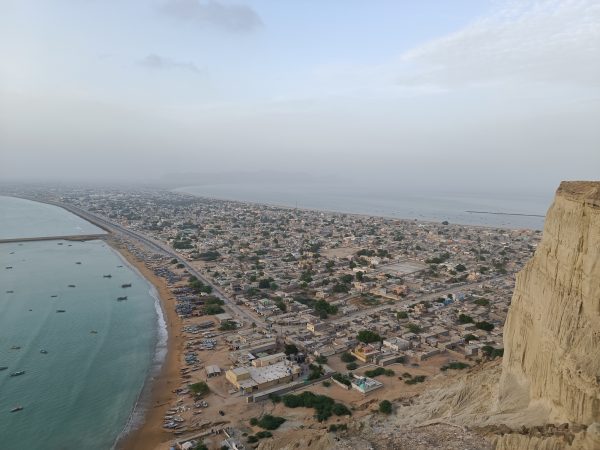
When the China-Pakistan Economic Corridor (CPEC) was first officially launched in 2015 during Chinese President Xi Jinping’s visit to Pakistan, Gwadar was intended to become the “crown jewel” of the project. Gwadar is a port city in southwestern Pakistan’s Balochistan Province, which has a coastline on the Arabian Sea and is rich with natural resources including oil, coal, and gold.
Despite these advantages, Gwadar has historically struggled with a lack of infrastructure and Balochistan remains Pakistan’s poorest province. For these reasons, Gwadar was seen by CPEC officials as a city with unrealized potential and thus the perfect centerpiece for its initiative. However, Gwadar’s CPEC projects have come to embody the shortcomings of China’s Belt and Road Initiative and have been described by analysts as “dying a slow death.”
The initial idea behind focusing CPEC investments on Gwadar’s development was to create a mutually beneficial project. China has long sought alternative ways to access the sea in order to avoid dependence on the Malacca Strait, a narrow waterway where a quarter of the world’s traded goods pass through. The United States has considerable naval presence in the strait’s surrounding area and as China-U.S. tensions rise, Beijing has invested resources to diversify its trade routes and search for a viable alternative to this risky maritime route.
Through developing Gwadar’s infrastructure, including the building of the deep-sea Gwadar Port, China intended to connect its western Xinjiang region to the Arabian Sea through a series of railway, highway, and pipeline projects that link Xinjiang to Gwadar Port. This route is intended to give China greater access to South Asian, Middle Eastern, and Central Asian markets, significantly reducing travel times. In return, Pakistan would use Chinese funding to transform the infrastructure of a neglected city at a time when its economy is struggling and less equipped to independently support this kind of large infrastructure projects.
The development of Gwadar was also intended to create 2 million employment opportunities for local residents and inject huge capital into Pakistan’s poorest province. This in turn was intended to help quell the violent unrest led by Baloch separatist groups that have long opposed Chinese infrastructure projects in this fragile region. These groups claim that Balochistan locals rarely share the wealth generated by foreign investments despite the fact that their province’s natural resources are being “plundered” in the process. Local testimony indicates that Pakistan’s government is seen as an enabler of China’s exploitation, with the two viewed as a united threat.
Government data indicates that less than 250,000 of the projected 2 million jobs have been created. Rather than this number rising as CPEC spending increases, the stagnation of infrastructure projects has in fact led to large-scale redundancies. The discontent caused by these job losses is exacerbated by the thousands of Chinese workers in Gwadar and the domination of Chinese companies, which have led these projects rather than local Balochi enterprises.
The situation has been even further exacerbated by the mass displacement of local people to accommodate new projects like the construction of Gwadar Port. Meanwhile, projects to develop Gwadar have not included providing local residents with access to clean water or electricity. The discrepancy birthed mass protests in late 2022 and early 2023, with locals complaining their needs were being overlooked by both officials from Islamabad and Chinese partners.
In order to address the safety concerns arising from local unrest, Pakistani authorities proposed the building of a fence around areas where Chinese nationals work for their protection, as well as the installation of 500 surveillance cameras. These proposals came alongside statements from Chinese officials about ensuring the Balochistan Liberation Army separatists would be “resolutely annihilated” with the help of the Pakistani government.
Considering how unrest in the area has been stoked by feelings of isolation and neglect, these proposals and their antagonistic language seem completely out of touch with the realities on the ground and are likely to further fuel tensions. The Pakistani government often dismisses dissenting locals as India’s proxies and thus brushes off any opposition to CPEC projects, despite statistics indicating these locals have reason to be resentful, having benefitted very little from CPEC projects in their local area.
In the most extreme cases, this resentment has led to terrorist attacks targeting Chinese entities operating in Pakistan. A suicide bomber killed five Chinese engineers working at a hydropower plant back in March, and last month two Chinese nationals were killed in a similar attack on workers at a power plant near Karachi airport. Other attacks in recent years include an attack on a Chinese convoy near Gwadar Port in 2023, an attack on Chinese tourists at the Pearl Continental hotel in Gwadar in 2019, and an attack on the Chinese consulate in Karachi in 2018. These are just a few examples of an onslaught of terrorist attacks perpetrated since the launching of CPEC initiatives in this region.
These attacks often come accompanied by threats issued to Chinese officials from local separatists, warning that the attacks will continue until China stops funding CPEC initiatives. Although China and Pakistan have jointly initiated a crackdown on these insurgents, the frequency of these violent attacks has been detrimental to private investment in the region. A Chinese minister recently admitted that “without security, the business environment cannot really improve” in response to the number of Chinese investors halting their projects in the area.
Alongside the repercussions of local terrorism, projects like the building of Gwadar Port seem to have been marred by significant misjudgments. The Gwadar Port project introduced severe restrictions on local fishing, a livelihood of great significance to the local population. Fishermen took to the streets to protest after they watched Chinese trawlers enjoy unrestricted access to fish resources while they themselves faced government-imposed constraints.
At the time of its construction, Pakistani officials claimed Gwadar Port would become the “Dubai” of South Asia and then-Prime Minister Nawaz Sharif declared the port would come to symbolize the dawn of a new era and bring “stability, peace and prosperity.” Contrary to these narratives, Gwadar Port appears to be no more than an empty vessel.
The port’s construction was completed in 2007, but it took nearly 10 years for operations to actually begin at the site. Even when the port did finally begin its operations, it has never hosted more than 22 ships in a year. China’s other recently constructed ports – including Hambantota in Sri Lanka and Kribi in Cameroon – host between 250-550 ships annually, by comparison.
There seem to have been fundamental flaws in the designing of the port, which have made it impossible for Gwadar to serve as the bustling trading hub it was intended to become. Gwadar Port was intended to serve as an update to neighboring Karachi’s older port, with the hope that as the latter port’s infrastructure becomes more outdated, Gwadar could take on extra traffic and relieve pressure on Karachi. However, Gwadar Port was only built with three berths compared to Karachi’s 33 and can only handle 3.2 percent of the number of containers Karachi can, meaning very little cargo can be processed.
There is also a serious lack of transportation links from Gwadar to other parts of the country, reducing the incentive for cargo ships to dock at the port as they cannot easily transport their goods to consumers. As noted above, unrest in Gwadar and Balochistan more broadly has discouraged investment needed to build out infrastructure connecting the port to Pakistan’s transportation networks. This flaw has also deterred potential investors who cannot see the lucrative future officials promise without these basic transport links and port facilities.
The business model used for CPEC projects in Gwadar is another problem. China has designed the projects so it takes roughly 90 percent of the revenue generated, leaving 10 percent for the Pakistani government and virtually none for the provincial or local government. This model leaves no incentive for locals to support these projects and contributes to the substantial resentment against the Chinese workers who are present.
The opening of a new airport in Gwadar last month as CPEC’s newest initiative further indicates how the project seems to be no more than a hollow shell. The airport was inaugurated virtually due to security concerns that prevented Chinese Premier Li Qiang from visiting in person. The inauguration ceremony took place in Islamabad, 1,500 kilometers away from the airport, a decision unlikely to instil confidence in investors, airline companies, or potential passengers. There are concerns that local insurgents may also exploit this new airport as a base for launching further attacks. Consequently, the airport risks sharing the same fate as Gwadar Port – heralded by officials as “a focal point for trade and investment in the region” but in reality being little more than a ghost town.
As the situation currently stands, CPEC in Gwadar can be considered a failure. If there is any chance to reverse its declining trajectory, there are several fundamental issues that must be addressed. There is currently little to no incentive for the local people to support CPEC projects – first because they are generating limited revenue and few jobs, but more importantly due to a business model that ensures locals will not enjoy the profits of these projects even if they become lucrative. This dynamic only serves to further fuel anger and violence in the region.
Both Pakistan and China appear so focused on preserving the reputations of their CPEC initiatives that more energy is spent on presenting the projects as successes rather than actually transforming them into meaningful, successful ventures. A new phase of CPEC was announced in 2022 with 63 new plans on the agenda to be completed by 2030 with an estimated value of $35 billion. It does not seem wise to invest in this number of new projects when the existing ones are yet to be successful. Until China and Pakistan prioritize the tangible outcomes of these initiatives over their public image, meaningful progress is unlikely.