

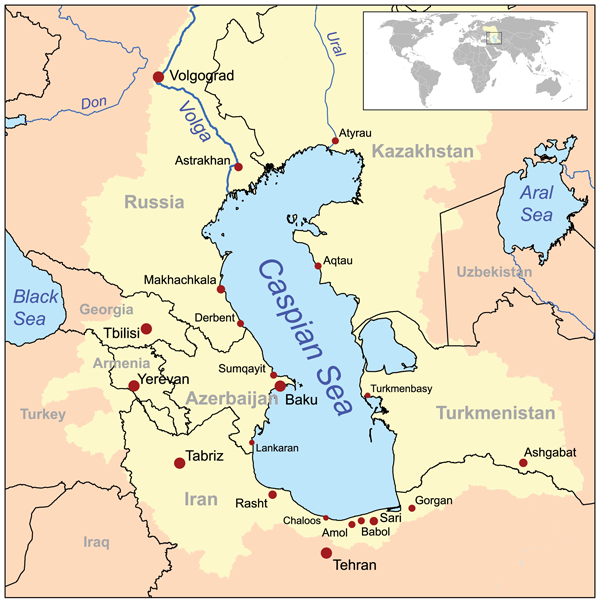
On December 25, 2024, Azerbaijan Airlines flight 8432 crashed, killing 38 people. Preliminary reports suggest the plane was shot at by Russian air defenses, forcing it to deviate from its planned flight path from Baku to Grozny. The aircraft limped across the Caspian Sea and crashed short of a runway near Aktau, Kazakhstan.
Coincidentally, the flight’s point of departure, Baku, and the city close to its crash site, Aktau, are the two main ports of the Trans-Caspian International Route (TITR), also known as the Middle Corridor. This trade route connects China to Europe through Kazakhstan, Azerbaijan, Georgia, and Turkiye.
For Europe, trade along this corridor has become increasingly important to gain access to Chinese goods, as well as Central Asian energy resources and critical raw materials, while bypassing sanction-stricken Russia and Iran. The EU has invested significantly in Middle Corridor trade, with an Investment Forum in January 2024 attracting 10 billion euros for the development of sustainable transport connectivity in Central Asia.
Azerbaijan and Kazakhstan in particular have hoped to attract the long-term investment needed for the expansion of the logistical facilities needed to increase trade volumes. China has already poured significant investment into both the ports of Aktau and Baku. Thanks to infrastructure improvements, the volume of cargo transported along the Middle Corridor rose by 63 percent in the first 11 months of 2024 to 4.1 million tons. Kazakhstan hopes to further expand the capacity of the Caspian ports of Aktau and Kuryk to 30 million tons by 2030 – a sevenfold increase from current levels.
Despite these rosy figures, significant challenges remain. The Caspian Sea, located at the heart of the Middle Corridor, still is a major obstacle to improving regional connectivity. Unresolved legal disputes, regional security issues, and steadily declining water levels could all inhibit this trade route from realizing its economic potential.
Caspian Sea Map (Wikimedia Commons)
Legal Issues
For most of the 20th century, only two countries had access to the Caspian Sea: the Soviet Union and Iran. With the collapse of the Soviet Union, four new littoral states emerged – Azerbaijan, Russia, Kazakhstan, and Turkmenistan – necessitating a new legal arrangement for the division of the sea. All sought to gain national control over a maximum seabed area, hoping to secure access to offshore oil and gas deposits.
Years of legal bickering followed. Iran proposed a condominium approach, which would give it access to rich hydrocarbon fields between Iran and Azerbaijan. Russia, Azerbaijan, and Kazakhstan promoted a division based on the median line principle. These three countries signed a trilateral agreement in 2003, dividing the northern section of the Caspian seabed according to a modified median line (MML). Iran and Turkmenistan rejected the MML principle for the division of the southern Caspian Sea, as this would leave them with a smaller seabed area compared to the condominium approach.
The 2018 Convention on the Legal Status of the Caspian Sea, although a major breakthrough, did not provide a solution to this problem. Instead, the signatories delegated the problem to future negotiations between the littoral states. The treaty also didn’t help overcome obstacles concerning the construction of submarine cables and pipelines needed to boost oil and gas exports from Central Asia, such as the Trans-Caspian Pipeline.
Under the 2018 Convention, littoral states are only allowed to construct seabed infrastructure provided that these projects comply with the environmental standards laid down in the Framework Convention for the Protection of the Marine Environment of the Caspian Sea, which was signed in 2003. Known as the Tehran Convention, this was the first legally-binding regional agreement signed by all Caspian littoral states.
Russia and Iran have repeatedly invoked the Tehran Convention to effectively block the construction of pipelines connecting Azerbaijan to Kazakhstan and Turkmenistan. This raises questions about whether Russia and Iran could again invoke environmental concerns to block the development of other trans-Caspian projects, such as a planned electricity cable and a hydrogen pipeline from Kazakhstan to Azerbaijan. Because of increasing tensions with the West, Moscow and Tehran are unlikely to grant Europe access to alternative energy sources.
Militarization of the Caspian Sea
Amid a lack of legal progress on seabed delimitation, a number of incidents occurred between the littoral states. In 2001, disagreements between Iran and Azerbaijan over the development of Caspian hydrocarbon fields nearly led to a military confrontation. Further tensions arose between Azerbaijan and Turkmenistan, and Azerbaijani gunboats threatened international oil company ships working on behalf of Turkmenistan on at least two occasions in 2008.
Ongoing disputes resulted in a slow but steady arms race. In the Caspian balance of naval power, Russia still holds most of the cards. As the Soviet Union’s legal successor state, it inherited three-quarters of all ships from the Soviet Caspian naval inventory. Since the start of Russia’s full-scale invasion of Ukraine in 2022, additional ships have entered the Caspian following a reported partial withdrawal of materiel from the Black Sea Fleet to the Caspian via the Volga-Don Canal.
Others have also invested in expanding their respective fleets. Kazakhstan and Turkmenistan have both enlisted Turkish shipping companies in the expansion of their fleets. Iran introduced its second homegrown warship in the Caspian in 2023, after the first had sunk in a storm just off the coast in 2018. Azerbaijan, after its reconquest of Nagorno-Karabakh, is also considering reallocating funds to renewing its aging naval inventory.
Since 2022, the Caspian Sea has served as a launching pad for bombers and cruise missiles against Ukraine. In response, the Ukrainian military managed to strike the main Russian naval base in Kaspiysk, Dagestan, with a kamikaze drone in early November 2024. The attack reportedly damaged the flotilla’s flagship along with several other vessels.
These hostilities, combined with Russia shooting down Azerbaijan Airlines flight 8432, are a potential threat to regional security in the Caspian Sea. This could deter long-term investments in trade and infrastructure development.
Declining Water Levels
The Caspian’s steadily declining water levels are another cause for concern. Over the last two decades, these have already dropped by 1.7 meters. A 2020 study published in Nature projects a decrease of a further 9 to 18 meters by the end of the century. Kazakhstan in particular is heavily affected; the northern part of the Caspian Sea is the shallowest, and here the coastline has already receded by up to 50 kilometers. On June 8, 2023, Kazakhstan officially declared a state of emergency over the low water level of the Caspian Sea. Azerbaijan’s President Ilham Aliyev in August 2024 called the shrinking of the Caspian Sea “catastrophic,” and the issue was further discussed at a roundtable event at COP29 in Baku.
While concerns about a drop in water levels are shared by all littoral states, there is no agreement on its cause. So far, governments in the region have mostly pointed to the natural cycle of water level fluctuations and thereby underplayed their own responsibility, or that of other states. Yet human interference has definitely contributed to the current environmental problems. Russia, for example, built a series of large dams on the Volga, which accounts for approximately 80 percent of the Caspian’s inflow. The inflow is reduced by Russian withdrawals for irrigation and drinking water purposes. Climate change plays a further role. Annual precipitation is decreasing in the Caspian and the Volga catchment area, while evaporation rates have gone up significantly. Water levels could further decline through desalination in Azerbaijan, Iran, Kazakhstan, and Turkmenistan.
In Kazakhstan, large-scale dredging has already started to keep Aktau and Kuryk open to ships. Despite these efforts, ships are still forced to leave port only partially loaded because of the shallower waters. The substantial costs of dredging and limited cargo capacity per ship are already increasing overall costs of shipping across the Caspian, making the Middle Corridor as a whole less attractive. In the long run, the projected decreases of water levels by 2100 could even make many of the Caspian ports wholly inaccessible.
Going Forward: Cooperation and Competition Along the Middle Corridor
On the one hand, Russia and Iran have little interest in strengthening trans-Caspian connectivity. Developing new trade routes and oil and gas infrastructure would compete directly with their existing corridors and pipelines. Moreover, through investment, both China and Turkiye are increasing their regional influence in the Caspian basin.
On the other hand, Russia and Iran have much to gain from keeping trans-Caspian trade moving. The Caspian Sea is a crucial part of the North-South Corridor linking Russia to Iran. Bilateral trade is increasingly important for these two sanctioned countries, and a substantial part of Iran’s arms deliveries to Russia is likely shipped across the Caspian.
The Ukraine war has also deepened Russia’s ties with Azerbaijan. Baku has become essential to Russian energy exports, sanctions evasion, and for keeping a land bridge open to Iran. Although the downing of the Azerbaijani airliner has dented this important relationship, Russia has no interest in frustrating Azerbaijan’s ambitions to expand Middle Corridor trade.
Meanwhile, the naval balance of power in the region is shifting. While Russia’s Caspian flotilla remains the largest, with far superior weapons systems, its supremacy is slowly eroded as a result of the declining water levels: Russia’s warships in the Caspian are the largest of all navy vessels in the region, requiring relatively deep waters to operate effectively. With the war in Ukraine ongoing, Russia is unlikely to prioritize adapting its fleet to these changing circumstances.
By contrast, Kazakhstan currently possesses a growing fleet of shallow draft ships that are better equipped to operate in the shallow northern part of the Caspian Sea. Turkiye in particular plays an active role in helping Azerbaijan, Kazakhstan, and Turkmenistan to expand their fleets and develop their overall military capabilities, through supplying ships and hosting exercises. This gives smaller Caspian states the opportunity to develop their armed forces more independently from Russia.
In an attempt to curb one of the underlying problems enabling this development, Russia together with other littoral states is expected to discuss declining water levels during the upcoming Conference of Parties to the Tehran Convention, which is set to take place in 2025. In any case it is unlikely that either Russia or Iran would be willing to give up their effective environmental veto under the Tehran Convention with regards to the construction of submarine pipelines and cables.
In sum, there are still many obstacles ahead for trans-Caspian trade and infrastructure development. Although under the current geopolitical circumstances, the Middle Corridor might seem an attractive option, the littoral states each face their own interconnected challenges that could very well become unmanageable over time, as interests diverge on important regional topics.