

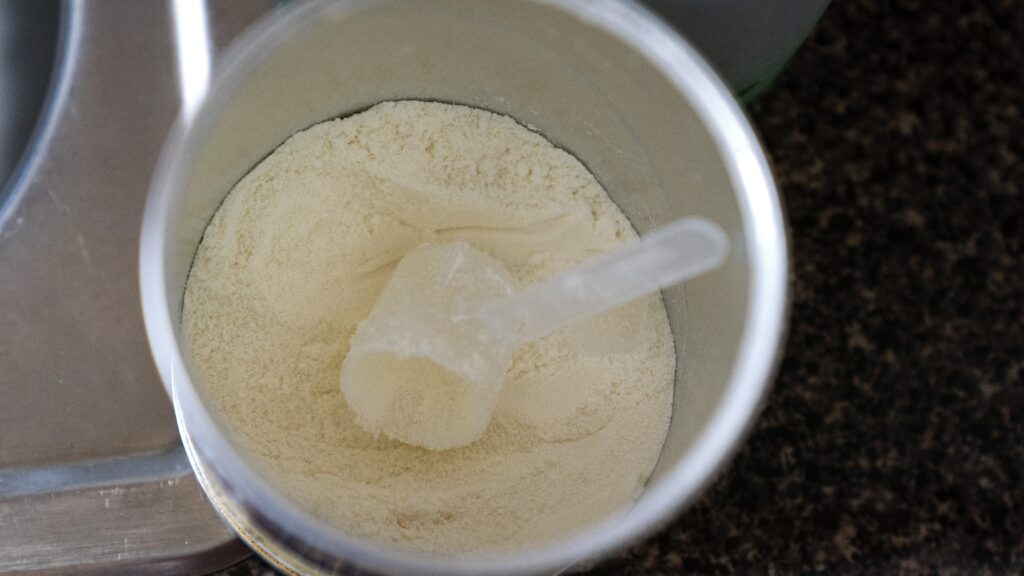
The big takeaway from a new government survey of infant formula is that the U.S. supply is largely safe. But experts and health officials say there are still steps that can be taken to make a product consumed by two-thirds of infants in the U.S. even safer.
One noteworthy finding from the Food and Drug Administration’s testing of 312 formula samples concerned per- and polyfluoroalkyl substances, or PFAS, also known as “forever chemicals.” The FDA detected five PFAS in the samples it tested, with the most common one — PFOS — found in half of all samples. Of those samples, the vast majority (95%) contained less than 2.9 parts per trillion (ppt) of PFOS.
What, exactly, does that mean? The FDA analysis doesn’t explain the PFAS results in much detail. But parents are bound to wonder, given that higher levels of exposure to PFAS, man-made chemicals used in products like nonstick cookware and stain-resistant clothing and rugs, have been linked to conditions including higher cholesterol, kidney and testicular cancer, and reduced vaccine efficacy.
STAT emailed with two experts for their reads on the results: Alex Bogdan, a toxicologist at the Minnesota Department of Public Health who’s studied PFAS in infant formula, and Katie Pelch, a senior scientist at the National Resources Defense Council, an environmental advocacy group.
These interviews have been edited for length and clarity.
What are the major takeaways for parents from the FDA’s PFAS results?
Pelch: There were many formula products that were PFAS free, which is good news, as this demonstrates that it is possible for manufacturers to produce PFAS-free formula. Unfortunately, the FDA testing results available online do not identify which brands had concerning levels of PFAS and so consumers are left in the dark and are not able to make informed decisions when shopping for formula.
Bogdan: It’s encouraging to see that only a few PFAS were detected, and that these occurred at fairly low levels. That said, there is room for improvement, and one of the best ways is for the federal government and states to implement laws and regulations to reduce unnecessary PFAS use and the amount of PFAS entering the environment.
One thing that I found confusing on the FDA results page is a graphic that says “95% of samples had PFAS levels at or below 28 ppt.” Wouldn’t 28 ppt be high, compared to the 4 ppt maximum contaminant level (MCL) set by the EPA? What do you make of the statistic that 5% of samples were above that cutoff point?
Bogdan: I also found this graphic a bit confusing when I compared it to the data spreadsheets. I think the FDA could have been a bit clearer in their data reporting.
The 4 ppt MCLs set by EPA were specifically for PFOS and PFOA, not all PFAS. PFOA was not detected in any of the formulas, and PFOS was detected at a maximum concentration of 6 ppt. MCLs are designed to consider a person drinking water over an entire lifetime. Relative to a lifetime, infant formula is only consumed for a short period of time before transitioning to other foods.
With the exception of one sample, the 5% of samples reported above 28 ppt were all PFBA but were also all below the limit of quantitation — so FDA detected PFBA but could not accurately determine how much PFBA was in the sample.
Therefore, it’s hard to say whether the 5% statistic is accurate or not. This is one reason that samples below the limit of quantitation are often not reported numerically, because it can cause difficulty in interpretation.
Even if the maximum reported concentration of PFBA (34 ppt) is accurate, it’s important to know that not all PFAS are equally potent. Based on available data, we know that PFBA is substantially less toxic than PFOS.
The Minnesota Department of Health creates health-based guidance values for contaminants in drinking water. This is the concentration of a chemical that is likely to pose little-to-no risk to human health. MDH’s guidance value for PFBA is 7,000 ppt, far above anything FDA detected. The EPA does not have an MCL for PFBA.
Looking at the data, do you see any patterns on the formulas that had higher levels of PFAS?
Bogdan: Powdered soy-based formulas tended to contain PFBA, which is a short-chain PFAS. This isn’t surprising to me, as short-chain PFAS are known to absorb more efficiently into plants than long-chain PFAS like PFOS. Again, it’s important to note that all of the formulas that tested positive for PFBA were below the limit of quantitation.
Dairy-based formulas tended to contain PFOS. This is also unsurprising as it’s known that PFOS efficiently transfers into milk. About 60% of the dairy-based formulas tested contained PFOS.
There was not as much overlap as I thought there would be. Generally speaking, only one type of PFAS was seen in a given formula. There were some dairy-based formulas that contained both PFBA and PFOS; these tended to have lower concentrations of PFBA compared to the soy-based formulas.
How important is it to lower the levels of PFAS in formula, and what can be done to do so?
Perch: It is very important to lower levels of PFAS in formula. For a large proportion of infants, formula is their only source of nutrition and they are often exposed to the same formula several times a day for many months. It was shocking to see some of the levels that were reported, and frustrating to know that manufacturers and the FDA don’t have to disclose these results to the public. Manufacturers should be diligently working to clean up their supply chains and manufacturing practices to ensure their products are free of PFAS and other toxics.
Bodan: The PFAS in formula are primarily coming from the stock materials used in formula production (milk, soy, etc.). To get PFAS lower in the finished formula, PFAS need to be reduced upstream in the process: namely, in things like cows and soybeans. To accomplish this, we need to overall reduce the amount of PFAS in the environment, by limiting or banning nonessential uses of PFAS and tackling things like PFAS-contaminated biosolids which are often spread on fields as fertilizer.
What should be the U.S. standard on PFAS in formula?
Bogdan: As low as is achievable, but this will be challenging. Policy changes outside of formula manufacture, like banning nonessential PFAS uses and limiting use of PFAS-contaminated biosolids in agriculture, will likely be necessary.
Perch: The goal should be to not have any PFAS in formula. The good news is that the results from this testing demonstrate that keeping PFAS levels below detection limits is possible for formula manufacturers. Therefore, the standard should be set at the detection limit.
Of note though, the test for the FDA only looked for the presence of 30 PFAS, but there are tens of thousands of PFAS in the class.
What are the potential effects or concerns about PFAS for infants?
Bogdan: One of the most sensitive effects of PFAS on infants and young children is on their immune systems. Epidemiology studies in young children have shown an association between lower antibody concentrations after vaccination and higher levels of PFAS in their blood but importantly, these studies have not shown an increase in incidence of disease.
Parents should also be aware that formula is only one potential route of PFAS exposure. If they are concerned about their child’s exposure to PFAS, there are simple steps they can take to help reduce it, including things like avoiding children’s products with stain-resistant treatments and regularly cleaning household dust. Dust can be a surprisingly important source of PFAS exposure, especially for infants and toddlers, since they crawl around on the floor and have a lot of hand-to-mouth behavior.
Anything else you think the public should know?
Perch: Infants are among the most vulnerable to toxic chemical exposure due to their small size and because their bodies are still undergoing rapid development. This makes it imperative to get as close to zero as possible for all of these contaminants.
These results and the reporting from FDA don’t take into account what the powdered formulas are being reconstituted with. Parents should check with their public water system to ensure PFAS have been tested for and that there is no contamination they should be concerned about. If there is contamination, filters are available that treat PFAS (please check performance sheets to make sure they address PFAS) and should be properly maintained.
STAT’s coverage of chronic health issues is supported by a grant from Bloomberg Philanthropies. Our financial supporters are not involved in any decisions about our journalism.