

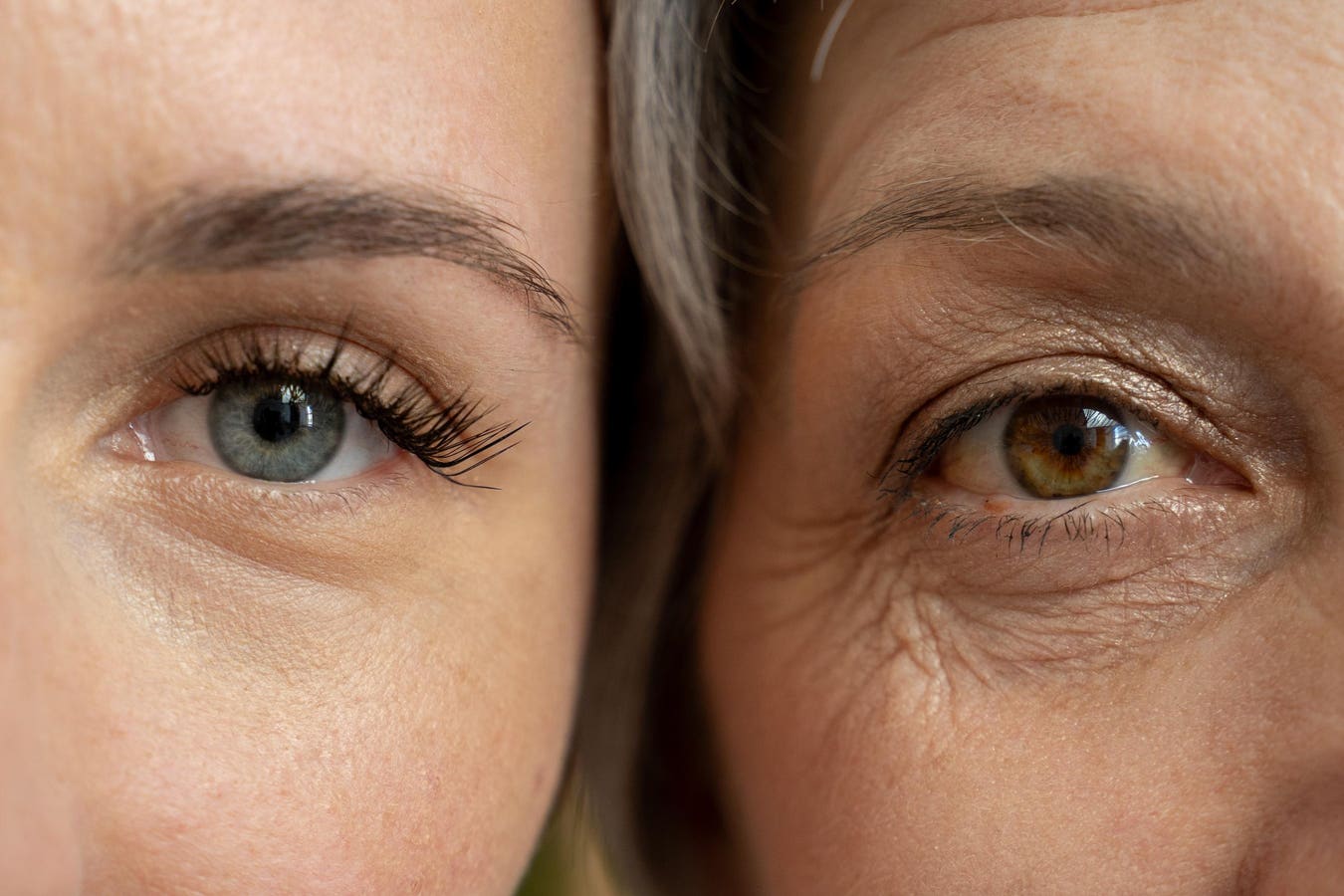
Biological age vs. chronological age is a scientifically validated notion, and it can be measured — but beware of a muddied commercial landscape.
getty
In recent years, the idea of a biological age that is separate from our birth age has increasingly seeped into the common discourse.
The pop star Katy Perry recently announced to her Instagram followers that her biological age is 33, and it’s clear that the concept has captured the wider public imagination, occasionally with dubious consequences. Back in 2018, a 69-year-old Dutch man infamously attempted to legally change his birth date to match his apparent biological age of 49, with the aim of improving his chances on dating apps. His request was denied by judges.
Yet amidst the hype, scientists working in the aging field are broadly in agreement that the underlying notion is valid. “Biological age is real,” says David Furman, a professor at the Buck Institute for Research on Aging. “There’s a difference between your chronological age and your biology, that’s for sure, and we can measure it by various means.”
Epidemiological studies have also suggested that various biological aging clocks – the term given to the suite of tests that attempt to measure biological aging using blood or saliva – can predict risk of disease. For example, faster aging according to GrimAge, a commonly used aging clock that measures DNA methylation in the blood, appears to predict individuals at a higher risk of cognitive decline. Research has also suggested that iAge, a clock which tracks chronic inflammation, can predict greater vulnerability to heart disease and frailty.
Because of this, Andrea Maier, professor of medicine and functional aging at the National University of Singapore, suggests that these tests could be used as early ‘alarm systems’ to flag people who might benefit from therapeutic or lifestyle interventions. “Because you know that they’re at higher risk, you can then actively intervene,” Maier says.
At the same time, scientists also believe that the information offered by biological aging clocks is open to misinterpretation. Social media is awash with celebrities, wellness gurus and biohackers using the tests to claim that they have managed to reverse or hold back time by decades. Unfortunately, says Bradley Elliott, a researcher at the University of Westminster and trustee for the British Society for Research on Ageing, this is an illusion.
Elliott explains that the tests available to consumers are capturing individual facets of aging. Examples include a test called GlycanAge which measures biomarkers that reflect immune function, while microbiome clocks estimate the aging of the gut. But aging is a progressive process, not merely governed by lifestyle, but our innate genetic programming. As a result, Elliott points out that while a 50-year-old’s immune system or gut health might be better than expected for their age, their body is still inevitably changing and losing function with time.
“Aging is something that happens to all of us,” Elliott says. “Even if we optimize everything, it’s [only] the rate of change which is modifiable.”
Regulation or Certification
Scientists therefore feel that a strong need exists for either better consumer education or guidance from trained healthcare professionals who can help people interpret their results.
When people discover that they appear to be biologically older, for instance, that may fuel health anxiety. “I’ve had patients who absolutely had a psychological crisis,” says Maier. “They think it’s a death sentence if a clock shows that they’re 10 years older.”
Maier cautions that a single age estimate from one clock is not especially informative. Instead, results from multiple clocks combined with functional health metrics such as VO2max, a measure of respiratory health, will provide a more accurate overview.
“We need to look at different organs,” says Furman. “One overall age number doesn’t help, you need to know more granular details. For example, if the heart is plus five [years] it’s suffering. If you have minus three [years] for the kidneys, that’s protecting you.”
Consumers also need to understand that biological age estimates can vary over the course of the day, meaning that if you’re repeating a test, it’s important to do so at the same time of day. The estimates can also fluctuate in response to things like physical activity. As an example, one 2025 study which used DNA methylation clocks to assess the biological ages of professional German soccer players discovered that if the tests were taken immediately after a match, they appeared biologically much younger, perhaps due to the physiological changes that occur in response to intense exercise. However, when retaken a few hours later, the measurements had returned to normal.
At the same time, not all biological aging tests, even those used in research, are ready for prime time. Furman says that proteomic clocks, which attempt to estimate age based on the levels of thousands of proteins in the blood, are still notoriously unreliable.
The commercial landscape has also been muddied by a proliferation of companies launching algorithms which purport to estimate biological age using selfies or surveys, and are not based on any real science at all. “With every smart device, if you download a couple of apps, it claims to tell you how old you really are,” says Maier. “This is very often nonsense. Everybody can say they have a new age matrix and offer it without external validation.”
Maier is unsure whether the solution is consumer education or regulation. One possible way forward may be certification where legitimate biological aging tests, which yield metrics that have been shown to be both reproducible and modifiable with different therapeutic interventions, are given a gold stamp by an international consortium of experts.
But while some aspects of the industry may at times feel akin to a Wild West, Maier is encouraged by the underlying science. She is adamant that biological aging clocks have a major role to play in preventative medicine in the coming years.
“My opinion is that there’s a huge opportunity to measure the health of aging individuals before diseases occur,” she says. “At your age, my age, we absolutely should know how our body is functioning.”
Thank you to David Cox for additional research and reporting on this article.