

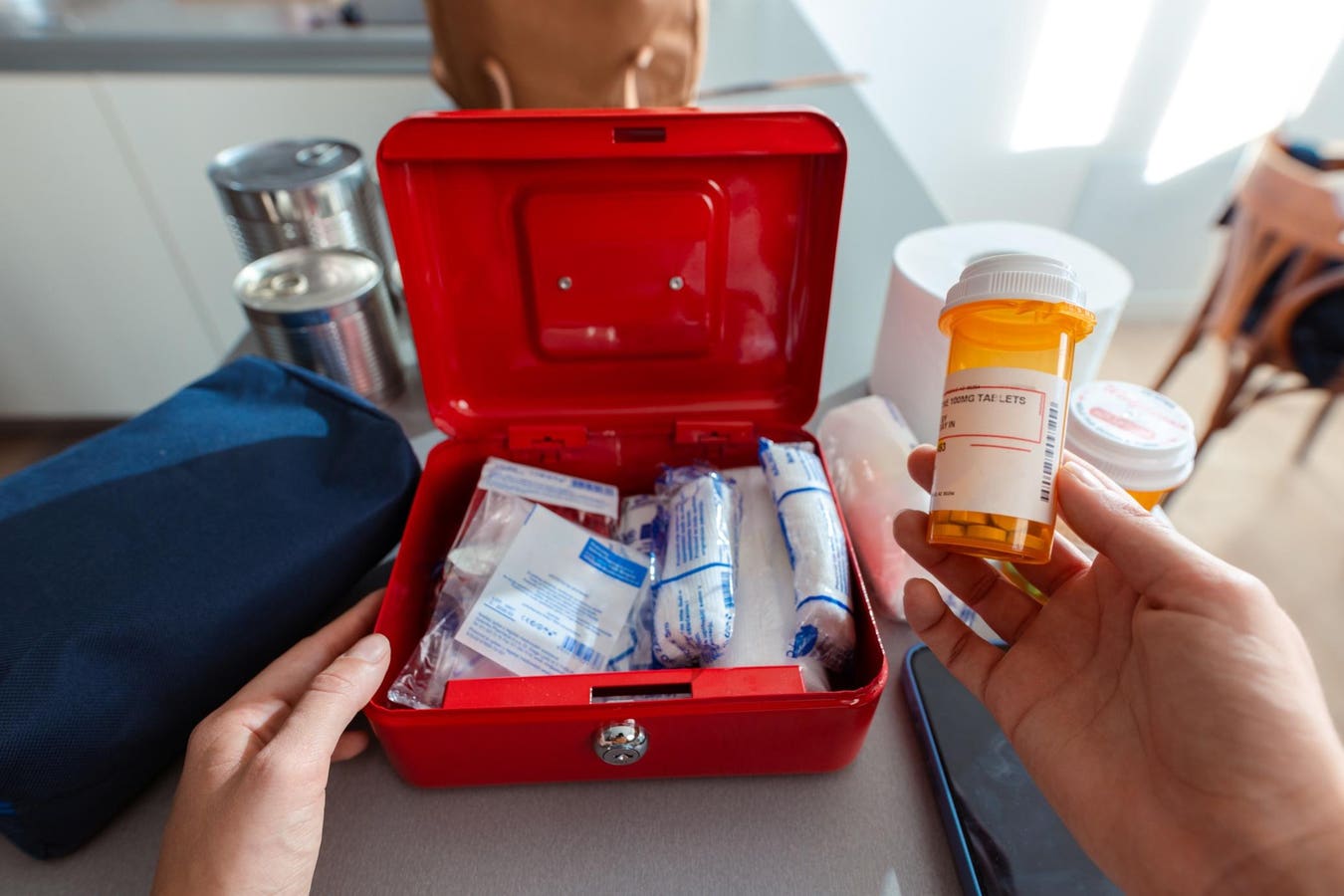
A close-up of a first aid kit with essential medical supplies and medications, promoting preparedness for emergencies.
getty
As you watch your favorite shows on TVs or via streaming platforms, you will eventually see the advertisement: a reassuring voice, a nifty kit opened up and displayed on a kitchen counter, and a promise that you can manage your own infections at home–no healthcare provider, no laboratory, no emergency department.
For several hundred dollars, companies now sell bundles containing prescription antibiotics, antivirals, corticosteroids, and instructional guides, marketed under the logic that self-treatment is faster, cheaper, and more convenient than professional care. The pitch is especially aggressive toward the “prepper” community, for whom stockpiling medications alongside food and water has become a preparedness norm. These kits are framed as a workaround to what their sellers describe as an inconvenient barrier: the requirement that FDA-approved prescription medications be evaluated and authorized by a licensed clinician.
Two of the most prominent vendors illustrate the model. Jase Medical markets its “Jase Case,” a physician-prescribed emergency antibiotic kit dispensed through a telehealth-adjacent workflow, pitched directly to consumers as preparation for scenarios in which conventional medical care may be unavailable or delayed. The Wellness Company offers a parallel and more expansive portfolio of “emergency medical kits” tiered by threat scenario–general preparedness, contagion, field use, radiation emergencies–several of which include prescription-class antimicrobials and other regulated medications dispensed outside the conventional prescriber-patient-pharmacy triad. Both companies operate with genuine commercial sophistication, and both exist, at least in part, because a real public need — access to medications during emergencies–has not been fully addressed by the formal healthcare system. That legitimate gap does not, however, neutralize the resistance risk their products carry.
What the advertising omits is the global crisis unfolding in precisely the same medications being packaged and sold. Antibiotic resistance–the capacity of bacteria to survive and replicate despite drugs designed to kill them–now causes an estimated 1.27 million deaths annually worldwide and contributes to nearly 5 million more. The World Health Organization characterizes AMR as one of the top global public health and development threats, and its consequences are not distributed equitably: low- and middle-income countries bear a disproportionate burden, their vulnerability amplified by poverty, weaker surveillance infrastructure, and limited access to newer agents. AMR also puts the gains of modern medicine at systemic risk–surgical procedures, caesarean sections, cancer chemotherapy, and organ transplantation all depend on reliable antimicrobial efficacy in ways that rarely feature in consumer-facing discussions of antibiotic access. In 2023, one in six laboratory-confirmed bacterial infections in the U.S. demonstrated resistance to first-line antibiotic treatment.
The Canary In The Coal Mine: A Rise In Healthcare-Associated Infections
Healthcare-associated infections infections (HAIs) rose 20% during and immediately following the COVID-19 pandemic, partly driven by high-volume, broad-spectrum antibiotic use in intensive care settings. The World Health Organization projects that uncontrolled resistance could impose more than one trillion dollars in cumulative healthcare costs by 2050 — a burden falling on systems already stretched to capacity.
The mechanism by which resistance develops is not a mystery. Every time an antibiotic is administered—whether by a physician or a consumer following a pamphlet–it exerts selective pressure on the bacterial ecosystem of the gut, the skin, and the environment. Bacteria carrying resistance genes survive; susceptible strains do not. Incomplete or inappropriate antibiotic courses amplify this effect by exposing bacteria to sub-therapeutic drug concentrations without eradicating them.
Home kits, by design, eliminate the diagnostic step that determines whether an antibiotic is actually indicated. A viral upper respiratory infection, a fungal skin rash, and a self-limited bacterial illness may all present with similar symptoms– fever, malaise, and localized discomfort–but only the last example warrants antibiotic treatment. Without culture data, imaging, or clinical examination, the consumer using a home kit is making that distinction by intuition.
Chickens kept in a dark environment in a mechanical chicken farm
getty
The agricultural parallel is instructive, and the home kit industry would do well to study it closely. For decades, industrial farming used antibiotics prophylactically and as growth promoters in livestock and fish, without veterinary diagnosis or prescription. The consequences were predictable and well-documented: resistant organisms proliferated in animal gut flora, transferred to meat and fish products, contaminated surrounding soil and groundwater through animal waste, and crossed into human pathogens. Studies demonstrated clear genomic linkages between resistance genes circulating in farm animals and those identified in human clinical infections–not a theoretical pathway, but a traceable epidemiologic one. The regulatory response took years, cost significant political capital, and remains incomplete.
What makes the agricultural lesson more urgent is that the curve is bending in the wrong direction again. The FDA’s most recent sales data, analyzed by the Food Animal Concerns Trust (FACT), documents a 16% year-over-year increase in sales of medically important antibiotics for use in food-producing animals between 2023 and 2024– the largest single-year rise since mandatory reporting began in 2009, and a 28% cumulative increase since the FDA’s last major stewardship intervention in 2017. The increases were not driven by expansion in animal populations: cattle numbers actually declined year-over-year, and poultry and swine flocks grew by less than one percent. What changed, according to FACT’s analysis, was institutional: major agricultural producers quietly reversed prior antibiotic reduction commitments as public pressure eased and regulatory oversight loosened. One large turkey producer abandoned a standing commitment to reduce antibiotic use by 10% annually as others followed.
The Framework of Antibiotic Stewardship
Critically, the industry’s own stewardship reports acknowledged that the surge provided “limited efficacy”–meaning the clinical justification for the increase was, by the industry’s own admission weak st best. The FDA’s Veterinary Feed Directive of 2017, which mandated veterinary oversight for agricultural antibiotic use, and the parallel consumer shift toward antibiotic-free meat products, had begun to bend the curve–but only after decades of permissive policy had already seeded the resistance landscape we now inhabit. The current reversal suggests that structural reform without sustained enforcement reverts to the baseline.
Farmer and vet inspecting cows feeding from trough on dairy farm
getty
The structural analogy to home drug kits is purposefully crafted. Both represent antibiotic use without formal diagnosis by a healthcare provider. Both bypass the surveillance infrastructure–culture and sensitivity data, prescription registries, outbreak tracking–that allows public health agencies to monitor and respond to resistance trends. And both have a natural constituency that frames professional oversight as an obstacle rather than a safeguard. The agricultural sector had an economic rationale for its practices; the home kit industry has a consumer convenience rationale for its. Neither rationale is adequate when set against the population-level consequences of accelerated resistance. The FACT data add a further dimension: institutional backsliding is not hypothetical. When regulatory attention diminishes and commercial incentives remain, the default trajectory is increased use, not decreased.
Proponents of these kits argue that they increase access to care for underserved populations who lack transportation, insurance, or proximity to healthcare facilities–a concern that deserves to be taken seriously on its own terms. But antibiotic access and antibiotic stewardship are not the same problem and conflating them does a disservice to both. Expanding access to telehealth, urgent care networks, and pharmacist prescribing authorities can address access barriers while preserving the diagnostic evaluation that distinguishes a bacterial infection from a viral one. A kit that ships trimethoprim-sulfamethoxazole and azithromycin to a consumer’s doorstep without any clinical input or scrutiny does not solve the access problem: it replaces it with a risk for antibiotic resistance .
The Value Of A Robust Regulatory Framework
The regulatory framework is clear in principle and absent in practice. The FDA requires a valid prescriber-patient relationship and a legitimate medical purpose for prescription drug dispensing. Whether the commercial structures behind home drug kits satisfy those requirements warrants urgent scrutiny–not only by the FDA but by state pharmacy boards, the CDC, and the relevant professional societies, including the Infectious Diseases Society of America (IDSA) and the American College of Emergency Physicians (ACEP). The CDC’s antimicrobial stewardship programs, which have produced meaningful reductions in inappropriate prescribing within hospitals, have no equivalent framework governing consumer-facing kit sales. The WHO has further called for new international legal instruments to enforce stewardship standards across sectors, and for improved surveillance systems to track resistance trends in real time–mechanisms that consumer kit sales currently operate entirely outside of.
The Take-Away Lesson
The lesson from agriculture is not that regulation is sufficient–it is that delay is costly. Resistant organisms, once established in a community reservoir, do not recede quickly. The bacteria selected by a consumer’s unsupervised antibiotic course do not stay in that consumer’s body; they transfer, via the microbiome and environmental pathways, to family members, communities, and the shared ecology of hospital-acquired pathogens. The home kit industry is, in effect, conducting an uncontrolled experiment in community-level antibiotic pressure, without trial registration, without safety monitoring, and without informed consent from the populations who will bear the downstream burden.
Convenience is a legitimate value in healthcare delivery, alongside patient autonomy. But neither is absolute, and both must be weighed against the permanence of the harms they risk producing. Antibiotic resistance, once entrenched, cannot be recalled like a defective product. The CDC and FDA have both the authority and the obligation to examine these products, establish clear regulatory boundaries, and act before the resistance curve steepens further. The evidence from agriculture–and the FACT data showing that curve already bending upward again–tells us what inaction looks like.
We don’t need to replicate that experiment in our medicine cabinets.
Peter J. Papadakos, M.D., Professor of Anesthesiology and Critical Care at the University of Rochester, is a contributor to this article.