

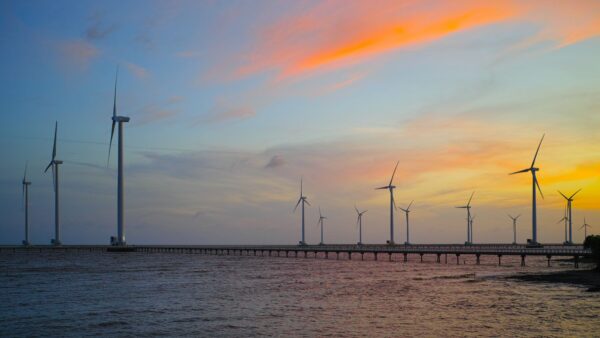
In Southeast Asia, Vietnam has been the undisputed leader when it comes to building renewable energy. In 2017, the government enacted a regulation that offered solar power developers a generous rate if they could build power plants that were operational by 2019. This was followed by a similar incentive for wind. The government did not place a cap on eligible capacity, so there was a huge influx of investment activity as developers and investors raced to get their projects built before the deadline.
As a result, electricity generated from renewables like solar and wind has soared. In 2018, solar and wind accounted for around .4 percent of all electricity produced in Vietnam. Following the 2019 deadline, solar and wind rose sharply as a share of generation. According to the latest annual report from state-owned electric utility EVN, solar and wind accounted for around 13 percent of electricity generated in 2024. Vietnam has outpaced pretty much all of its regional peers when it comes to the production of clean energy and done it in a very short period of time.
But this achievement came at a considerable cost, one that has been borne mainly by EVN. As investors rushed into the market, it created billions of dollars in new liabilities and operating costs because the utility was now obligated to buy electricity from these power plants at a fairly high rate. In a well-regulated energy market, a utility might be expected to raise prices on consumers in order to recover such increased costs.
But in Vietnam, as in many emerging markets, electricity prices paid by consumers are tightly controlled by the state. And with the onset of the COVID-19 pandemic in 2020, the government was extremely reluctant to pass any cost increases onto Vietnamese consumers. This placed intense financial strain on EVN, with the utility recording a $790 million loss in 2022 and a $1 billion loss in 2023 (calculated using consolidated financial statements at current exchange rates). With cash reserves dwindling and mounting payments to new renewable suppliers, the government finally passed a series of price hikes onto consumers.
By 2025, EVN found itself on much sounder financial footing. Thanks to the price increases revenue rose 11 percent from 2024 to 2025, and the utility posted a net profit of nearly $2 billion. Cash from operations is way up, and the financial peril has faded. But investment in new renewable projects has also slowed way down. EVN has been able to preserve its financial stability not only by increasing revenue, but also because new renewable projects have slowed. Last year, the utility even tried to back-track on some existing projects claiming there were questions about regulatory compliance.
EVN’s annual report shows that after rising sharply in response to the incentive scheme, the share of wind and solar generation has remained steady at around 13 to 14 percent from 2022 to 2024. This means a lot less new renewable energy has been built in recent years, pivoting away from the previous model whereby EVN acted as the main buyer of renewable power from private developers in order to induce more investment.
Does that mean Vietnam’s clean energy ambitions have reached an impasse? Not necessarily. But the road forward may start looking less like the traditional model of centralized state control under EVN, and more like a decentralized system with the gradual introduction of market-oriented mechanisms.
A key step in this process is the expanded use of Direct Power Purchase Agreements for clean energy. This allows eligible customers with high energy needs to enter into direct purchase agreements with suppliers of renewable energy, rather than having to go through EVN. A LEGO factory operating out of the Vietnam-Singapore Industrial Park is one of the first large-scale deals of this nature.
Samsung also recently agreed to buy electricity from the privately operated Duc Hue 2 Solar Power Plant through the EVN-operated grid. Data centers are also now eligible for direct purchase agreements, an important development given the energy-intensive nature of such operations. The government likewise plans to have a retail electricity market up and running by next year, which will complement the wholesale electricity market launched in 2019.
The long-term impact of these reforms remains to be seen, but the overall policy direction seems clear. Vietnam’s energy sector has traditionally been dominated by state-owned entities like EVN. It has been a centralized model designed to keep the production of energy firmly under the purview of the state, and to insulate Vietnamese consumers from price volatility. But this model has its limits, especially as investment needs increase in response to rapid economic growth.
Now the government is pushing reforms that will, it is hoped, introduce more efficient mechanisms that provide a greater degree of flexibility when it comes to producing and consuming electricity. It will also lessen the financial burden on EVN as it pushes the energy sector away from its traditional state-controlled roots, and toward a more decentralized orientation.
Will it work, and to what extent can the state truly relinquish control over a vital economic input like energy, especially when it comes to the price paid by Vietnamese consumers? We don’t know. But at the very least, these developments suggest the sector is on the cusp of a new phase and it will be interesting to see where it leads.